

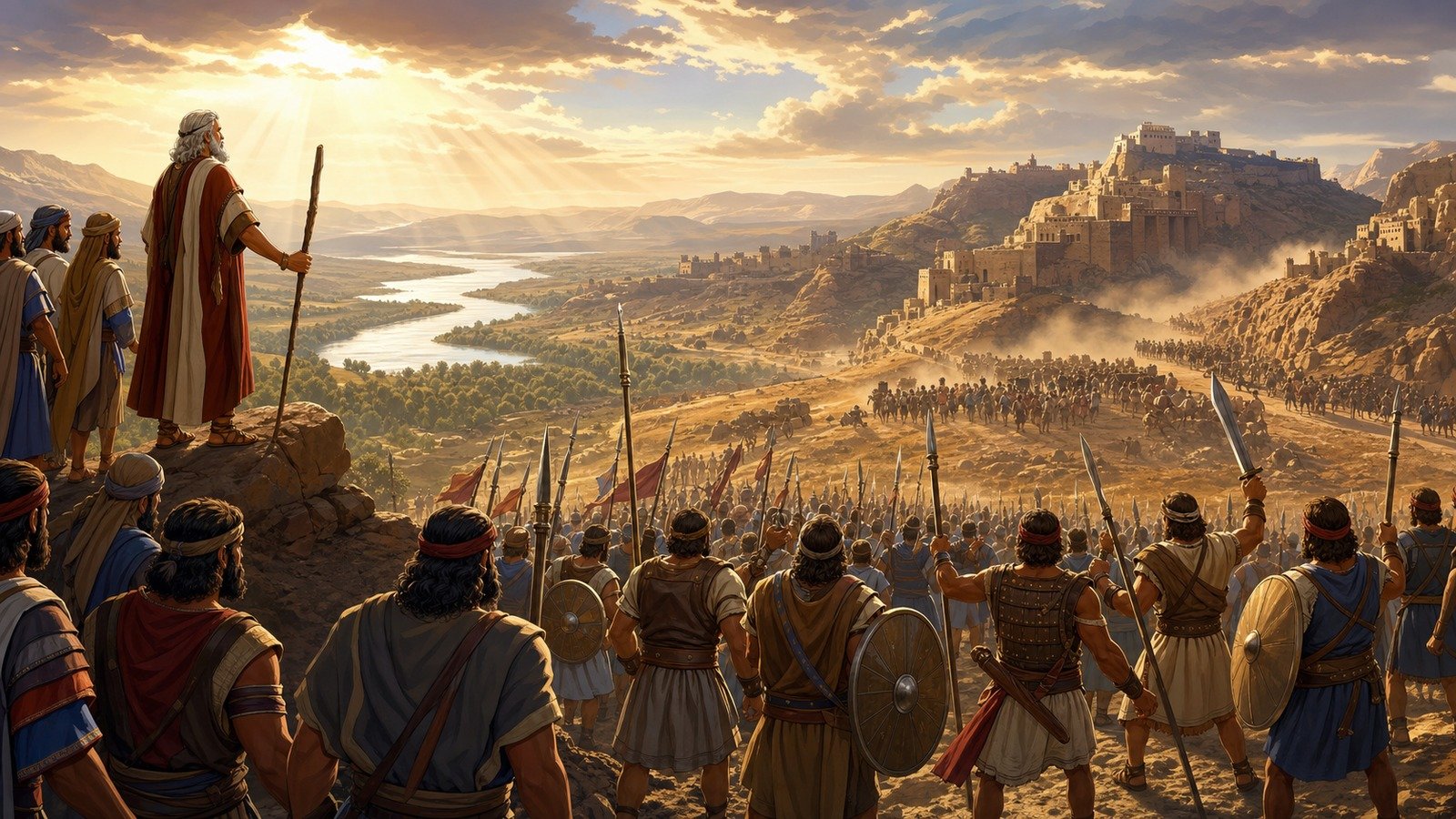
Israel defeats the Amorite kings Sihon and Og east of the Jordan, securing territory later assigned to Reuben, Gad and half of Manasseh, before crossing into Canaan proper.
Further context
2 min readThe first territory Israel takes and holds lies east of the Jordan rather than inside Canaan proper.
They send Sihon king of the Amorites the same message they sent Edom: let us pass through, we will not turn aside into fields or vineyards or drink from any well, we will travel along the King's Highway until we have passed through. He refuses, musters his army and attacks at Jahaz. Israel wins and takes his land from the Arnon gorge north to the Jabbok, including his capital at Heshbon.
A poem is then quoted, introduced with the words that is why the poets say. It celebrates a fire going out from Heshbon that consumed Ar of Moab, and mourns the people of Chemosh, the Moabite god. That is an Amorite victory ballad about Sihon's own earlier conquest of Moabite territory, and it is being quoted to establish that the land Israel now holds was not Moab's to claim, since Sihon had already taken it from them. A song written to celebrate one conquest is doing service as a title deed against a third party.
Og king of Bashan comes out at Edrei with his whole army and is defeated the same way, which gives Israel the fertile plateau north-east of the Sea of Galilee.
A note about Og reads like a museum label. He was the last of the Rephaites, and his bed was made of iron and was more than nine cubits long and four wide, and it was still on display in the Ammonite capital. Nine cubits is around four metres. The Hebrew word rendered bed can also mean a bier or a sarcophagus, and large basalt sarcophagi are known from that region, which some readers take as the likelier explanation of an object being shown to visitors generations later.
This territory becomes the inheritance of Reuben, Gad and half of Manasseh, who ask for it because it suits their herds, and who are required to cross the Jordan and fight alongside everyone else before settling in it.
The archaeology presents a real difficulty and it is better stated than avoided. Tell Hesban, the usual identification for Heshbon, has been extensively excavated, and Late Bronze Age occupation there is slight, with the substantial remains belonging to the Iron Age and later. The same pattern appears at several other sites named in the conquest narratives. Explanations offered include misidentification of the site, a settlement's name moving to a nearby location, and a later date for the events themselves. None has resolved it.
The King's Highway that Israel keeps asking to use is a real road. It ran the length of the Transjordan plateau from the Gulf of Aqaba north to Damascus, carrying caravan traffic between Arabia and Syria, and control of it was worth fighting for. Every request Israel makes to pass along it is refused, by Edom and then by Sihon, which is why a journey that should have been a march up an established route becomes a war.
Both defeats stayed fixed in the national memory. A psalm recited in worship lists Sihon and Og by name, centuries later, in a litany of things God had done, which indicates how these two obscure kings functioned for people who had never been anywhere near the Arnon.