

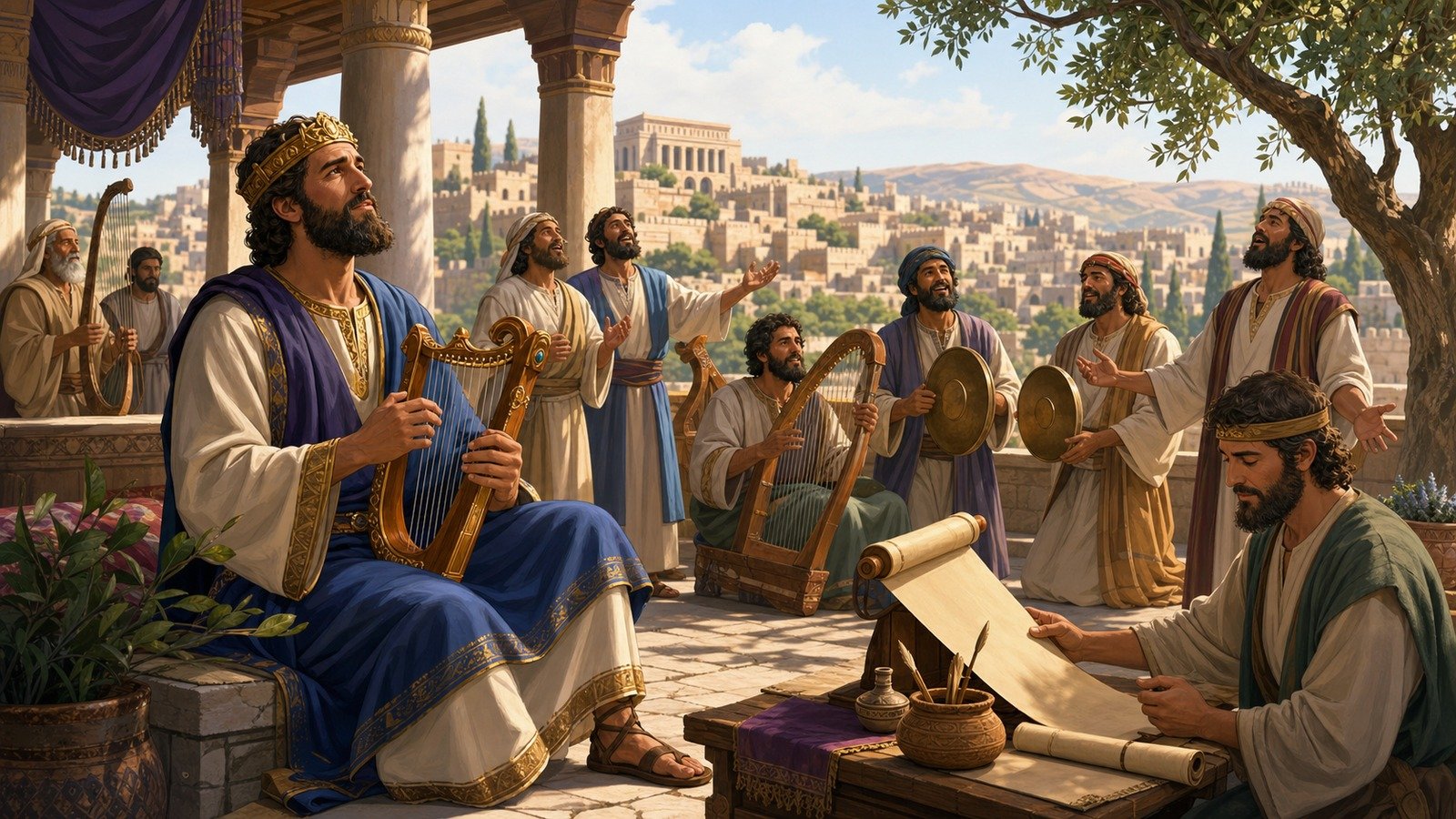
Roughly half the Psalter carries a superscription attributing it to David, spanning his years as a fugitive, king and penitent sinner; other psalms are attributed to Asaph, the sons of Korah and Solomon, with the collection assembled and edited over a much longer period.
Further context
2 min readThe Psalms are not a book in the ordinary sense. They are a collection of a hundred and fifty poems assembled over centuries, divided into five sections each ending with a formula of praise, and containing material from the time of the monarchy through to the period after the exile.
Seventy-three carry a superscription associating them with David, and how much weight those headings bear is disputed. The Hebrew preposition used can mean by David, for David, belonging to David, or concerning David, and it is the same construction used elsewhere for a collection rather than an author. The headings are also unstable: the Greek version attaches David's name to psalms the Hebrew leaves anonymous. What is not in doubt is that he was remembered as a musician from the earliest material about him, brought into Saul's court on the strength of his playing, and credited with organising temple music.
Thirteen of those headings name a specific occasion in his life, most of them from the years as a fugitive: fleeing from Saul, the cave, the Ziphites informing on him, feigning madness before the Philistine king, and the aftermath of Bathsheba.
The range of what is in the collection is wider than most people expect. There are hymns of straightforward praise. There are royal psalms for a coronation or a wedding. There are songs sung on the road to Jerusalem for the festivals. There are wisdom poems about how to live.
And there are the laments, which are the largest single category, running to about a third of the whole. Those poems complain, argue, accuse and demand, and several of them end without resolution. How long, LORD? Will you forget me for ever? Why do you hide your face from me? My God, my God, why have you forsaken me? Nothing is done to soften them, and their presence in the worship book of a nation is the most striking thing about the collection.
A smaller group asks God to destroy someone, in language nobody quotes on a greetings card, and Christians have argued for centuries about what to do with those.
The music is not incidental to them either. Many carry technical instructions in their headings: to the director of music, with stringed instruments, according to a named tune, and a word that appears seventy-one times and whose meaning is lost, possibly a musical interlude or a change of key. What survives is a libretto for a repertoire nobody can now perform.
Individual dating is impossible in almost every case. A poem about being surrounded by enemies fits a hundred situations across five hundred years, and the collection was deliberately compiled so that the words could be reused by anyone. That is why it outlived its authors: the specifics were filed off.
Two effects follow from that. The Psalms became the prayer book of Judaism and then of the Church, recited daily in monastic communities for fifteen centuries and set to music in every European tradition. And they are quoted in the New Testament more than any other Old Testament book, with words from them on the lips of a dying man at the crucifixion.