

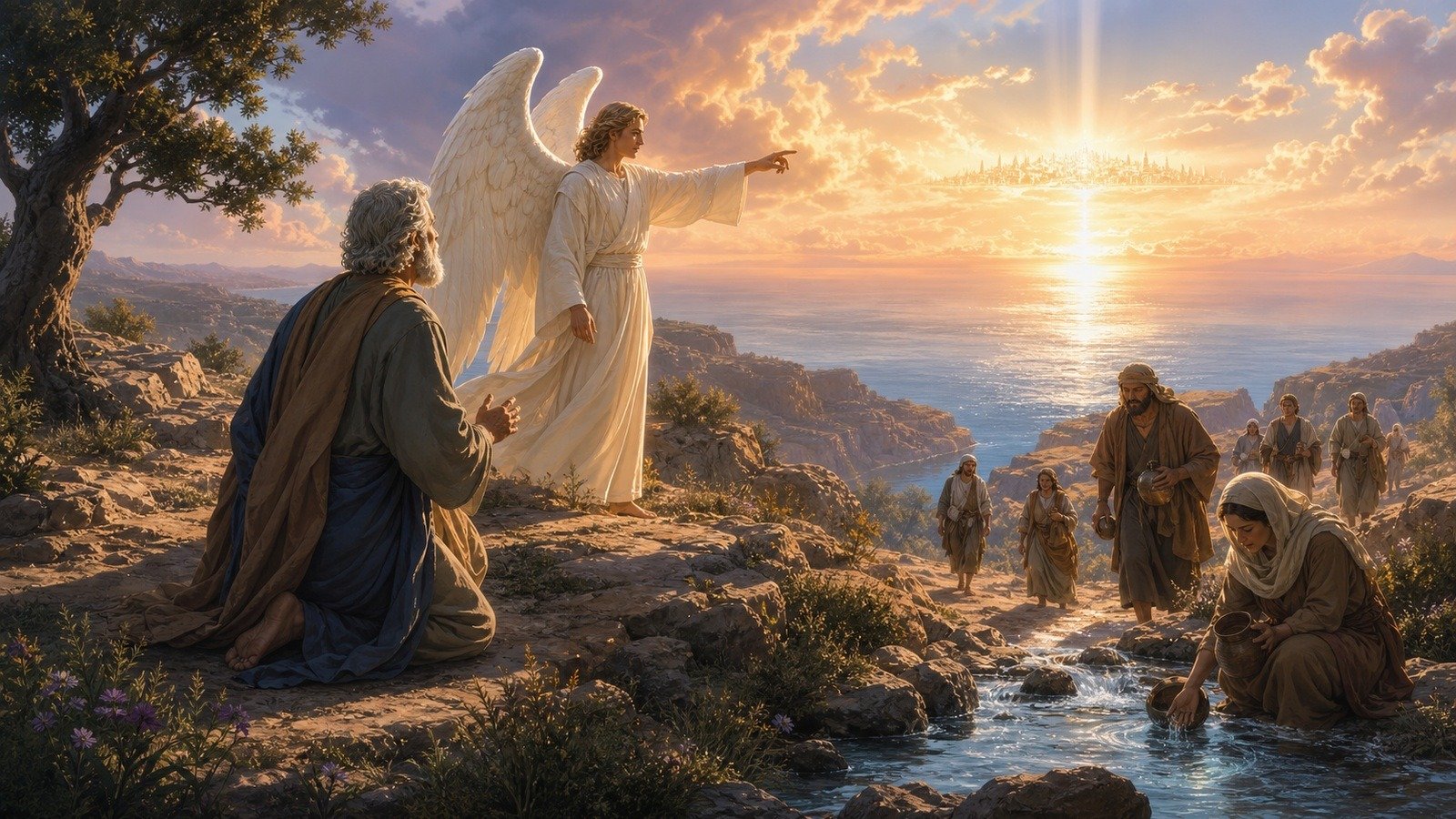
Revelation closes with assurances that these words are trustworthy, repeated promises of Christ's imminent return, a warning against tampering with the book's text, and a final invitation, "Let the one who is thirsty come," ending the New Testament, and the whole Christian Bible, on a note of expectation.
Further context
3 min readThe last page of the book is not a vision. It is a series of short statements, some by the angel, some by John and some by Jesus speaking directly, and they overlap without any narrative frame.
The angel says: these words are trustworthy and true. The Lord, the God who inspires the prophets, sent his angel to show his servants the things that must soon take place.
Then, three times in the closing lines and once earlier: look, I am coming soon.
That word soon has been the difficulty for two thousand years, and it should not be smoothed over. The book was written for congregations under pressure in Asia Minor, it says repeatedly that the time is near, and those congregations died of old age. Every generation since has read the same word.
The responses offered are several: that the Greek describes suddenness rather than immediacy; that a day is like a thousand years and a thousand years like a day; that the coming is not one event; and that the promise is meant to be lived under rather than calculated from. None of them removes the tension, and the book itself makes no attempt to.
John falls down to worship at the angel's feet a second time and is stopped a second time, in the same words: do not do that! I am a fellow servant with you. Worship God!
Then the instruction that reverses one given earlier: do not seal up the words of the prophecy of this scroll, because the time is near. Daniel had been told to seal his up.
A warning follows about adding to or taking away from the words of the prophecy, using a formula found in ancient documents generally, where it functioned as a copyright notice against careless scribes rather than as a claim about the whole Bible, though it has often been read that way.
I am the Alpha and the Omega, the First and the Last, the Beginning and the End. The first and last letters of the Greek alphabet, which is also the first thing said in the book.
The Spirit and the bride say, come! And let the one who hears say, come! Let the one who is thirsty come; and let the one who wishes take the free gift of the water of life.
He who testifies to these things says: yes, I am coming soon.
Amen. Come, Lord Jesus.
The grace of the Lord Jesus be with God's people. Amen.
The closing lines mix voices without marking the changes, which has made the ending difficult to lay out on a page and has produced different arrangements in different editions.
Come, Lord Jesus is a translation of an Aramaic phrase, marana tha, which Paul leaves untranslated at the end of one of his letters and which appears in a church manual from around the end of the first century as part of the words used at the shared meal. It is one of the very few fragments of the language the first believers actually prayed in.
That the last book of the Bible ends with a request rather than a statement is worth registering. The final word is not a description of the end but an invitation to two parties: come to anyone who is thirsty, and come to the one who has promised to.