

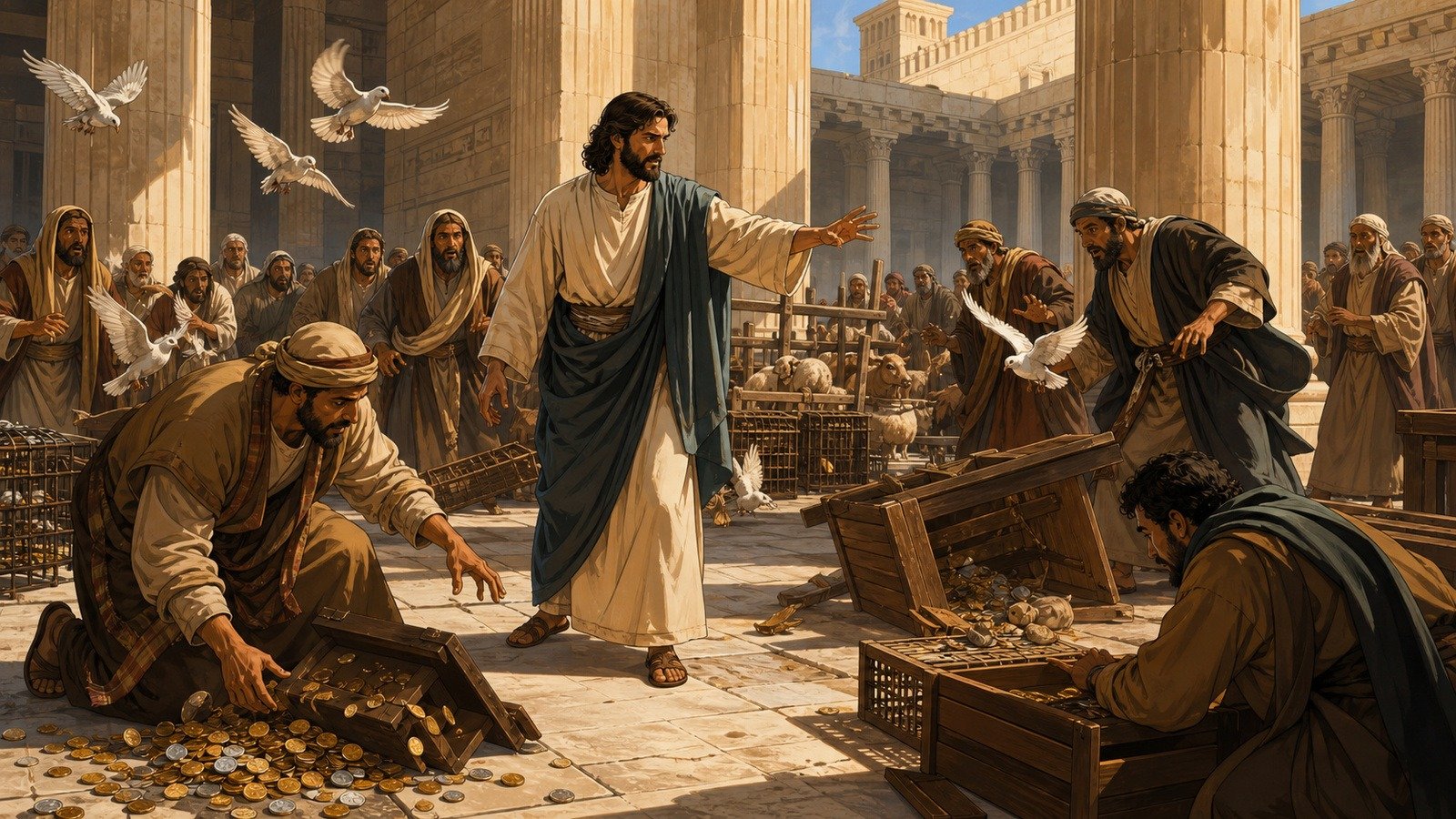
Jesus overturns the money changers' tables a second time, quoting Isaiah and Jeremiah against turning God's house into "a den of robbers."
Further context
3 min readJesus enters the temple courts the next morning and drives out those buying and selling, overturns the tables of the money changers and the benches of those selling doves, and will not allow anyone to carry merchandise through the courts.
What was going on there was not, on the face of it, corrupt. Pilgrims came from across the empire and could not bring animals for sacrifice a thousand kilometres, so animals were sold on site. The annual temple tax had to be paid in a specific currency, since Roman coins carried the emperor's image and a claim to divinity, so money had to be changed. Both services were necessary and both were provided.
The trade took place in the Court of the Gentiles, the outermost and largest court, and the only part of the complex a non-Jew was permitted to enter. Stone tablets stood at the boundary warning foreigners on pain of death not to go further, and two of them have been found. It is that court, and only that court, that had become a market and a thoroughfare.
The two lines he quotes state the case. My house will be called a house of prayer for all nations, which is from Isaiah and is about foreigners being gathered in. And, you have made it a den of robbers, which is from Jeremiah, spoken in the temple gateway before the first destruction, to people who committed injustice all week and then sheltered in the building.
A den is where robbers retreat to be safe, not where they rob.
Herod's temple was the largest sacred enclosure in the ancient world, its platform covering about fourteen hectares, built with stones some of which weigh several hundred tonnes and can still be seen in the western wall. The work had been running for nearly fifty years and was not finished. Josephus describes the whole structure as visible from a distance like a mountain covered with snow, and the annual traffic in sacrificial animals ran into the hundreds of thousands.
One man clearing a section of that is a small event physically and an enormous one legally, since the trade was licensed by the priestly establishment and the income mattered.
Whether this is the same episode as the clearing recorded at the beginning of his public work, moved for arrangement, or a second one, is genuinely disputed, and the wording differs enough in each version to keep the question open.
The response is recorded in one sentence. The chief priests and the teachers of the law heard this and began looking for a way to kill him, for they feared him, because the whole crowd was amazed at his teaching.
The following days are spent teaching in those same courts, and the confrontations come one after another: the question about his authority, the trap about paying taxes to Caesar, the Sadducees on the resurrection, and the question about the greatest commandment. Each is an attempt to produce something usable in a prosecution.
What he does to the tables is often described as anger, and the word is not used of him here. What is recorded is action and two quotations, both from prophets, and the second of them was delivered in that same building to people who assumed the building itself would protect them. It did not, and Jeremiah's audience watched it burn.