

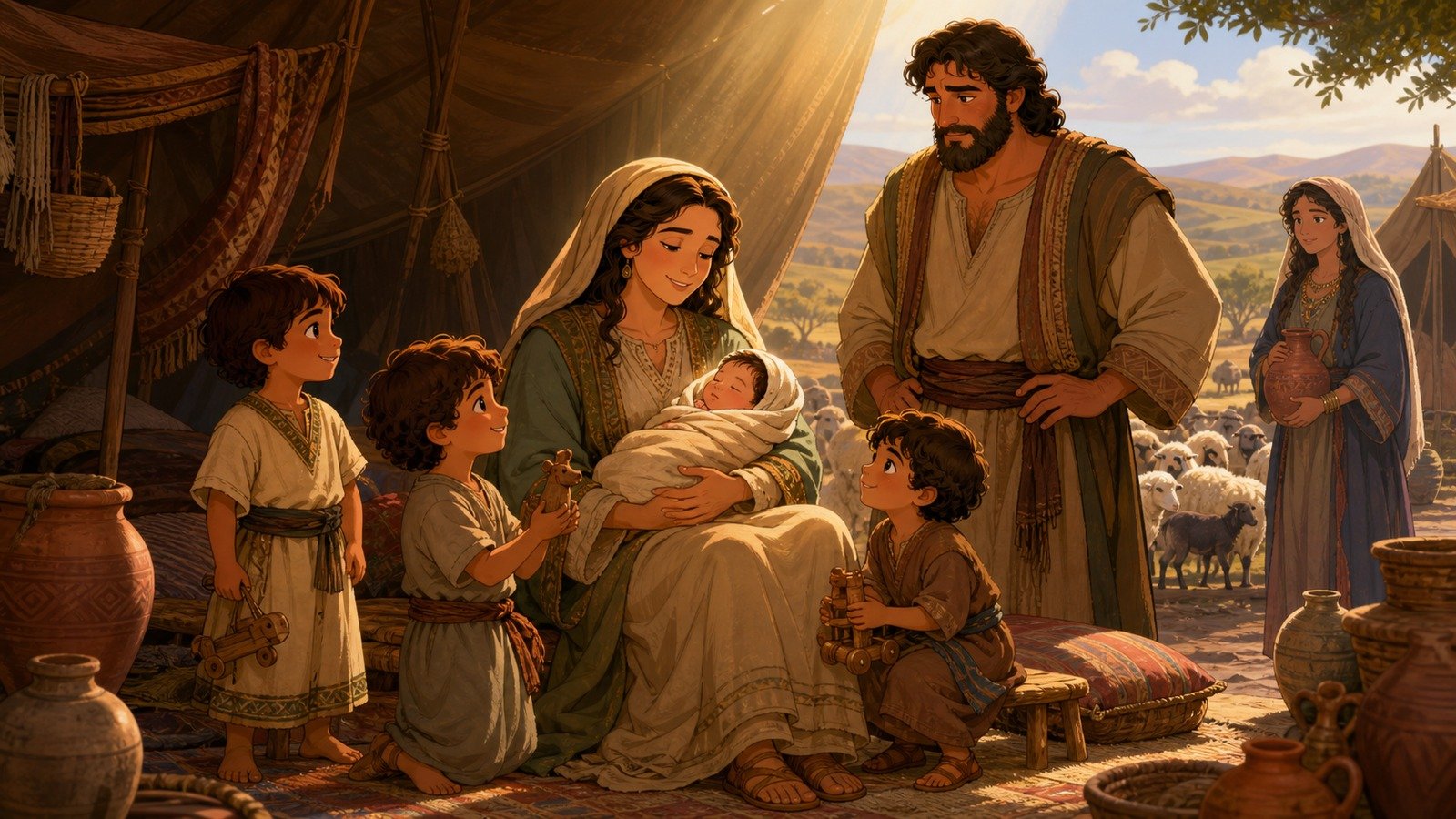
Loved less than Rachel, Leah bears Jacob four sons in succession; she reads each birth as a sign of God's attention to her situation, naming Judah, whose line later includes David and Jesus, in simple gratitude.
Further context
3 min readThe first thing said about Leah after the wedding is that she was not loved, and the Hebrew is blunter than that: the word is "hated", used in legal contexts for the wife who is not the favourite rather than for active hostility. What follows is that she conceives and Rachel does not, and the pattern of the disregarded wife bearing children while the loved one cannot runs through the whole of this stretch.
Each birth comes with a name and the sentence that explains it, and the four sentences together make a short and painful account of a marriage.
Reuben comes first. The LORD has seen my misery, she says, and surely my husband will love me now. The name sounds like the Hebrew for "he has seen my misery" and also breaks apart as "see, a son".
Simeon follows, and she says the LORD heard that she is not loved. The name is connected with the verb to hear (shama).
Levi is third, and here she says that now at last her husband will become attached to her, because she has borne him three sons. The name is linked with a verb meaning to join or attach (lavah).
Three sons, and each name is an argument addressed to her husband. She is counting, and anyone reading can watch her hoping.
Judah is the fourth and the pattern breaks. This time, she says, I will praise the LORD. The name is connected with the verb to praise (yadah), and her husband is not mentioned at all. Whatever changed between the third birth and the fourth is marked by removing him from the sentence.
She then stops having children, which sets up the bargaining that follows.
Two of these four sons carry the whole of the rest of the Hebrew scriptures. Levi becomes the tribe from which Aaron, the priesthood and Moses himself descend, so the entire sacrificial system belongs to the line of the third son. Judah becomes the tribe of David and of the kings in Jerusalem, and the promise attached to it in Jacob's final words, about the sceptre not departing from Judah, is the thread on which later expectation of a coming king was hung. Matthew opens the New Testament by tracing Jesus through Judah.
Both of them are sons of the wife Jacob did not want. Neither is the firstborn, and neither is a son of Rachel. The same principle has now operated across four generations: Isaac over Ishmael, Jacob over Esau, and now the third and fourth sons of the unloved wife over the eldest and over the children of the favourite.
The four names also record something about how a marriage was understood. A wife who was not loved had one route to standing in the household, and it was sons. Each name Leah gives is addressed outward, to a husband who is not listening, until the fourth, where she stops addressing him. Whether that is resignation or something better is left entirely open, and it is the only interior movement anyone in this household is granted.
Reuben, the firstborn, forfeits his position through an incident recorded much later. Simeon and Levi are both condemned in Jacob's final blessing for their part in a massacre at Shechem. That is what leaves Judah at the head of the line, and none of it has happened yet at the point where a woman is naming her fourth child.