
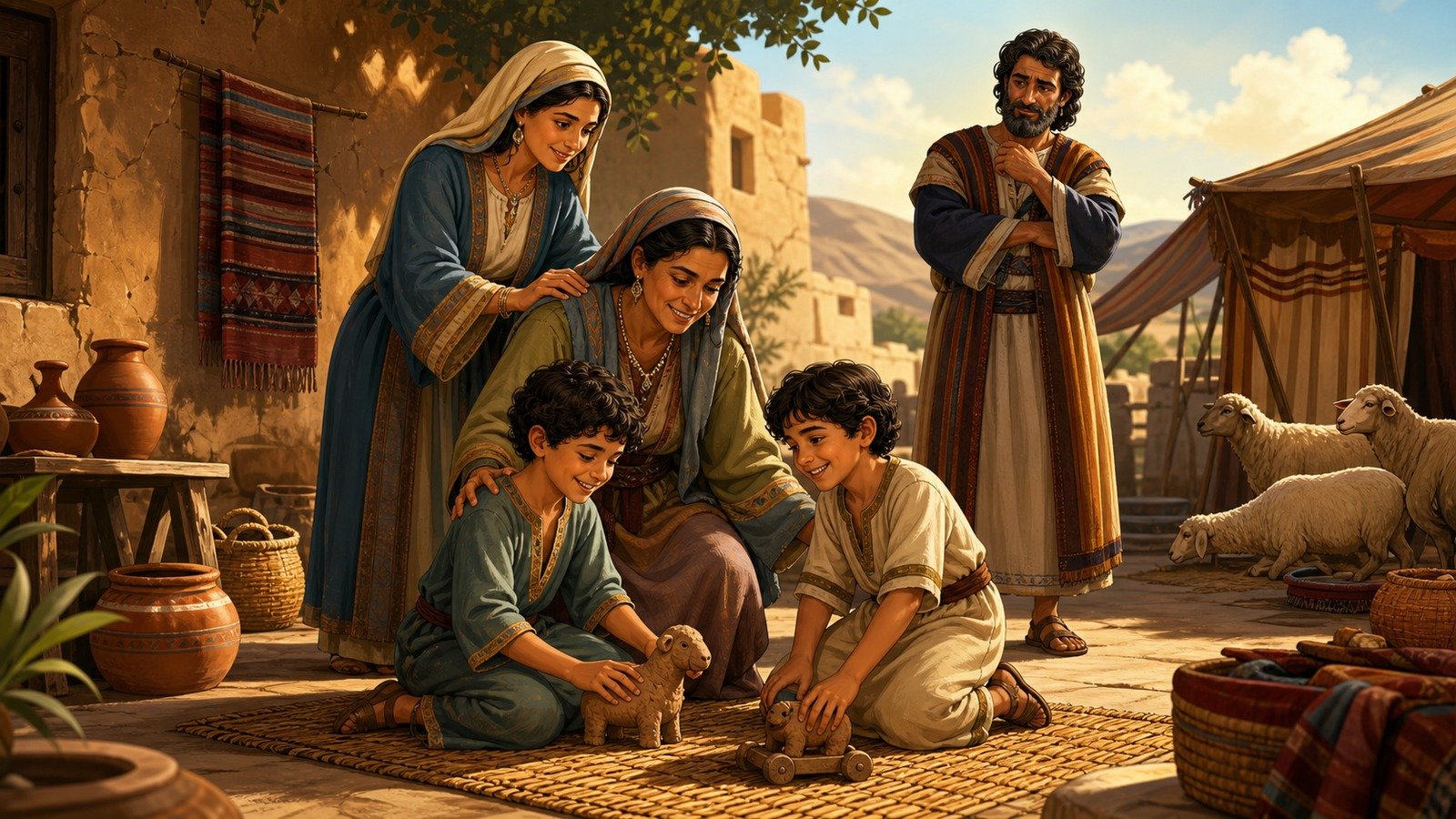
Still childless and desperate, Rachel gives her servant Bilhah to Jacob to bear children on her behalf, following the same custom Sarah had used with Hagar a generation earlier; Dan and Naphtali are born.
Further context
3 min readGive me children, or I will die. That is Rachel's opening line, and it is made out of desperation rather than temper. Her sister has four sons and she has none.
Jacob's reply is the only recorded moment of anger between them, and it is a correction rather than a comfort: am I in the place of God, who has kept you from having children? He is right about the fact and useless about the situation, and both halves of that are allowed to stand.
Her solution repeats what Sarah did three generations earlier. She gives her servant Bilhah to Jacob so that she may build a family through her. The legal machinery is identical to the Hagar arrangement, and so is the vocabulary: the child will be born, as the Hebrew has it, on Rachel's knees, an adoption gesture in which the newborn is received onto the lap of the woman who will count as its mother.
The outcome is different from Sarah's. Bilhah bears two sons and nobody is expelled, because Rachel eventually has children of her own and the household stays intact.
Dan comes first, and Rachel's explanation is that God has vindicated her and listened to her plea. The name comes from a verb meaning to judge or to give a verdict in someone's favour (din), and the sense is that a case has been decided for her.
Naphtali is the second, and the naming sentence there is the most revealing thing she says anywhere: I have had a great struggle with my sister, and I have won. The name is connected with a verb meaning to wrestle or twist. She is not describing a struggle with childlessness. She names her son after a contest with Leah and keeps score in the process.
The gesture of receiving a child onto the knees turns up three times in this family, and each time it establishes a legal relationship rather than an affectionate one. Rachel takes Bilhah's sons this way, Joseph's grandchildren are placed on his knees in Egypt, and adoption formulas of the same kind appear in Mesopotamian contracts. Motherhood here is a status conferred by an act in front of witnesses, which is what allows two slaves to bear four of the twelve tribes without any later dispute about where those tribes belong.
The standing of these two boys is worth stating, because the same question has been handled differently before. Ishmael, born to a slave in Abraham's household, was blessed and provided for and then placed outside the covenant line. The sons of Keturah were given gifts and sent east. Dan and Naphtali are counted among the twelve without qualification, receive tribal territory, and appear in every list of the tribes. Bilhah's status does not follow her children, and no dispute about it is ever recorded.
The territories those tribes eventually hold lie in the north. Naphtali receives the hills west of the Sea of Galilee, and Isaiah names Zebulun and Naphtali as the regions where a great light will be seen, a line the Gospels apply to Jesus' work around Capernaum. Dan is allotted land in the south-west, fails to hold it against the Philistines, and migrates north to take a town by force, an episode recorded at the end of Judges and told without approval.
The births in this stretch are compressed into about seven years by the internal arithmetic, which is tight enough that some readers have questioned whether the sequence as it stands can be fitted into the time available.