

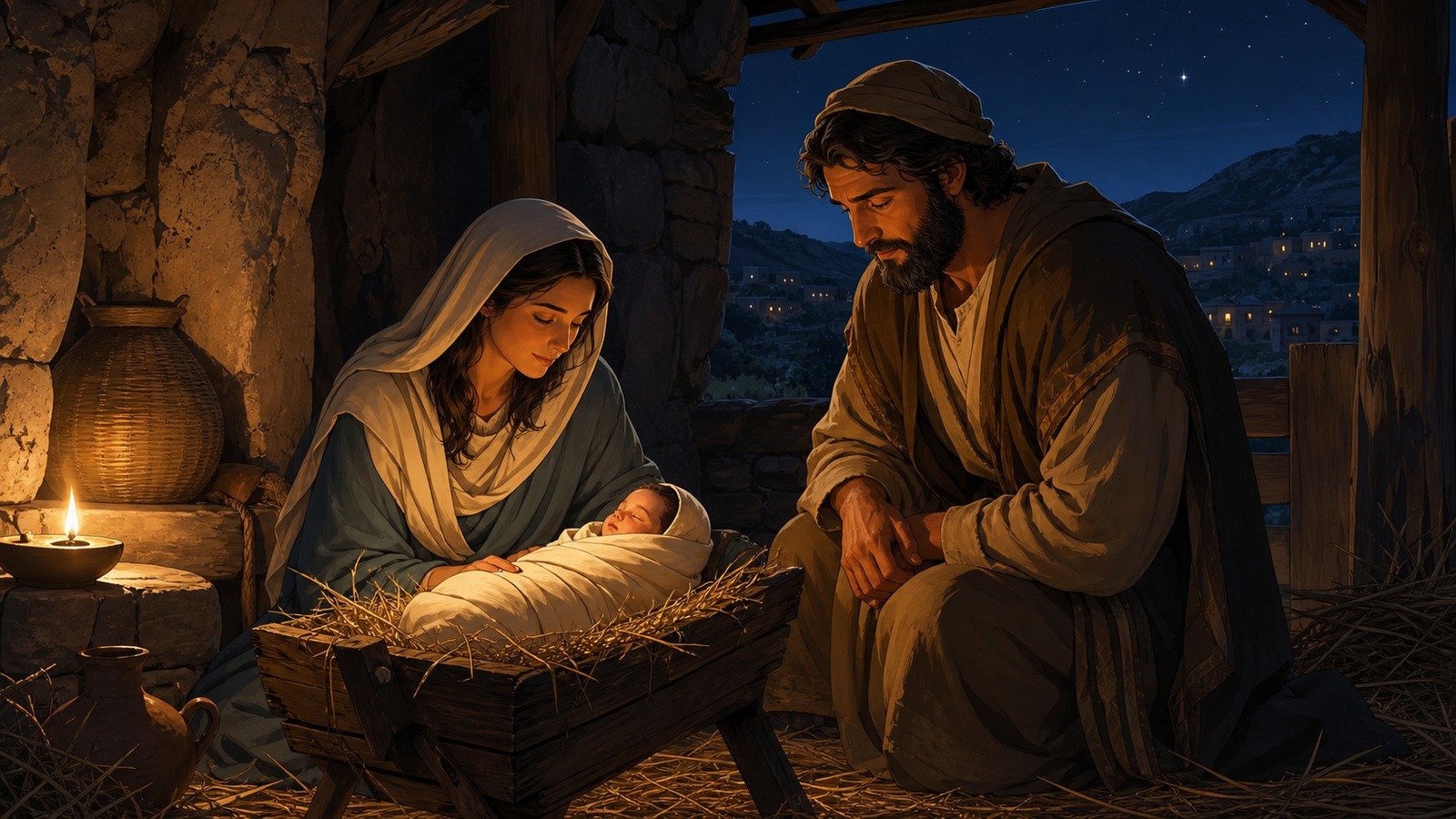
A Roman census brings Joseph and the heavily pregnant Mary to Bethlehem, Joseph's ancestral town, where Jesus is born and laid in a manger because there is no guest room available, fulfilling Micah's earlier prophecy of Bethlehem as the Messiah's birthplace.
Further context
3 min readA decree from Caesar Augustus requires a census of the entire Roman world, and Joseph travels from Nazareth in Galilee to Bethlehem in Judea, because he belonged to the house and line of David. The distance is about a hundred and fifty kilometres by the practicable routes, four or five days on foot, with a woman late in pregnancy.
The census is the sharpest historical difficulty in the Gospels and it should be stated plainly. Luke dates it to the governorship of Quirinius in Syria, and the census under Quirinius that is well attested from other sources took place around AD 6, roughly a decade after Herod's death, and it triggered a revolt. Several harmonisations have been proposed: that the Greek should be read as before Quirinius was governor, that he held an earlier command in the region, that an enrolment begun earlier was completed under him, or that a registration for an oath of allegiance is meant. None commands agreement, and anyone claiming the problem is settled in either direction is overstating.
The birth itself takes one sentence and contains no stable. She gave birth to her firstborn, a son, wrapped him in cloths and placed him in a manger, because there was no guest room available for them. The word usually translated inn is the same one used later for the upper room of the Last Supper, and it means a guest room rather than a commercial inn, for which Luke uses a different word entirely in another story.
Ordinary houses in that region often had a single living space with a lower area where animals were brought in at night, with feeding troughs cut into the floor or the wall between. A family arriving to stay with relatives, finding the guest space already full, and being put in the main room where the animals were kept, accounts for everything described without requiring a barn or an innkeeper, neither of which is mentioned.
Bethlehem is about ten kilometres south of Jerusalem, and the reason Joseph goes there is a village association with David that was a thousand years old.
One further thing about the town. Bethlehem sits on the edge of the Judean hills where the cultivated land gives out, about ten kilometres from Jerusalem, and its name means house of bread. It had been a village of no importance for a thousand years apart from one association, and the only reason anyone in the family was there was a tax registration.
The dating works backwards from Herod's death, which is generally placed in 4 BC, and the birth is therefore usually put around 6 or 5 BC. The calendar we use was calculated in the sixth century by a monk working from imperfect information, and it is out by several years, which is why the year of Christ's birth is not year one.
The census is the historical difficulty. Luke dates it to when Quirinius was governor of Syria, and Quirinius conducted a census in AD 6 which is well attested and which provoked the revolt of Judas the Galilean. That is about ten years after Herod's death.
The proposals for reconciling this include reading the Greek as before Quirinius was governor, an earlier term of office for him, and a long registration process begun earlier and completed under him. None is established, and it is one of the genuine open problems.
The stable is an inference. What is recorded is a manger and no room in the kataluma, a word meaning guest room rather than inn, and the same word is used of the upper room at the last supper. Village houses of the period often had a lower level where animals were brought in at night, and a family displaced from the guest room would sleep there.
The swaddling is ordinary practice and is mentioned because the shepherds are told to look for it.