
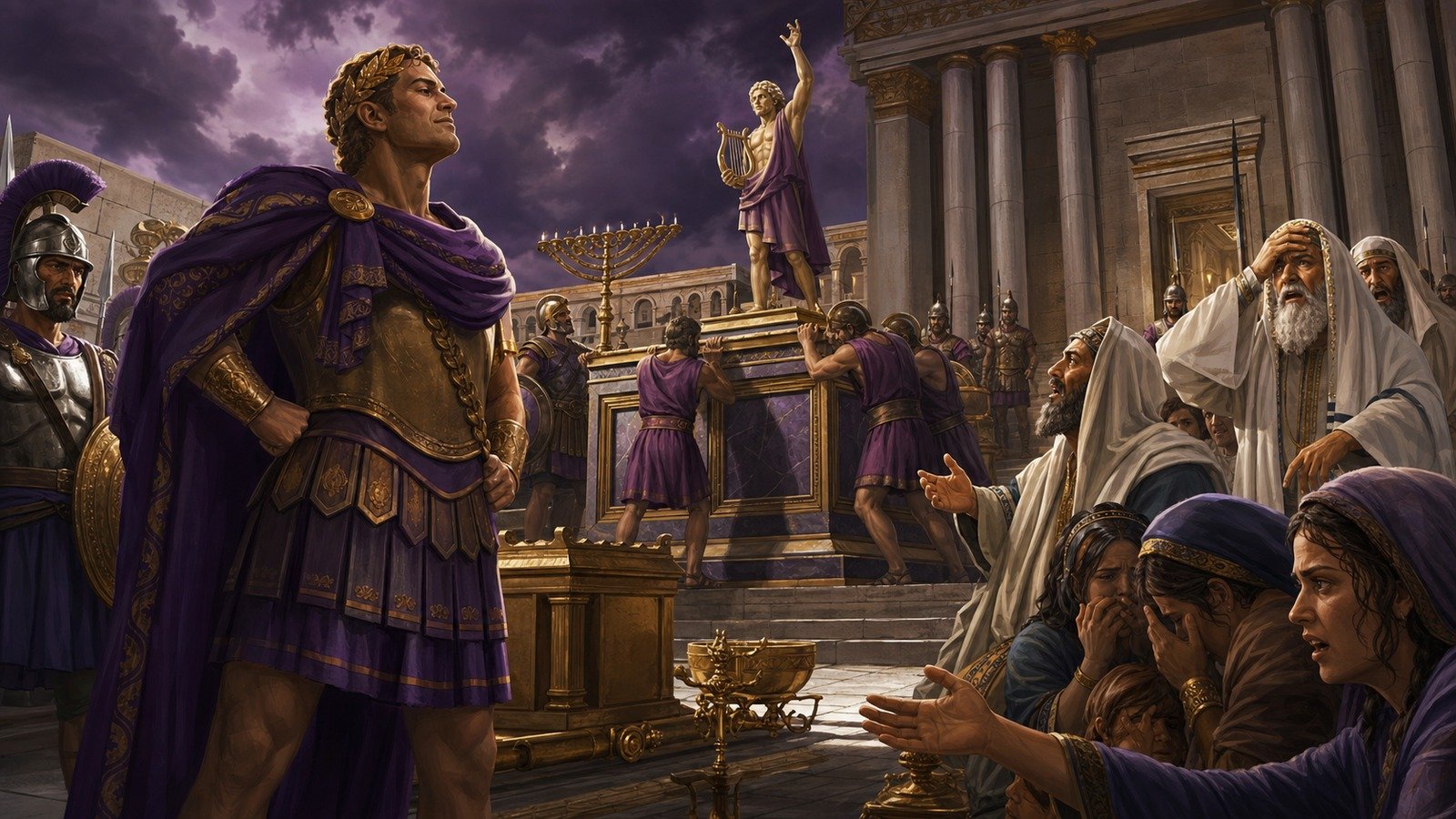
Seleucid king Antiochus IV bans Jewish religious practice, outlaws circumcision and Sabbath observance, and erects an altar to Zeus in the Temple, sacrificing a pig on it, an act of deliberate desecration that provokes open Jewish revolt.
No canonical Scripture reference (historical context outside the Protestant canon)
Further context
3 min readAntiochus IV took the title Epiphanes, meaning God manifest, and his coins carry it. His enemies called him Epimanes, the mad one, which is a pun on it.
The crisis begins with a rumour. He is campaigning in Egypt in 168 BC when the Romans intervene: a Roman envoy meets him outside Alexandria, hands him a letter from the Senate ordering him to withdraw, and when he asks for time to consider, draws a circle in the sand around him and tells him to answer before stepping out of it. He withdraws, humiliated, and marches north.
Meanwhile a report that he had died reaches Jerusalem, and the deposed high priest Jason attacks the city to take it back from Menelaus. Antiochus arrives to find what he interprets as a revolt, storms the city and plunders the temple.
What follows in 167 BC is unlike anything in the region's history, and its novelty is the point. Ancient empires did not usually attack religions; they added local gods to the imperial collection. He bans the practice of Judaism outright. Circumcision is prohibited on pain of death, and mothers who had their sons circumcised were executed with the infants hung around their necks. Sabbath observance and the festivals are forbidden. Copies of the scriptures are torn up and burned, and possession of one is a capital offence. Sacrifice at the temple is stopped.
Then, on the fifteenth day of Kislev, an altar to Olympian Zeus is erected over the altar of burnt offering, and ten days later pigs are sacrificed on it. The phrase used for that installation in the sources is a Greek rendering of a Hebrew expression that also appears in Daniel, usually translated as the abomination that causes desolation.
Why he did it is still debated. The older view treats it as a deliberate policy of Hellenisation imposed by an ideological king. More recent work argues that he was responding to what he read as sedition, at the invitation of one Jewish faction against another, and that the persecution began as a political settlement of a civil conflict and escalated.
Whatever the motive, the effect is that for the first time a Jewish population is required to choose between its religion and its life. The literature that comes out of that crisis, including accounts of an aged scribe refusing to eat pork even in pretence, and of a mother watching seven sons executed, gives Judaism its vocabulary of martyrdom, and the letter to the Hebrews alludes to those stories.
What Antiochus IV actually did is set out in the sources with unusual specificity. He entered the temple, took the golden altar, the lampstand, the table for the bread and the vessels; he prohibited sacrifice, Sabbath observance and circumcision on pain of death; he ordered copies of the law to be torn up and burned; and he had an altar built on top of the altar of burnt offering, on which pigs were sacrificed.
Mothers who had their sons circumcised were put to death with their infants hung round their necks.
Why he did it is genuinely disputed. Persecution of a religion for its own sake was not normal Hellenistic practice, and the likeliest explanation involves the faction fight in Jerusalem itself, in which a Hellenising party among the aristocracy had already built a gymnasium and sought Greek citizenship for the city, and Antiochus intervened on their side after mistaking a local revolt for a general rebellion.