

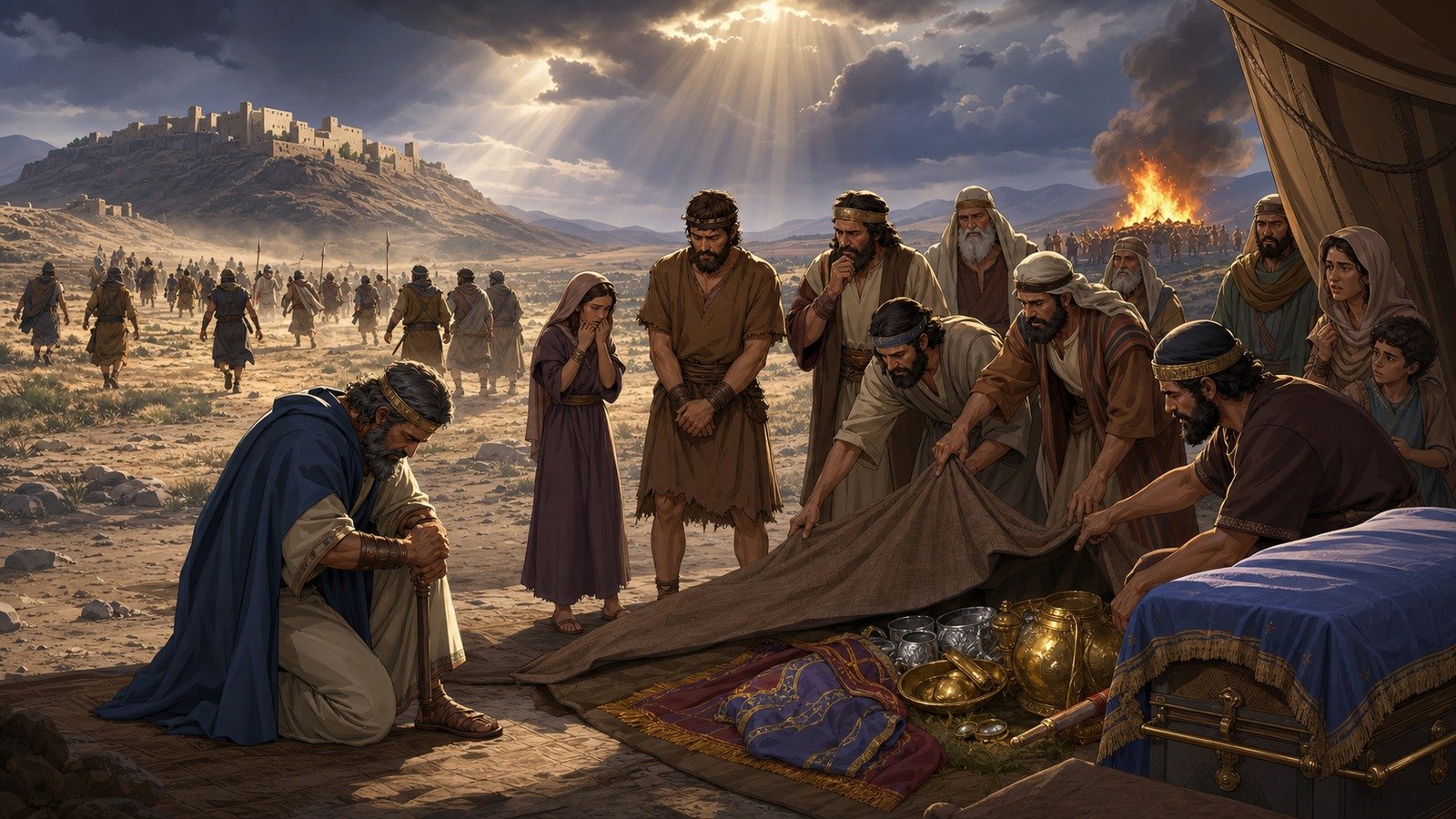
Israel is unexpectedly defeated at Ai because Achan secretly kept plunder devoted to destruction from Jericho; once his sin is exposed, he and his family are executed and the plunder destroyed.
Further context
2 min readJericho was placed under a ban and nothing from it was to be kept. One man kept something, and the consequences fall on everybody before anyone knows who he is.
Ai is scouted next and the report is confident: only two or three thousand men are needed, do not weary the whole army, the people there are few. About three thousand go up and are routed, and thirty-six are killed, and the survivors are chased down the slope. The hearts of the people melted and became like water, which is the phrase Rahab used about Jericho a few weeks earlier, now applied to Israel.
Joshua tears his clothes and falls face down before the ark until evening, and his prayer is the same complaint the wilderness generation made: if only we had been content to stay on the other side of the Jordan. The reply is unusually abrupt: stand up. What are you doing down on your face? Israel has sinned.
The offender is identified by lot, tribe by tribe and clan by clan and family by family, which gives him a long time to come forward and he does not. Achan of the tribe of Judah then confesses, and the itemised list is precise: a beautiful robe from Babylonia, two hundred shekels of silver and a bar of gold weighing fifty shekels, hidden in the ground inside his tent with the silver underneath. I saw them, I coveted them, and I took them.
He is stoned along with his household in a valley afterwards named Trouble, and that includes his sons and daughters, his livestock and his tent. Collective punishment of a family for one man's act is what happens, and it is not softened, and Israelite law itself later forbids putting children to death for their parents' offences. The tension between the two is real, and the usual explanation, that a household was a single legal unit in this period, accounts for the practice without making it comfortable.
What the episode establishes is a principle the conquest narratives keep returning to: the community is treated as one body, so that what one man buries under his tent floor defeats an army on a hillside three days later. Thirty-six men died before anybody knew a robe was missing.
The items themselves are worth noticing. A robe from Babylonia is an imported luxury, silver and gold are portable wealth, and none of it is food or tools or anything a man in a tent needed. What he took was the sort of thing that could not be used or displayed without questions being asked, which is why it went under the floor and stayed there. The confession, when it finally comes, is in three verbs in the order they happened: I saw, I coveted, I took.
The valley of Trouble reappears much later in an unexpected place. Hosea, promising restoration to a nation in a very bad state, says that the valley of Trouble will be made a door of hope.