

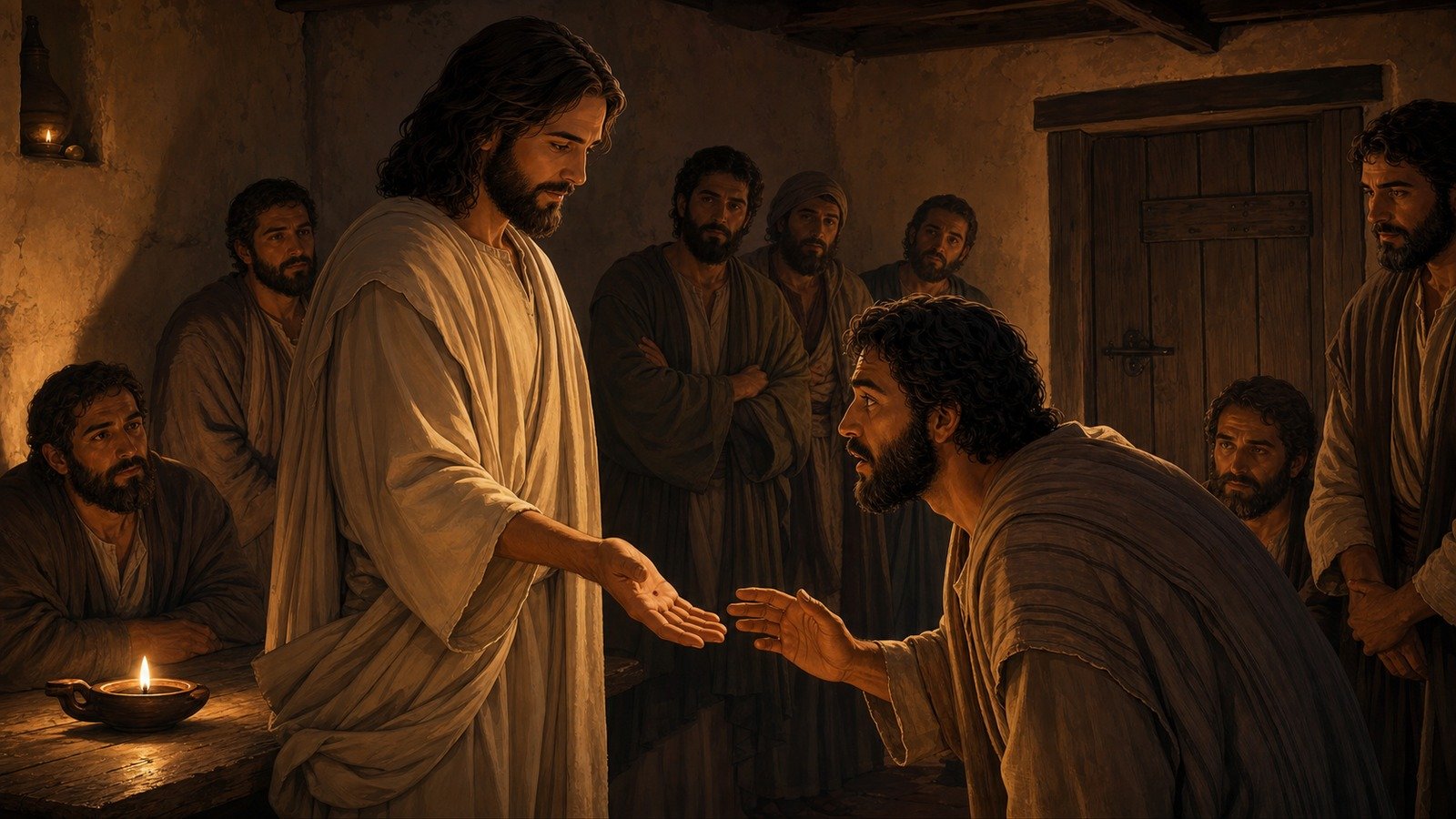
Absent at the first appearance, Thomas refuses to believe without physical proof; a week later Jesus appears again and invites him to touch his wounds directly, prompting Thomas' declaration, "My Lord and my God!" and Jesus' blessing on those who believe without having seen.
Further context
2 min readThomas, called Didymus, which means the twin, was not with the others when Jesus came, and he is the only one of the group whose scepticism is recorded in his own words.
Two things are worth knowing about him before the famous line. When Jesus proposed going back into Judea after the authorities there had tried to stone him, it was Thomas who said, let us also go, that we may die with him. And at the last supper it was Thomas who interrupted to say that they did not know where he was going, which produced one of the best-known answers in the New Testament. He is not a timid man; he is a literal one who says what everybody else is thinking.
The others tell him they have seen the Lord.
Unless I see the nail marks in his hands and put my finger where the nails were, and put my hand into his side, I will not believe.
That is a demand for the same evidence the others had already been given unasked. They had been shown the hands and the side on the Sunday evening; he is asking for what they received.
A week later the disciples are in the house again and Thomas is with them. Though the doors are locked, Jesus comes and stands among them and says, peace be with you.
Then he turns to Thomas and repeats his conditions back to him, almost word for word. Put your finger here; see my hands. Reach out your hand and put it into my side. Stop doubting and believe.
Whether he did is unknown. What he said is not: my Lord and my God.
Those five words are the strongest statement any of the disciples makes anywhere. Every earlier confession had used a title that a Jewish speaker could apply to a man: Messiah, Son of God, prophet, teacher. This one does not.
Because you have seen me, you have believed; blessed are those who have not seen and yet have believed.
That sentence is addressed past Thomas to everyone who would come afterwards, which is to say to every reader.
Doubting Thomas has become a byword in English, and it is a slightly unfair one. He asked for evidence, was given it, and drew a larger conclusion from it than anyone else in the room. Later tradition, preserved in Syriac and Indian sources, has him travelling east as far as India, and the Saint Thomas Christians of Kerala trace their church to him.
The week between the two appearances is the only measured interval in the resurrection accounts, and it means the disciples spent seven days in the same house with a man who had told them they were wrong.
Nothing is said about how that week went, and it is one of the more human silences in the New Testament. He is not thrown out, corrected or argued into agreement. He stays with them, unconvinced, until the question is settled in front of him.