

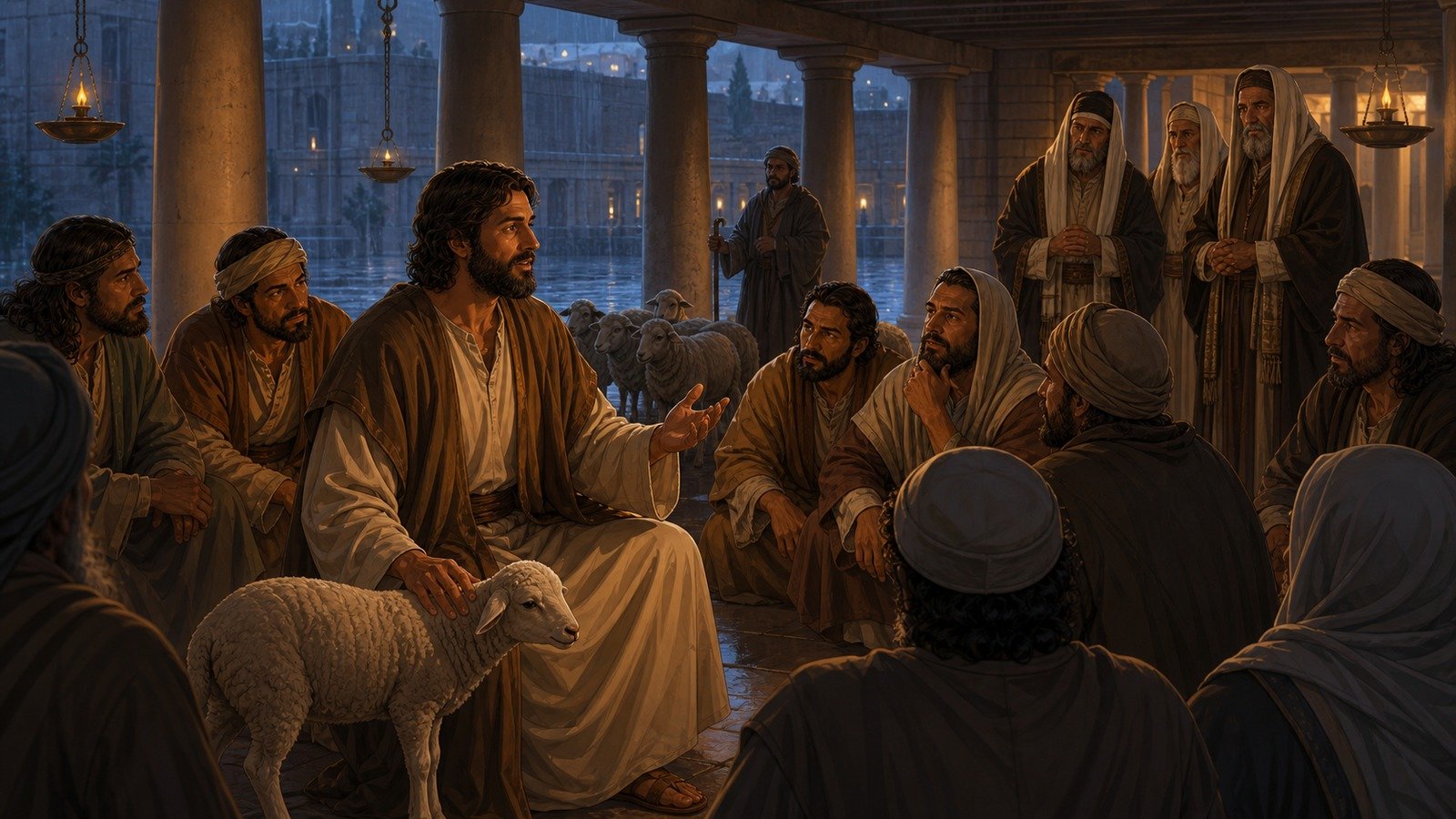
Jesus describes himself as the good shepherd who lays down his life for the sheep, in contrast to hired hands who abandon them; at the winter Feast of Dedication (Hanukkah) he claims unity with the Father so directly that his listeners attempt to stone him for blasphemy.
Further context
2 min readShepherding was not a romantic occupation, and the imagery Jesus uses here is drawn from how it actually worked. Sheep in that country were kept for years and were known individually; several flocks might share a walled enclosure overnight with one man at the gate; and in the morning each shepherd called and his own animals separated themselves out and followed. Travellers in the region were still describing exactly that in the nineteenth century.
He begins with a thief who climbs in by another way, and the shepherd who comes through the gate. The sheep listen to his voice. He calls his own sheep by name and leads them out. They will never follow a stranger; in fact, they will run away from him because they do not recognise a stranger's voice.
Then two statements about himself. I am the gate for the sheep. And, I am the good shepherd. The good shepherd lays down his life for the sheep.
The contrast drawn is with the hired hand, who has no ownership in the flock, and who abandons them and runs when he sees the wolf coming. That is not a slur on labourers; a hired man risking his life for someone else's animals would have been foolish, and the point is precisely that ownership changes what a man will accept.
The imagery carries a long history that the audience knew. The prophets had denounced the shepherds of Israel, meaning its rulers, for feeding themselves and letting the flock scatter, and had promised that God himself would come and search for his sheep.
Then a sentence that reaches beyond the immediate audience: I have other sheep that are not of this sheepfold. I must bring them also. There shall be one flock and one shepherd.
The Feast of Dedication is Hanukkah, held in December, marking the rededication of the temple after Antiochus IV had desecrated it with pagan sacrifice and the Maccabean revolt had recaptured Jerusalem. It was a festival about foreign rule, defiled worship and a temple made clean again, and it is winter, so he is walking in Solomon's Colonnade, the roofed portico on the eastern side where people sheltered.
The authorities surround him: how long will you keep us in suspense? If you are the Messiah, tell us plainly.
The exchange ends with I and the Father are one, and they pick up stones again. Asked which good work they are stoning him for, they answer: not for any good work, but for blasphemy, because you, a mere man, claim to be God.
The confrontation at the Feast of Dedication is the last public exchange before the raising of Lazarus, and after it he crosses the Jordan and stays where John had been baptising at the beginning.
The sheepfold imagery would have been read against the festival being celebrated. Hanukkah commemorated a priesthood that had fought for the temple, and the ruling family descended from those fighters had held both the high priesthood and the crown until Rome ended the arrangement. Telling that audience about shepherds who abandon the flock, in the week they were celebrating shepherds who had not, was not a neutral choice of image.