

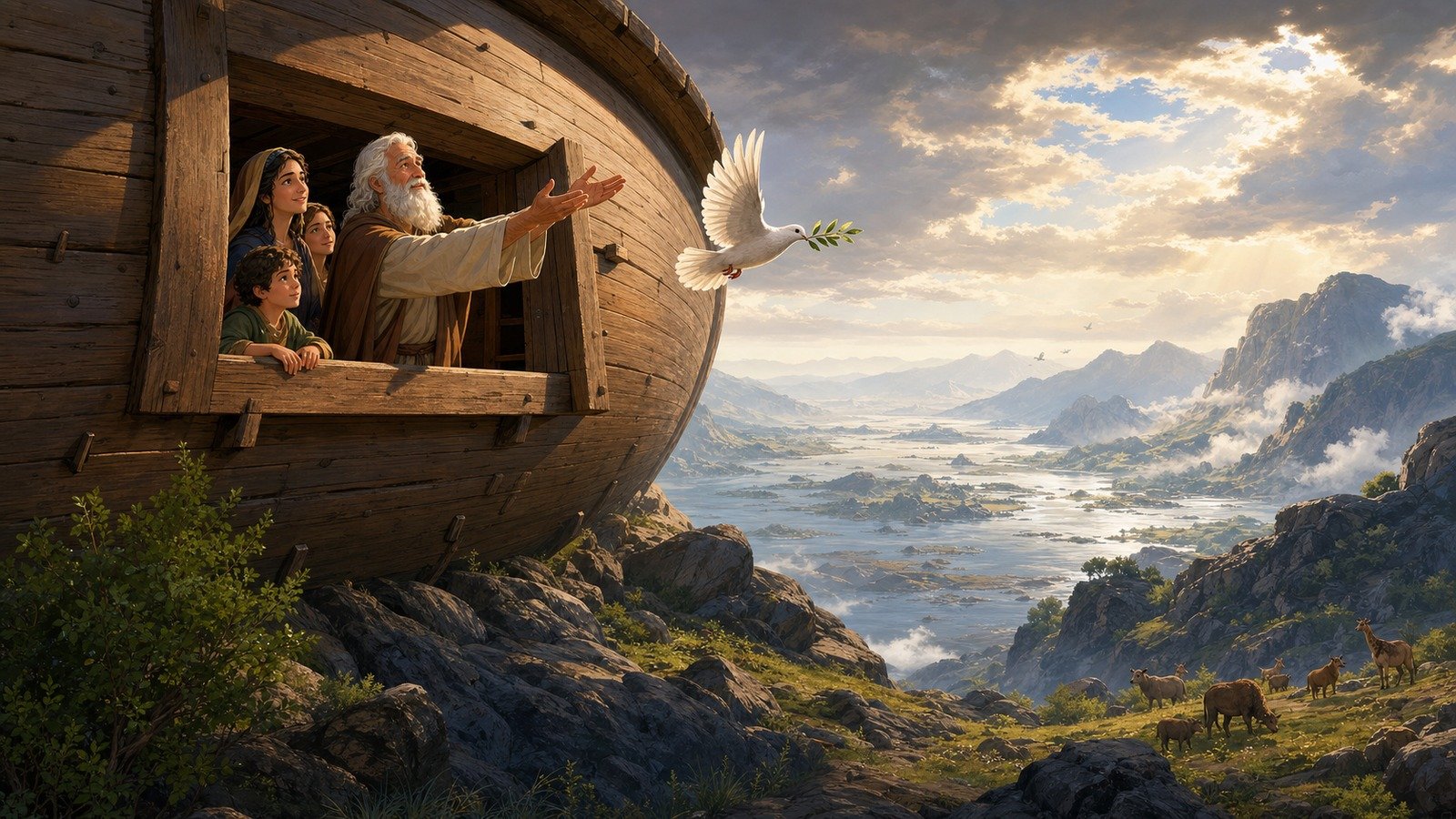
The waters recede over several months, the ark rests on the mountains of Ararat, and Noah sends out a raven and then doves to test whether the ground has dried before finally leaving the ark.
Further context
2 min readA wind, and then a long wait. The Hebrew for that wind (ruach) is the same word used of what moved over the waters at the very beginning, and the echo is the first signal that something is being remade rather than merely drained.
The sentence that opens the recovery says that God remembered Noah, and the verb does not mean that anyone had been forgotten. It is used throughout the Hebrew scriptures for acting on a commitment already made, so it marks the point where judgement turns into rescue.
The springs and the floodgates are closed, the rain stops, and the water begins to go down. On the seventeenth day of the seventh month the boat comes to rest on the mountains of Ararat.
That plural matters and it is almost always lost. What is named is a region, not a peak. Ararat corresponds to Urartu, a kingdom in the highlands of eastern Anatolia and the southern Caucasus that appears repeatedly in Assyrian royal inscriptions from the ninth century BC onwards, covering territory in what is now eastern Turkey, Armenia and north-western Iran. Identifying the landing place with the specific volcanic cone now called Mount Ararat is a later tradition rather than part of the story, and expeditions searching that one mountain are looking at a single point inside a very large area.
The scale then contracts sharply. The tops of the mountains become visible on the first day of the tenth month. Forty days after that Noah opens the window and sends out a raven, which goes back and forth without settling; a carrion bird had no reason to come back. He then sends a dove, which finds nowhere to perch and returns. Seven days later he sends it again and it comes back in the evening with a freshly plucked olive leaf in its beak, which tells him that trees are standing above water somewhere. Seven days after that it does not come back at all.
The three attempts, spaced a week apart, are how patience gets measured here. A man with no way of steering, no window on the world except one hatch, and no information beyond what a bird brings him, waits and sends and waits again.
The dates are exact enough to add up. Entry on the seventeenth day of the second month of his six hundredth year. The surface dry on the first day of the first month of the six hundred and first. The ground completely dry on the twenty-seventh day of the second month. From going in to coming out, one year and ten days, which on the three-hundred-and-sixty-day year used here comes to three hundred and seventy.
The two halves of the Flood are told in completely different registers. The first uses vast round numbers and universal language: all flesh, every living thing, the whole earth. The second counts in sevens, watches one bird and reports one leaf. That the world was habitable again is not announced. It is worked out from a twig.