

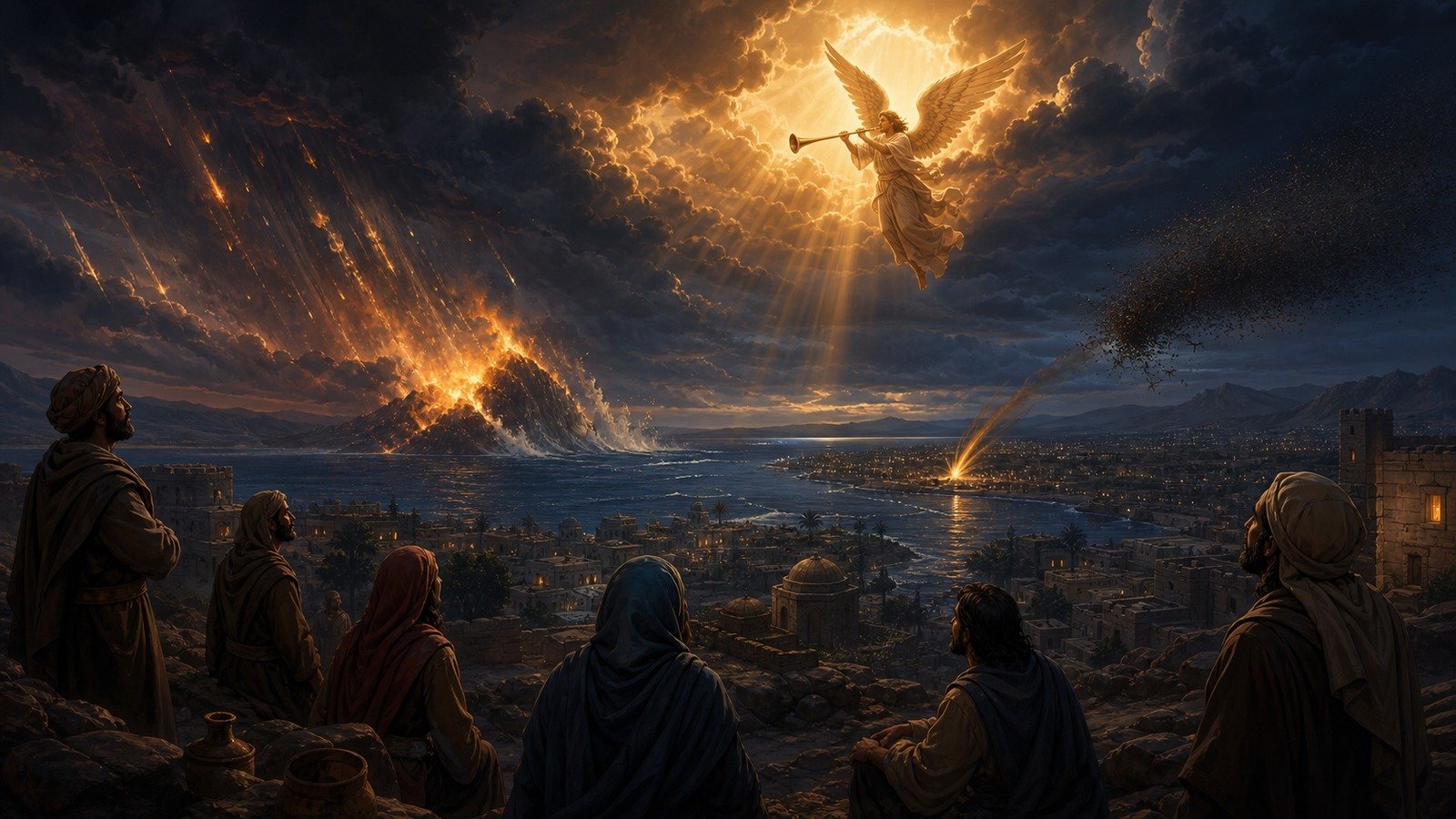
Each trumpet brings escalating disaster: hail and fire, a burning mountain cast into the sea, a poisoned star, darkened skies, monstrous locusts that torment without killing, and an army of two hundred million that kills a third of humanity.
Further context
2 min readThe trumpet judgements are constructed on the plagues of Egypt and they follow the same logic: the natural order turning against those who trusted it.
The first brings hail and fire mixed with blood, and a third of the earth, the trees and all the green grass are burned up.
The second: something like a huge mountain, all ablaze, is thrown into the sea. A third of the sea turns to blood, a third of the living creatures in it die, and a third of the ships are destroyed.
The third: a great star, blazing like a torch, falls on a third of the rivers and springs. The star is named Wormwood, after a bitter desert shrub used as a byword for the taste of judgement, and a third of the waters turn bitter and many people die.
The fourth: a third of the sun, moon and stars are struck, so that a third of the day is without light.
The fraction is consistent and it is a limit rather than a total. What is being described is severe and partial, and the reason is given later: the survivors still did not repent.
The fifth trumpet opens the shaft of the Abyss, and smoke comes up like the smoke of a gigantic furnace, darkening the sun. Out of the smoke come locusts, and the description is elaborate: they look like horses prepared for battle, with something like crowns of gold, faces like human faces, hair like women's hair, teeth like lions' teeth, breastplates of iron, wings sounding like chariots, and tails with stings like scorpions.
They are told not to harm grass or trees but only people, and not to kill them but to torture them for five months, which is roughly the lifespan of a locust. During those days people will seek death and will not find it.
The sixth releases four angels bound at the great river Euphrates, and an army of two hundred million mounted troops. The Euphrates was the frontier with Parthia, and the direction any invasion of the eastern provinces would come from.
A third of mankind is killed. And the rest of mankind still did not repent of the work of their hands; they did not stop worshipping demons, and idols of gold, silver, bronze, stone and wood, which cannot see or hear or walk.
The locusts have a king over them, the angel of the Abyss, whose name is given in both Hebrew and Greek: Abaddon, meaning destruction, and Apollyon, meaning destroyer. It is the only time the book supplies a name in two languages.
Some readers have connected Apollyon to Apollo, whose symbol was the locust and whom Domitian claimed as a patron, which would give the name an edge for the first readers.
The refusal to repent is stated twice in the trumpet sequence and it is the only conclusion the sequence draws. The disasters do not produce a change of mind in anyone.
The locusts of the fifth trumpet are told not to harm the grass, which is what locusts exist to do, and the reversal is the point: they are sent after people instead.