

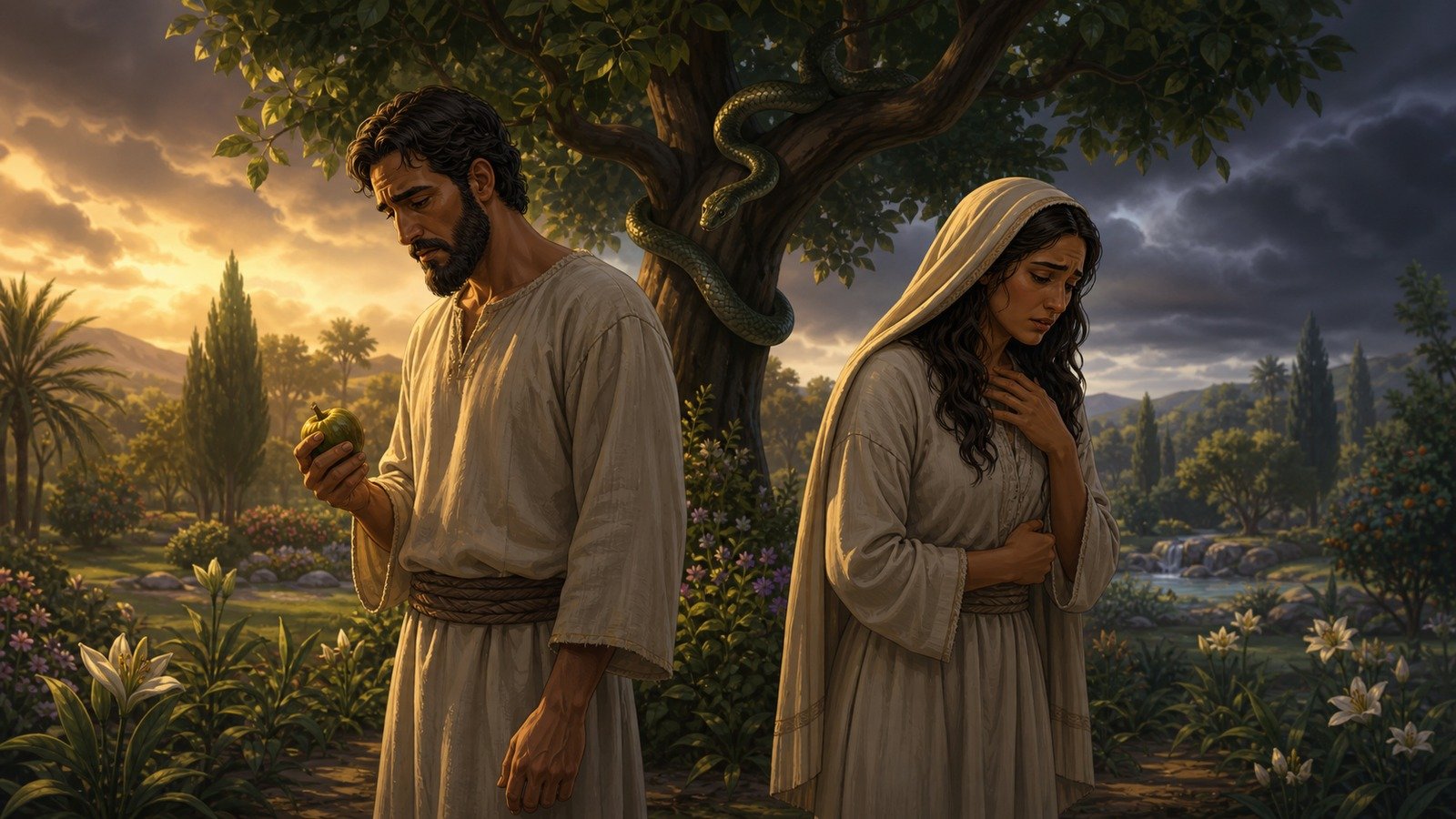
The serpent tempts Eve, she and Adam eat the forbidden fruit, and both are expelled from Eden under a curse touching the serpent, the woman and the ground itself. Genesis 3:15 promises a future descendant of the woman who will crush the serpent, a line Christian readers have long taken as the Bible's first messianic promise.
Further context
3 min readThe serpent was the most cunning of all the wild animals God had made. That places it among the creatures, and nothing else is ever said about what it was. The identification with Satan comes from writing produced well over a thousand years later, where the devil is called "that ancient serpent". Readers who make the connection are borrowing from that later material, and it is worth knowing which claim comes from where.
The temptation proceeds in three moves. It begins with a distortion: did God really say you must not eat from any tree in the garden? The actual prohibition covered one tree out of many. The woman corrects the exaggeration and then adds a clause of her own, that they must not touch it, which was never part of the command. The serpent then contradicts the penalty outright, "you will not certainly die", and finally supplies a motive, claiming that God is withholding something and that eating will open their eyes and make them like God, knowing good and evil.
She eats and gives some to her husband, who is described as being with her. What follows is not what was promised. Their eyes are opened and what they see is their own nakedness. They sew fig leaves together and hide among the trees. Asked directly what has happened, the man blames the woman and, by implication, God for giving her to him; the woman blames the serpent. Neither answers the question.
The judgements are addressed to each in turn. The serpent will move on its belly and eat dust. The woman is told of increased pain in childbearing, and of a relationship with her husband described in a clause about desire and rule that has been translated in several different ways and argued over for centuries. The man is not cursed; the ground is. It will produce thorns and thistles, food will come through sweat, and he will return to the dust he was taken from. Death, announced earlier as the penalty, arrives here as a slow return to the ground rather than as an execution.
One line inside the judgement on the serpent has carried enormous weight. God tells it that he will put hostility between it and the woman, and between its offspring and hers, and that "he will crush your head, and you will strike his heel". Christian readers from the second century onwards have taken this as the first indication anywhere in Scripture of a deliverer who would undo what happened in the garden. The sentence itself speaks of the woman's offspring collectively, and reading it as a single individual is an interpretation formed in the light of much later material rather than a claim the words make on their own.
They are then clothed by God in garments of skin, which implies the first death in the story, and driven out. Cherubim, winged guardian figures of a kind well attested in Assyrian and Babylonian palace sculpture, are stationed with a flaming sword to block the way back to the tree of life.
Paul builds two of his central arguments on this scene, setting Adam against Christ as two representatives whose actions carry consequences for everyone belonging to them. Whatever a reader concludes about how literally to take the garden, that pairing is why the episode occupies the position it does in Christian thought, and why an event with no date and no location is treated as the hinge of everything after it.