

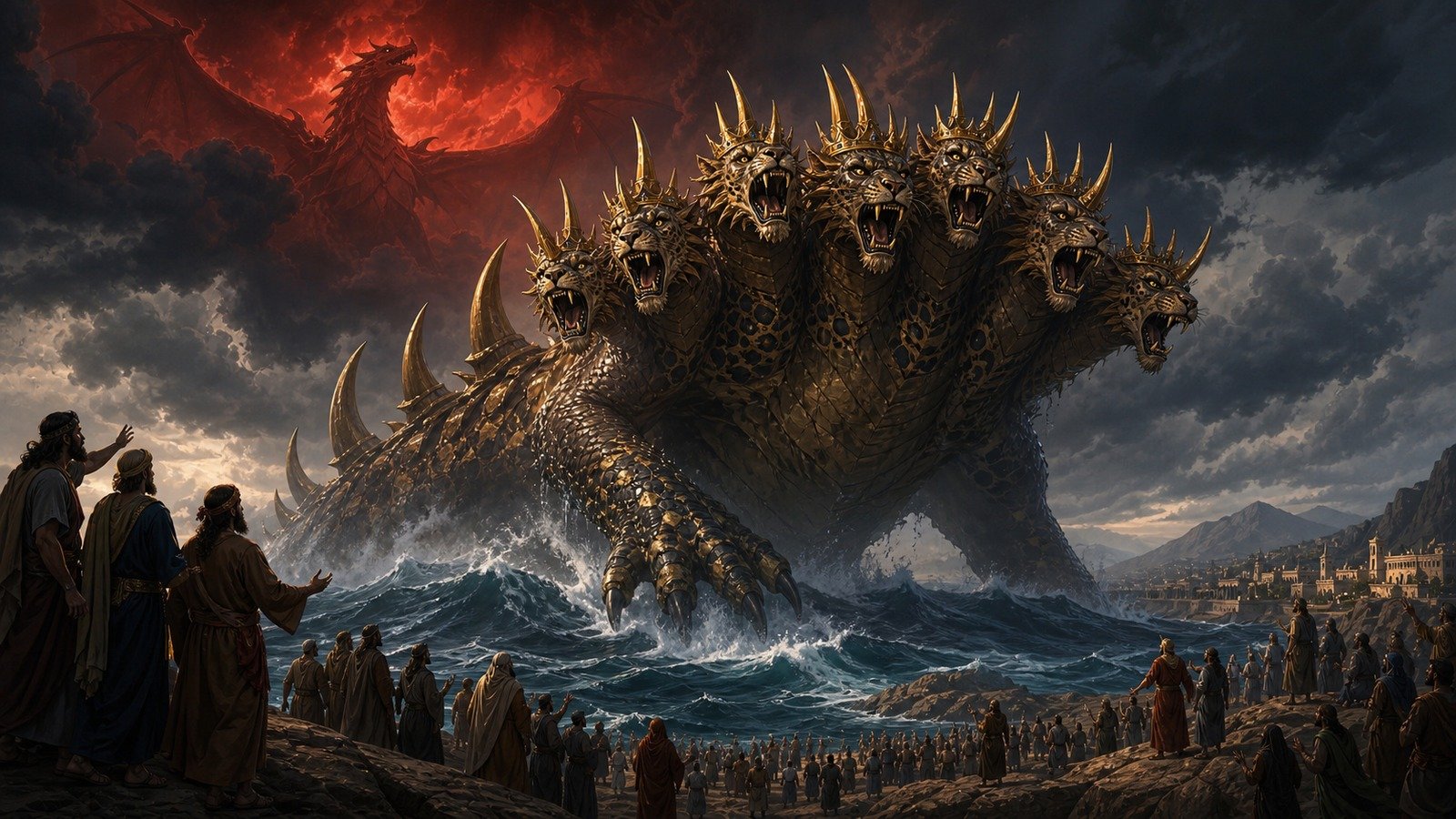
A monstrous beast rises from the sea, receives authority from the dragon, and is worshipped by the whole world; it wages war against God's people and is given power over every tribe, people, language and nation.
Further context
2 min readThe dragon stands on the shore of the sea, and a beast comes up out of it, with ten horns and seven heads, ten crowns on its horns, and on each head a blasphemous name.
The beast John describes resembles a leopard, with feet like a bear and a mouth like a lion. Those three animals are the first three of the four beasts in Daniel's vision, which represented successive empires, and here they are combined into one.
The sea matters. To a first-century reader in the province of Asia, power arrived by sea, from Rome.
The dragon gives the beast his power and his throne and great authority. One of its heads seems to have had a fatal wound, but the wound has been healed, and the whole world is filled with wonder and follows the beast. People worship the dragon and the beast, asking: who is like the beast? Who can wage war against it?
That question is a parody. Who is like you, O Lord, is the line sung at the Red Sea.
The beast is given a mouth to utter proud words and blasphemies, and authority for forty-two months, the same limited period as before. It is given power to wage war against God's holy people and to conquer them, and authority over every tribe, people, language and nation.
Then a sentence addressed straight to the reader: this calls for patient endurance and faithfulness on the part of God's people.
What the beast represents is the central question of the book's interpretation. The strongest historical case identifies it with the Roman imperial system and its cult, which had temples in most of the seven cities and required a gesture of worship that Christians would not make. The healed fatal wound is usually connected to the widespread rumour that Nero had not really died and would return from the east at the head of a Parthian army, a belief so persistent that at least three impostors exploited it.
Readings that treat the beast as a figure still to come, or as a recurring pattern of political power demanding what belongs to God, have long histories of their own and are not exclusive of the first.
What the vision describes practically is a state that requires worship, that persecutes those who refuse, and that is enormously popular while doing it.
Nero died in June 68 and the rumour that he had survived circulated for at least twenty years. Tacitus, Suetonius and Dio all record it, and at least three impostors raised followings in the east on the strength of it, one of them supported by the Parthians.
That a healed mortal wound made the whole world wonder is, on the historical reading, a description of something the first readers had watched happen twice.
The beast's authority is given, its mouth is given, its power is given, and the passive verb is used four times in as many sentences, always without naming who does the giving.
Daniel's four beasts came up out of the sea as well, and in that vision the sea is the source of chaos, which is how it functions through most of the Hebrew Scriptures.