

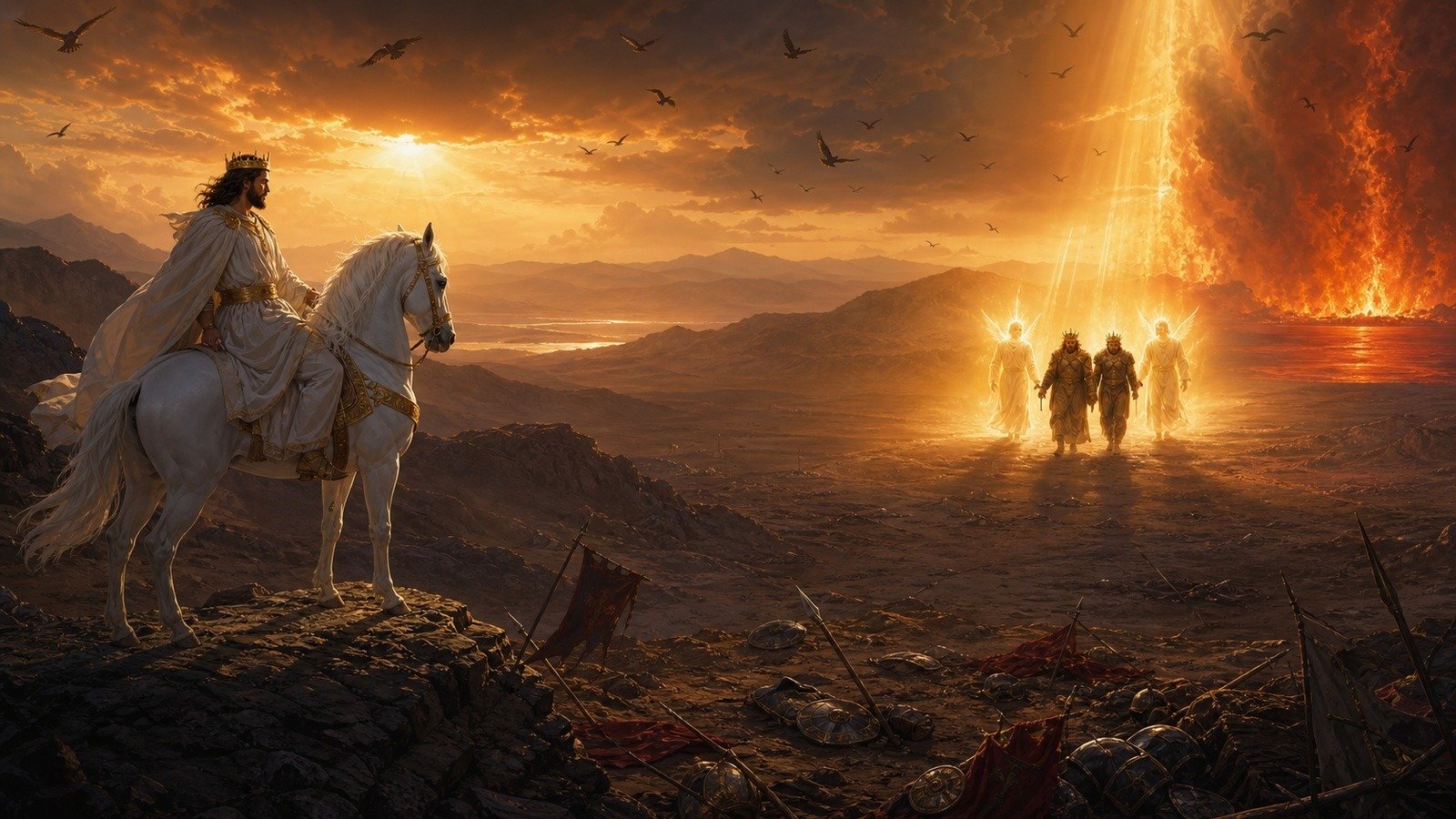
The beast and the kings of the earth gather to fight the rider on the white horse but are defeated; the beast and the false prophet are thrown alive into a fiery lake, and the rest are killed by the sword from the rider's mouth.
Further context
3 min readThe beast and the kings of the earth and their armies gather together to wage war against the rider on the horse and his army.
Then the battle, and there is no battle.
The beast was captured, and with it the false prophet who had performed the signs on its behalf. The two of them were thrown alive into the fiery lake of burning sulphur. The rest were killed with the sword coming out of the mouth of the rider on the horse.
Nothing is described happening in between. The forces assemble, and then the sentence moves straight to the outcome. The armies of heaven, introduced a few lines earlier in linen rather than armour, do nothing whatever.
That is consistent with everything the book has said about how the Lamb overcomes, and it is the reason so many readers have been careful about drawing military conclusions from it.
The false prophet is the second beast, the one that came up out of the earth with two horns like a lamb, and this is where it is given that name.
The fiery lake of burning sulphur is introduced here for the first time. Sulphur, or brimstone in older English, occurs naturally around the Dead Sea, and the destruction of Sodom is described as burning sulphur raining down. The image would have carried that association immediately.
Whether it describes a place, a state or the end of something has been argued for as long as there have been Christians, and the three positions have names: eternal conscious punishment, annihilation, and the hope that it is not final. Each has been held by serious people in every century, and each rests on different passages read against each other.
Then the birds gorge themselves on the flesh of the fallen.
That closing image comes from Ezekiel, where birds and wild animals are summoned to a sacrificial feast after the defeat of Gog, and the borrowing is close enough to be deliberate.
The gathering of the kings for battle has been anticipated twice already, once at the sixth bowl and once here, and both times the assembly is described at length and the fighting is not described at all.
Where the beast came from has been stated: out of the sea. Where the false prophet came from has been stated: out of the earth. Where they go is stated here, and the geography of the book is complete.
Christian writers who have taken this scene as a warrant for holy war have always had to work against its own details, since the only participants who do anything are a rider who speaks and an army in wedding clothes.
The false prophet is the third member of a trio the book has assembled deliberately: a dragon, a beast who receives authority from him, and a second beast who directs worship towards the first. The parallel to the pattern being opposed is exact and is presumably meant to be noticed.
Thrown alive is stated of the two beasts and not of anyone else, and the distinction between the fate of the systems and the fate of the people who followed them is maintained through the whole scene.
Sulphur deposits still occur around the southern end of the Dead Sea, and the smell of them is the reason the region carried the associations it did.