

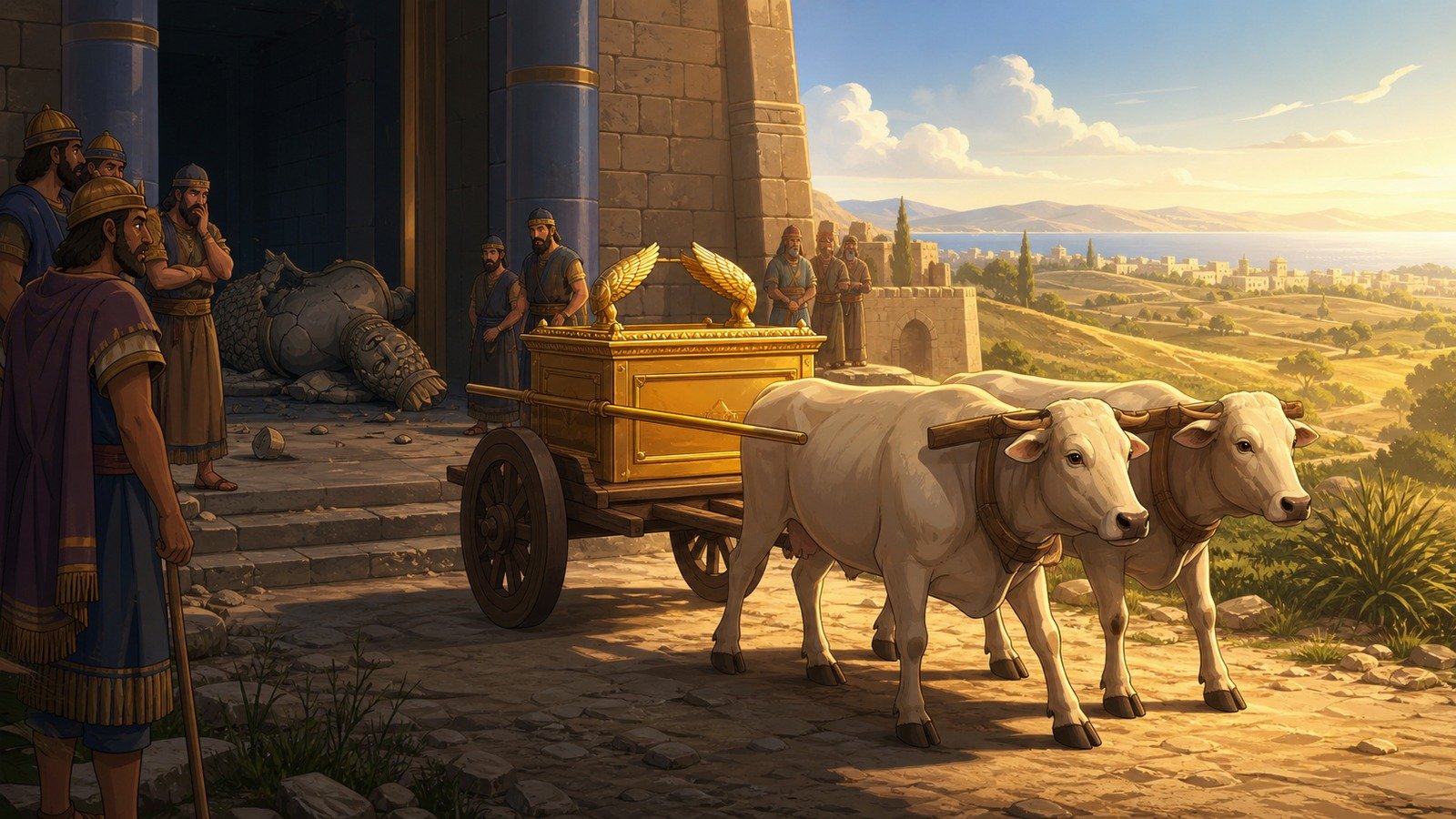
The captured ark brings plague and the collapse of the Philistine god Dagon's idol wherever it is placed. After seven months the Philistines return it to Israel on a cart pulled by cows, along with a guilt offering.
Further context
3 min readThe Philistines take their trophy to Ashdod and set it up in the temple of Dagon beside the statue, which is the standard way of displaying a captured god: the defeated deity is placed as a subordinate in the victor's house.
In the morning Dagon is face down on the ground in front of it. They set him up again. The next morning he is face down again with his head and hands broken off on the threshold, leaving only the torso. A short note explains that this is why the priests of Dagon and everyone entering the temple at Ashdod do not step on the threshold to this day, which means a local custom is being traced to the incident.
Then the population is afflicted with tumours, and rats feature in the affliction as well, which has led to the common suggestion of bubonic plague, since that is spread by fleas on rodents. The identification is plausible and cannot be confirmed from the description.
The ark is moved to Gath and the same thing happens. It is sent on to Ekron, and the people there see it coming and protest that it has been brought to kill them. After seven months the Philistine rulers call in their priests and diviners and ask what to do.
The advice they get is careful and it includes a controlled experiment. Send it back with a guilt offering of five gold tumours and five gold rats, one for each ruling city. Put it on a new cart pulled by two cows that have calved and have never been yoked, shut their calves up at home, and let them go. If the cart goes towards Israelite territory, the LORD did this; if it turns aside, it was chance. Nursing cows separated from their calves and never broken to a yoke should not walk anywhere in a straight line.
They go straight up the road towards Beth Shemesh, lowing all the way, without turning to the right or the left, while the five rulers follow as far as the border.
The reapers at Beth Shemesh are harvesting wheat in the valley and look up and see it coming. They split the cart for firewood and sacrifice the cows.
Then a difficult passage. A number of men of Beth Shemesh are struck down for looking into the ark, and the figure given in the Hebrew is impossibly large for a small town and may be corrupt, with several ancient witnesses and manuscripts giving a much smaller number. Their reaction is a question the whole sequence has been building towards: who can stand in the presence of the LORD, this holy God? To whom will the ark go up from here?
The gold objects sent back are also worth noting. Making models of the affliction and sending them away with the offending object is a recognised practice in the ancient world, and votive figures of afflicted body parts have been found at shrines across the Mediterranean for centuries afterwards. The Philistine priests are doing what their own religion suggested, using their own logic, and the experiment they design with the cows is a genuine attempt to distinguish coincidence from cause.
It ends up at Kiriath Jearim, in a private house, where it stays for twenty years until David eventually fetches it. Nobody wants it, and by the end of the episode the Philistines and the Israelites are equally anxious to get rid of it.