

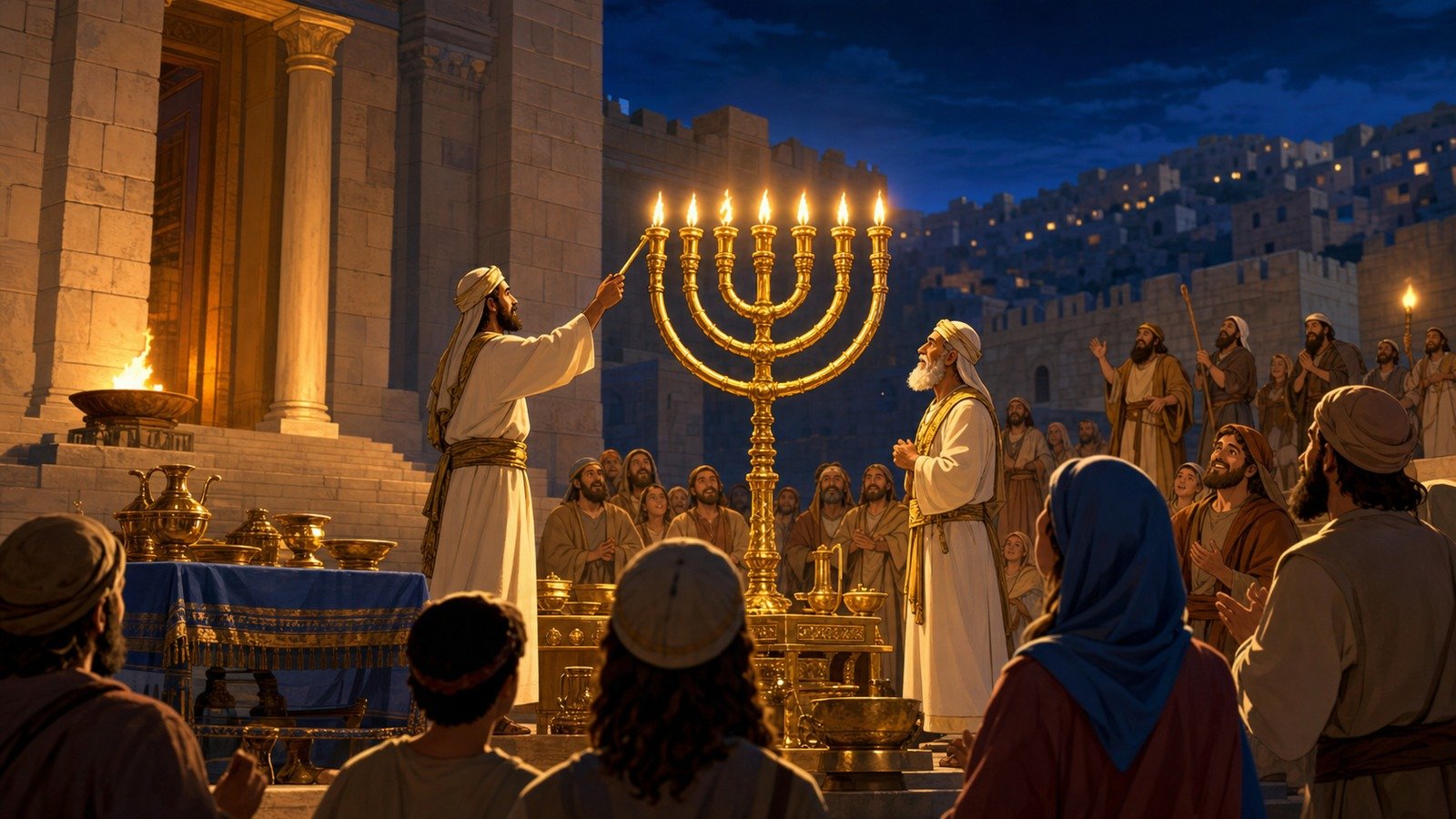
Judas Maccabeus recaptures Jerusalem and rededicates the desecrated Temple, an event commemorated annually in the Jewish festival of Hanukkah, referenced in the Gospels as the Festival of Dedication.
No canonical Scripture reference (historical context outside the Protestant canon)
Further context
3 min readThree years and a few days after the altar to Zeus was set up, Judas and his men go up to Mount Zion and find the sanctuary desolate, the altar profaned, the gates burned, shrubs growing in the courts as in a thicket, and the priests' chambers pulled down.
They tear their clothes and lament, and then they work. Blameless priests are chosen to cleanse the sanctuary. The defiled stones of the altar are removed and taken to a place on the temple hill, and stored there until a prophet should come to say what to do with them, which is a careful piece of legal caution about objects nobody knew how to classify. A new altar is built of unhewn stones, in accordance with the old requirement that no iron tool be used on them. The sanctuary is rebuilt, new holy vessels are made, and a new lampstand, altar of incense and table are brought in.
The rededication takes place on the twenty-fifth day of Kislev in 164 BC, three years to the day after the desecration, and the sacrifice is offered on the new altar at the same hour it had been stopped. There is singing, harps, lutes and cymbals, and the celebration lasts eight days, patterned on the eight days of the autumn festival they had been unable to keep in the hills.
It is then decreed that the days should be observed annually, and they have been ever since. Hanukkah, meaning dedication, is a minor festival by the standards of the biblical calendar and it commemorates an event no biblical book records.
The story about a single day's supply of consecrated oil burning for eight days appears in Jewish tradition several centuries later and not in the contemporary accounts, which give the length of the festival as an eight-day pattern taken from Tabernacles. Both explanations are widely repeated and only one of them is early.
The stones of the old altar are the detail most worth pausing on. They could not be used, because they had been defiled, and they could not be destroyed, because they had been consecrated. So they were stacked on the temple hill and left there until a prophet should come and say what to do with them, and as far as anyone knows they were never dealt with. It is a very precise picture of a community that had lost the authority to settle its own hard cases.
The festival appears once in the New Testament. Jesus is described walking in Solomon's Colonnade at the temple in winter, at the Feast of Dedication, when he is surrounded and asked how long he will keep them in suspense and told to say plainly whether he is the Messiah. A conversation about a claim to be God's anointed takes place at the festival commemorating a revolt against a foreign king who had called himself God manifest.
The rededication in December 164 BC is described in detail. They found the sanctuary desolate, the altar profaned, the gates burned and shrubs growing in the courts. They tore down the defiled altar and stored its stones in a suitable place until a prophet should come to say what to do with them.
That last clause is worth noticing. They knew they had no authority to decide, and rather than guess they put the problem in storage.
A new altar was built of unhewn stones, new vessels were made, the lamps were lit, and the dedication was kept for eight days with singing, harps, lyres and cymbals, and it was decreed that it should be observed annually.
The story of one day's oil burning for eight is not in the earliest accounts and appears first in the Talmud, several centuries later.
The eight-day festival with lights is what survives, and it falls in December each year.