

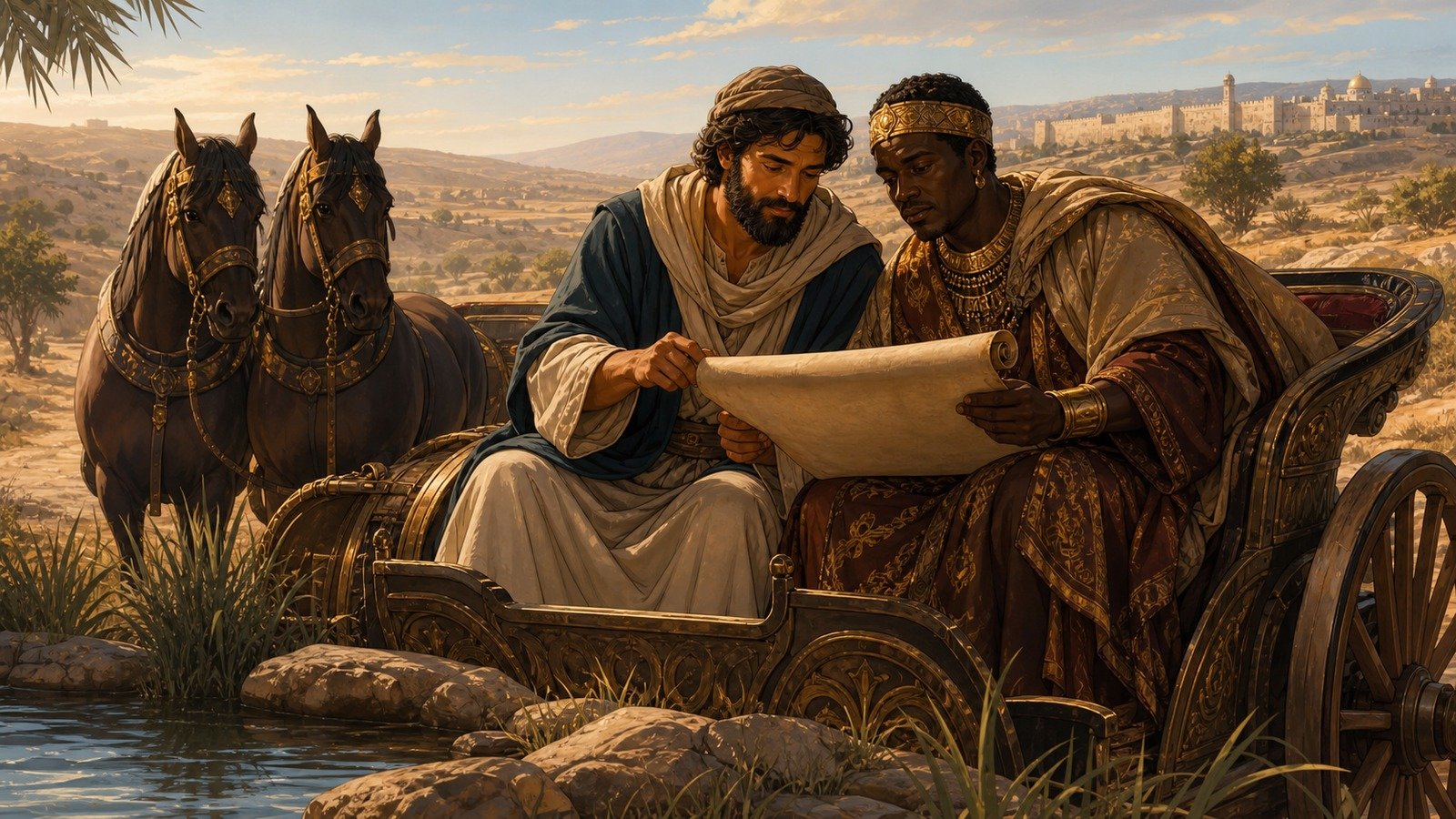
Directed by an angel to a desert road, Philip meets a court official of the Ethiopian queen reading Isaiah, explains the passage as pointing to Jesus, and baptises him before being "suddenly taken away" to continue preaching elsewhere.
Further context
3 min readAn angel tells Philip to go south to the desert road that runs from Jerusalem down to Gaza, which is an instruction to leave a successful mission in Samaria and stand on an empty road.
On it he meets a court official of the Kandake, queen of the Ethiopians, in charge of all her treasury, returning home from worshipping in Jerusalem and reading aloud from Isaiah in his chariot.
Almost every word of that description carries information.
Ethiopia here means the kingdom of Kush, centred on Meroe in what is now Sudan, not the modern country of that name. Kandake is a title rather than a personal name, borne by the queen mothers who exercised real power there, and it appears in Greek and Latin sources.
The man is a eunuch, which was the ordinary condition of high officials handling a queen's treasury, and it placed him under a specific legal disability: the law excluded men who had been emasculated from the assembly of the Lord. He had travelled perhaps two and a half thousand kilometres to worship at a temple whose inner courts he could not enter.
He is also wealthy enough to own a private copy of a prophetic scroll, which was an expensive object, and he reads it aloud, which is how almost everyone read in the ancient world.
He has reached the fourth of the servant songs: he was led like a sheep to the slaughter, and as a lamb before its shearer is silent, so he did not open his mouth. In his humiliation he was deprived of justice. Who can speak of his descendants? For his life was taken from the earth.
Do you understand what you are reading? Philip asks, and the answer is the honest one: how can I, unless someone explains it to me?
Tell me, please, who is the prophet talking about, himself or someone else?
Starting from those very words, Philip told him the good news about Jesus.
They come to some water and the official asks what can stand in the way of his being baptised. The question is a real one from a man who had spent his life being told what he could not enter, and it is the reason the answer matters.
He is baptised, goes on his way rejoicing, and is never mentioned again.
A few chapters before this, Isaiah has God promising eunuchs who hold fast to his covenant a name better than sons and daughters.
The road from Jerusalem to Gaza runs down through the Judean hills to the coastal plain, and there were two routes, one of which ran through open country and is presumably the desert road meant.
Kush appears throughout the Hebrew Scriptures, and a psalm has Cush stretching out her hands to God. The kingdom had its own writing, its own pyramids at Meroe and its own queens, and Jewish communities existed along the Nile as far south as Elephantine. A treasury official making the pilgrimage is not an exotic accident; he is at the end of a long line of contact.
The Spirit takes Philip away afterwards, and he appears next at Azotus and travels up the coast preaching in all the towns until he reaches Caesarea, where he is still living about twenty years later when Paul stays in his house.