

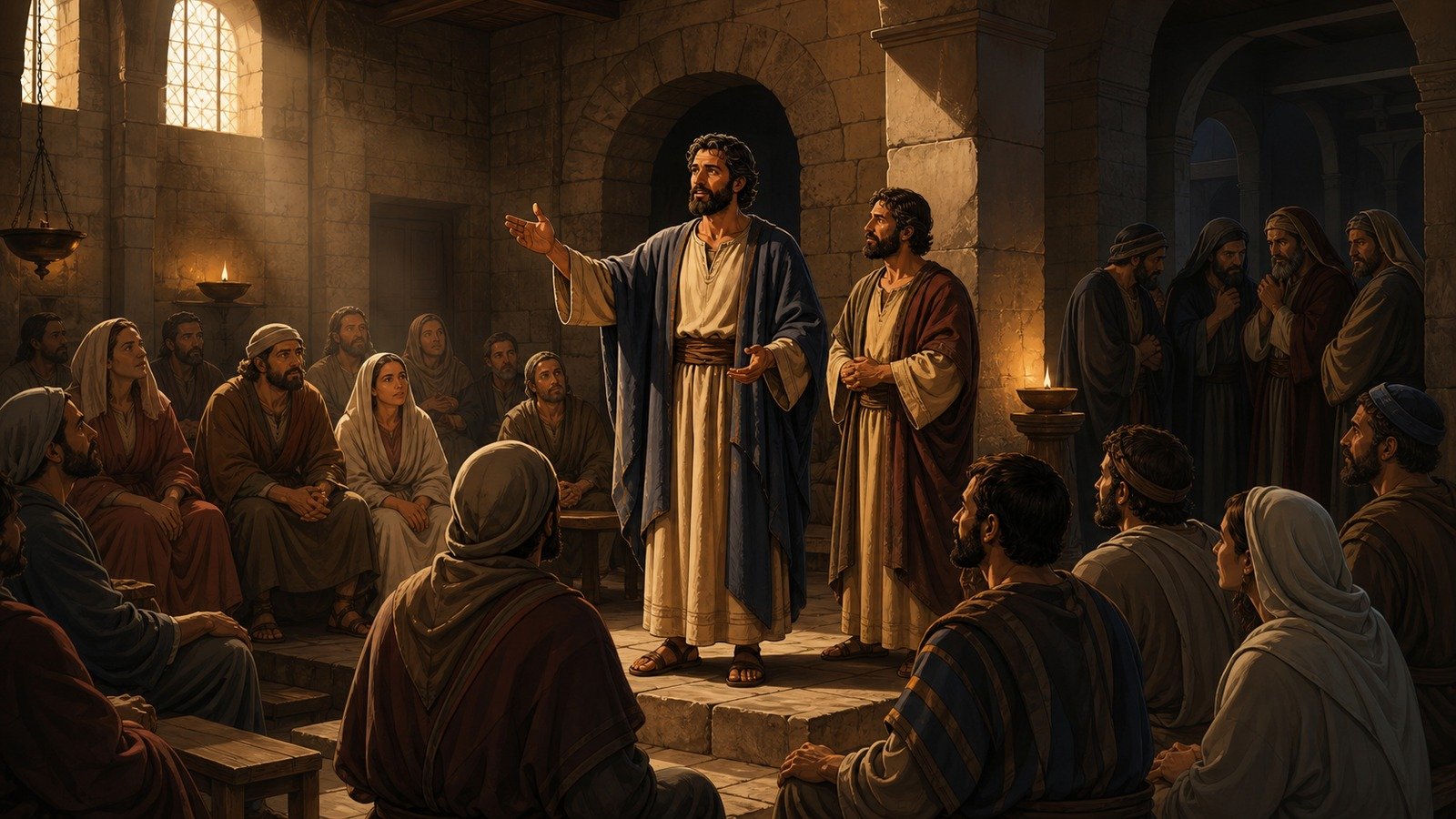
In a synagogue at Pisidian Antioch, Paul surveys Israel's history culminating in Jesus and offers forgiveness through him; when jealous opposition arises from some in the synagogue, Paul and Barnabas declare they are turning to the Gentiles instead.
Further context
2 min readFrom Paphos they sail to Perga on the southern coast of Asia Minor, where John Mark leaves them and returns to Jerusalem, a departure that causes a quarrel later.
Then they go inland to Pisidian Antioch, a Roman colony sitting about eleven hundred metres up on the Anatolian plateau. Getting there meant crossing the Taurus mountains through country notorious for bandits, and Paul later mentions dangers from rivers and from bandits in a list of things he had survived.
On the Sabbath they go into the synagogue and sit down. After the reading from the Law and the Prophets, the synagogue leaders send word inviting them to speak if they have a message of encouragement.
That invitation was normal practice. Any competent visiting Jewish man could be asked to address the congregation, and it is the mechanism by which the message reached every city on the route.
The sermon is the first of Paul's to be recorded at length, and its shape follows the pattern of the earlier ones with one significant addition.
He starts with Israel's history: the exodus, the wilderness, the conquest, the judges, Samuel, Saul, and then David, a man after God's own heart. From David's descendants God has brought to Israel the Saviour Jesus, as he promised.
Then the standard material. John's preaching. The people of Jerusalem and their rulers condemning him, and in doing so fulfilling the words of the prophets read every Sabbath. Pilate. The tomb. God raised him from the dead, and for many days he was seen by those who had travelled with him from Galilee to Jerusalem.
The addition comes at the end, and it is the beginning of Paul's distinctive argument: through him everyone who believes is set free from every sin, a justification you were not able to obtain under the law of Moses.
The response is enormous. On the next Sabbath almost the whole city gathers to hear the word of the Lord. When some of the Jews see the crowds they are filled with jealousy and contradict what he says.
Then the turn: we had to speak the word of God to you first. Since you reject it, we now turn to the Gentiles.
Pisidian Antioch was one of a series of colonies Augustus planted across the region to hold down the tribes of the Taurus, and its ruins include an imperial sanctuary and an aqueduct. The road Paul used, the Via Sebaste, was built for the same purpose and survives in stretches.
The pattern established in that synagogue holds for the rest of his career: he goes to the Jewish community first in every city, including after announcing that he is turning to the Gentiles, which he does more than once.
The response of the Gentile listeners is described in a phrase that has been translated in several ways: all who were appointed for eternal life believed. It is one of the sentences that recurs in every argument Christians have had about election, and it is stated here without any development at all.