

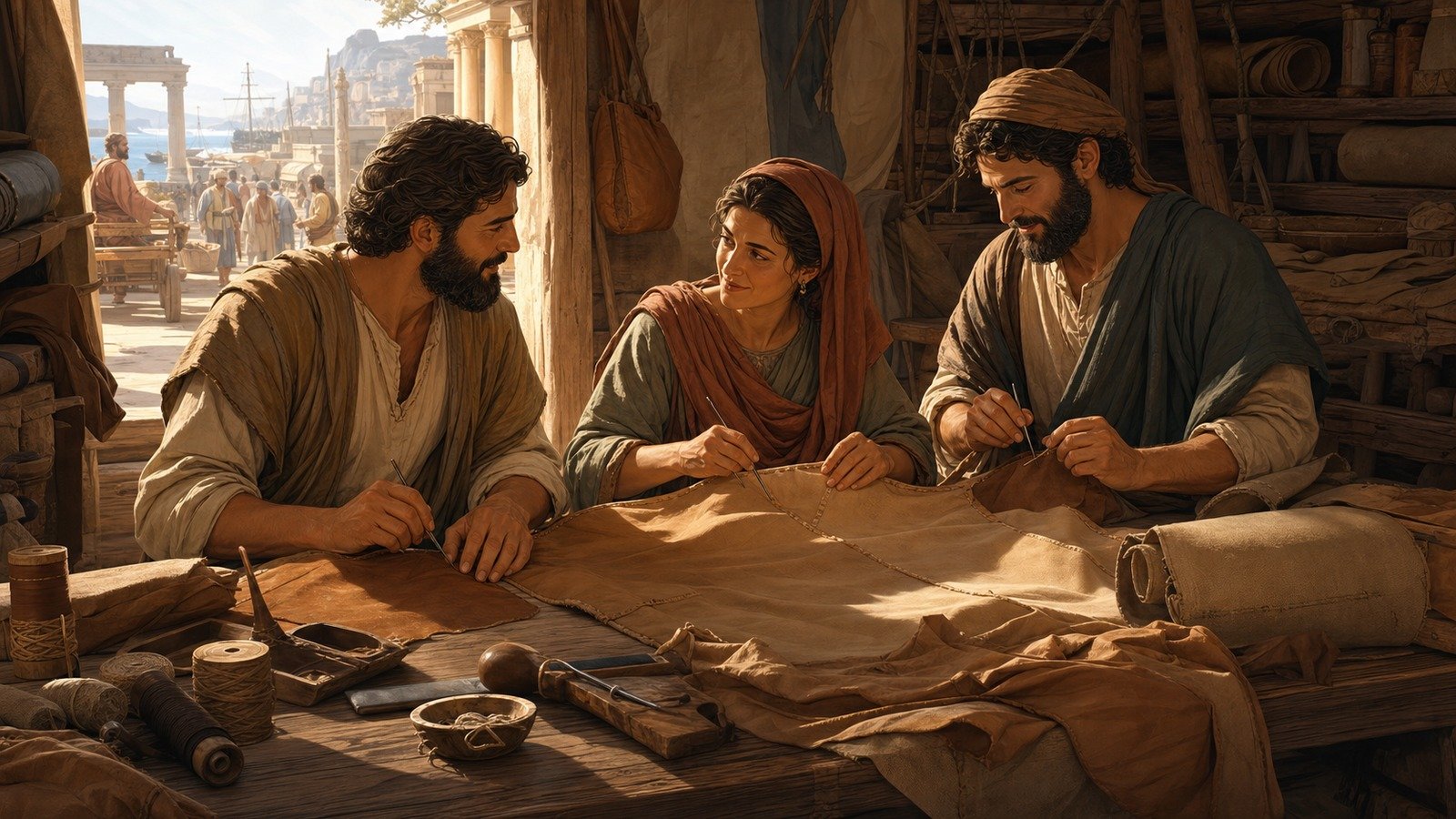
At Corinth, Paul meets a Jewish couple, Aquila and Priscilla, recently expelled from Rome under Claudius; sharing their trade as tentmakers, he lodges and works with them while reasoning in the synagogue every Sabbath.
Further context
2 min readCorinth stood on the narrow isthmus joining mainland Greece to the Peloponnese, with a harbour on each side, and small ships were dragged overland across a paved slipway between them rather than sailing round the dangerous southern capes. That position made it rich, cosmopolitan and transient.
The old Greek city had been destroyed by Rome in 146 BC and refounded by Julius Caesar a century later as a colony for freedmen, so its population was largely of slave descent, its official language Latin, and its wealth new. Its reputation for immorality was proverbial enough that a Greek verb meaning to behave like a Corinthian existed, though most of that reputation attached to the older city.
There Paul meets a Jew named Aquila, a native of Pontus on the Black Sea, who had recently come from Italy with his wife Priscilla, because Claudius had ordered all Jews to leave Rome.
That expulsion is recorded independently. Suetonius writes that Claudius expelled the Jews from Rome because they were constantly making disturbances at the instigation of Chrestus, which is very probably a garbled reference to disputes about Christ within the Jewish community there, and it is usually dated to AD 49.
Paul goes to see them, and because he is a tentmaker as they are, he stays and works with them. The trade involved leatherwork and heavy cloth, and it was portable, which is what made it useful to a man who kept moving.
Paul's insistence on paying his own way is one of his firmest habits and he writes about it at length. He tells the Corinthians that he preached the gospel free of charge so that nobody could say he was in it for money, and that he worked night and day so as not to be a burden.
Every Sabbath he reasons in the synagogue, trying to persuade Jews and Greeks. When Silas and Timothy arrive from Macedonia, bringing a gift that frees him from the workbench, he devotes himself exclusively to preaching.
When the opposition becomes abusive he shakes out his clothes and moves next door, to the house of a God-fearing man named Titius Justus. Crispus, the synagogue leader, and his entire household believe.
He stays a year and a half, longer than anywhere so far.
Corinth is the church Paul wrote to most and worried about most. Two long letters survive, and both refer to others that do not, so there were at least four. The problems he addresses in them are factions, lawsuits between members, sexual immorality, disorder at the shared meal, disputes about food offered to idols, and confusion about the resurrection.
That the congregation with the fullest surviving correspondence is also the most troubled one is a coincidence of preservation, and a useful one.
The isthmus slipway, the diolkos, has been partly excavated and its grooved paving is visible near the modern canal. Corinth's two harbours meant a captain could avoid rounding Cape Malea, about which the Greeks had a proverb advising sailors to make their wills first.