

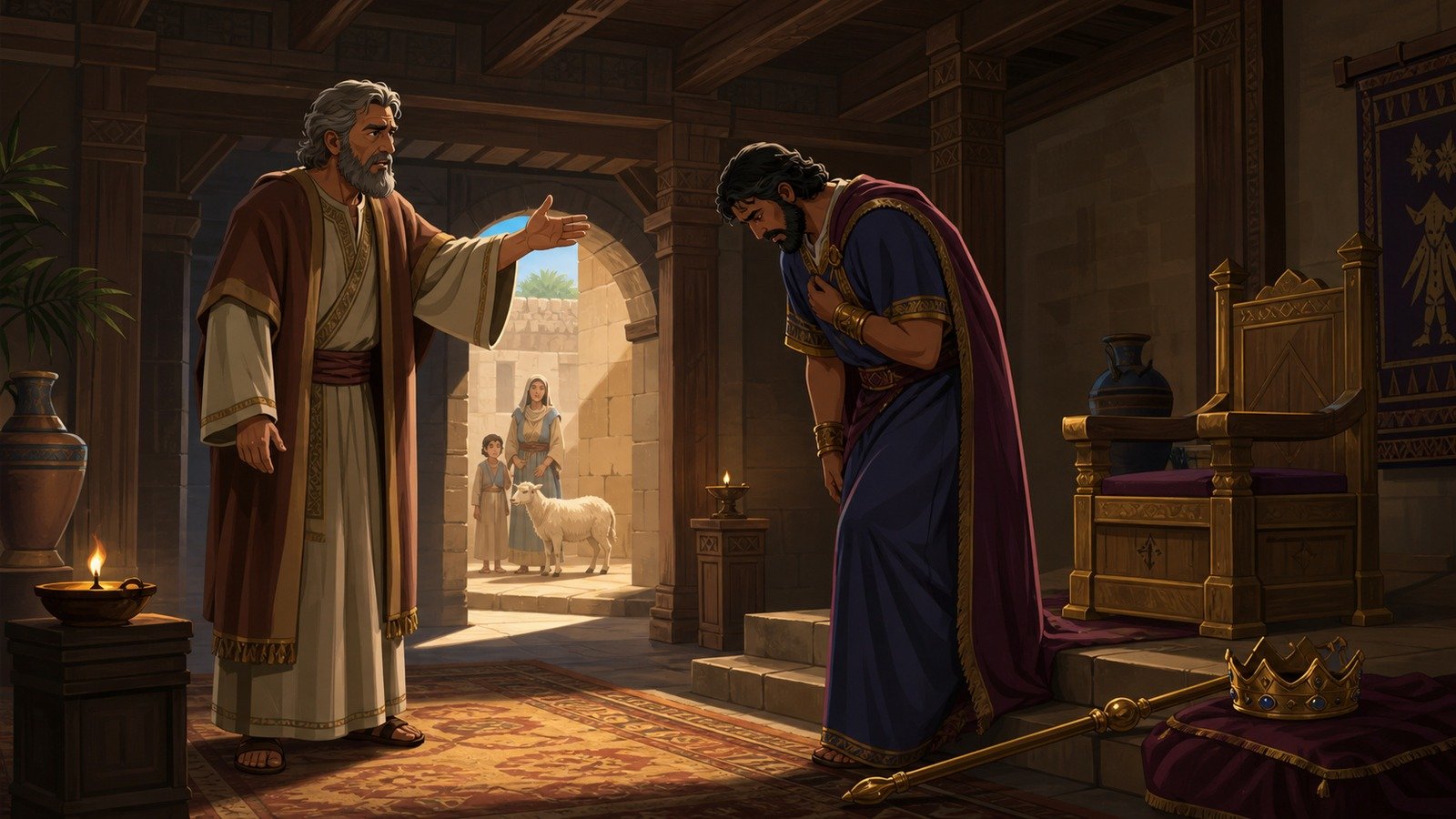
The prophet Nathan confronts David with a parable that exposes his own guilt; David confesses immediately, and though forgiven, is told the sword will never leave his household. The child conceived with Bathsheba dies; Solomon is born to the couple afterward.
Further context
2 min readNathan comes to David with a legal case rather than an accusation, which is the only way to get a verdict out of a man who has stopped applying his own standards to himself.
Two men in a town, one rich with very many sheep and cattle, one poor with nothing except one little ewe lamb he had bought. It grew up with him and his children, shared his food, drank from his cup and slept in his arms, and was like a daughter to him. A traveller comes to the rich man, and rather than take from his own flocks he takes the poor man's lamb and prepares it for his guest.
David burns with anger and delivers a judgement: the man who did this deserves to die. He must pay for that lamb four times over, because he did such a thing and had no pity.
Then four words: you are the man.
What follows is an itemised charge. I anointed you king over Israel. I delivered you from Saul. I gave you your master's house and your master's wives into your arms. I gave you all Israel and Judah. And if all this had been too little, I would have given you even more. Why did you despise the word of the LORD by doing what is evil in his eyes? You struck down Uriah the Hittite with the sword and took his wife to be your own. You killed him with the sword of the Ammonites.
The sentence has two halves. The sword will never depart from your house. And calamity will come out of your own household, and what was done in secret will be done to you in broad daylight before all Israel. Both of those are fulfilled in detail over the following years: a rape, two murders, a rebellion by his own son, and his concubines taken publicly on the palace roof by that son.
His confession is three words in Hebrew: I have sinned against the LORD.
The reply is immediate and does not remove the consequences. The LORD has taken away your sin. You are not going to die. But because by doing this you have shown utter contempt for the LORD, the son born to you will die.
The child falls ill and David fasts and lies on the ground all night for seven days, refusing food and refusing to be raised up. When the child dies his attendants are afraid to tell him, and he works it out from their whispering. Then he gets up, washes, puts on lotions, changes his clothes, goes into the house of the LORD and worships, and then asks for food.
His explanation is the flattest thing he ever says. While the child was alive I fasted and wept, for I thought, who knows? The LORD may be gracious to me and let the child live. But now that he is dead, why should I go on fasting? Can I bring him back again? I will go to him, but he will not return to me.
He then comforts Bathsheba, and their next son is Solomon.