

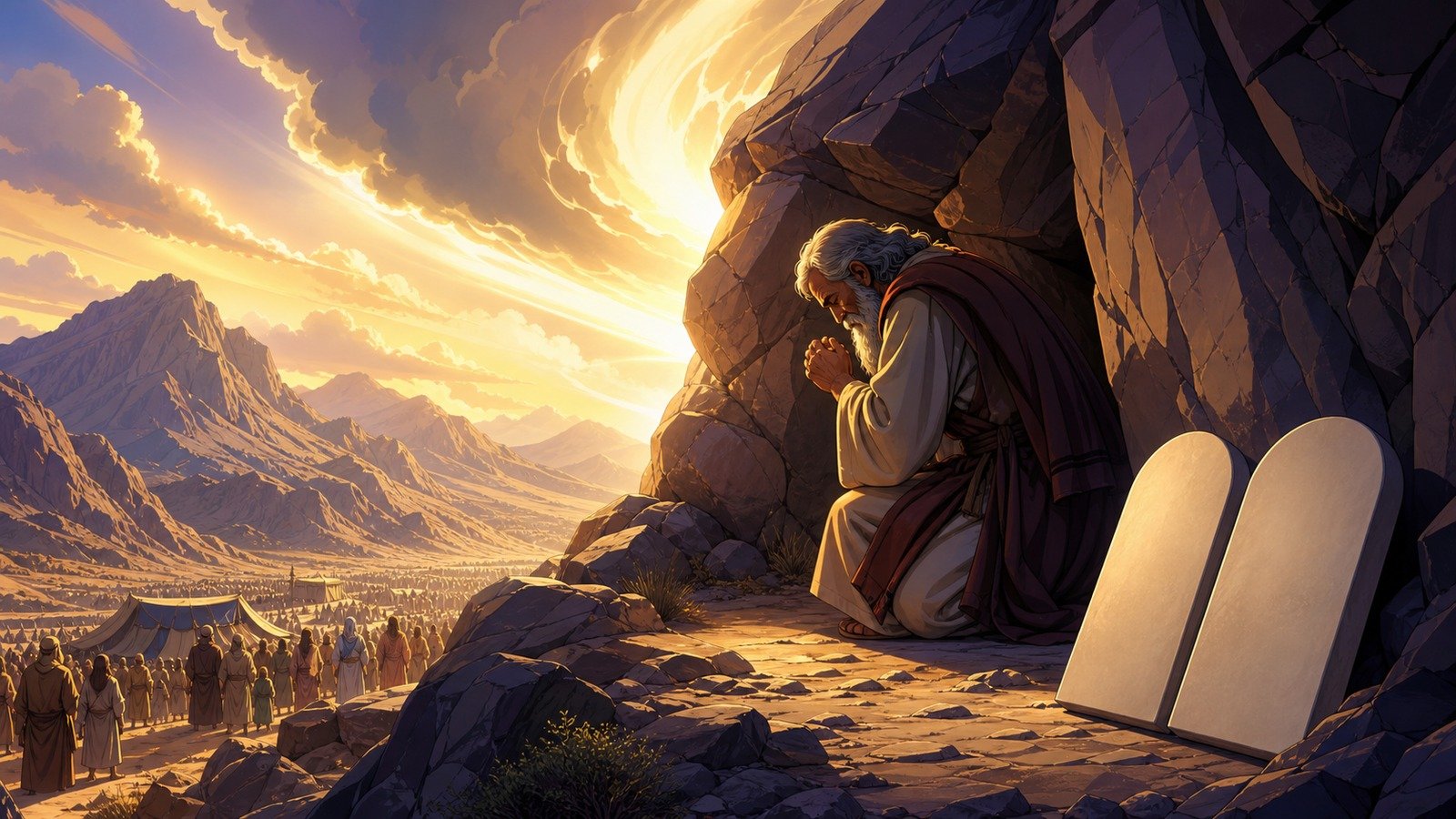
Moses pleads for the people and asks to see God's glory; God passes before him proclaiming his own character, "compassionate and gracious," and the covenant is renewed with fresh stone tablets.
Further context
2 min readThe offer that comes next sounds generous and is the worst news anyone in the camp has heard. Go up to the land flowing with milk and honey. I will send an angel before you and drive out the inhabitants. But I will not go with you, because you are a stiff-necked people and I might destroy you on the way. The land is granted and the presence is withdrawn, and when the people hear it they begin to mourn and take off their ornaments.
Moses pitches a tent outside the camp, where anyone enquiring of the LORD would go, and where the pillar of cloud comes down at the entrance. One line there has no parallel anywhere: the LORD would speak to Moses face to face, as one speaks to a friend. Joshua, described as a young aide, does not leave the tent.
Moses uses that access to argue, and the argument is the heart of the whole crisis. If your Presence does not go with us, do not send us up from here. How will anyone know that you are pleased with me and with your people unless you go with us? What else will distinguish me and your people from all the other people on the face of the earth? He is contending that a nation with a land and no God is indistinguishable from any other nation, and that the promise is worthless on those terms.
The request is granted, and he immediately asks for more: now show me your glory. The answer sets a limit and grants what can be granted. I will cause all my goodness to pass in front of you, and I will proclaim my name in your presence. But you cannot see my face, for no one may see me and live. He is put in a cleft in the rock and covered with a hand until it has passed.
New tablets follow, and this time he cuts them himself. Then comes the proclamation, and it is the single most quoted description of God in the Hebrew scriptures: the LORD, the LORD, the compassionate and gracious God, slow to anger, abounding in love and faithfulness, maintaining love to thousands, and forgiving wickedness, rebellion and sin, yet he does not leave the guilty unpunished. Later writers cite it repeatedly, and Jonah quotes it as a complaint when God spares a city he wanted destroyed.
The covenant is renewed on stated terms, with a warning against treaties with the peoples of the land and a repetition of the festival calendar. He spends forty days there without eating bread or drinking water.
When he comes down his face is radiant and he does not know it. The Hebrew verb means to send out rays, and it shares its consonants with the noun for a horn, which is how the Latin translation rendered it. That is why medieval and Renaissance art, including Michelangelo's statue, gives Moses horns. He puts a veil over his face when speaking to the people and takes it off when he goes in to speak with God, and Paul builds an extended argument on that veil.