

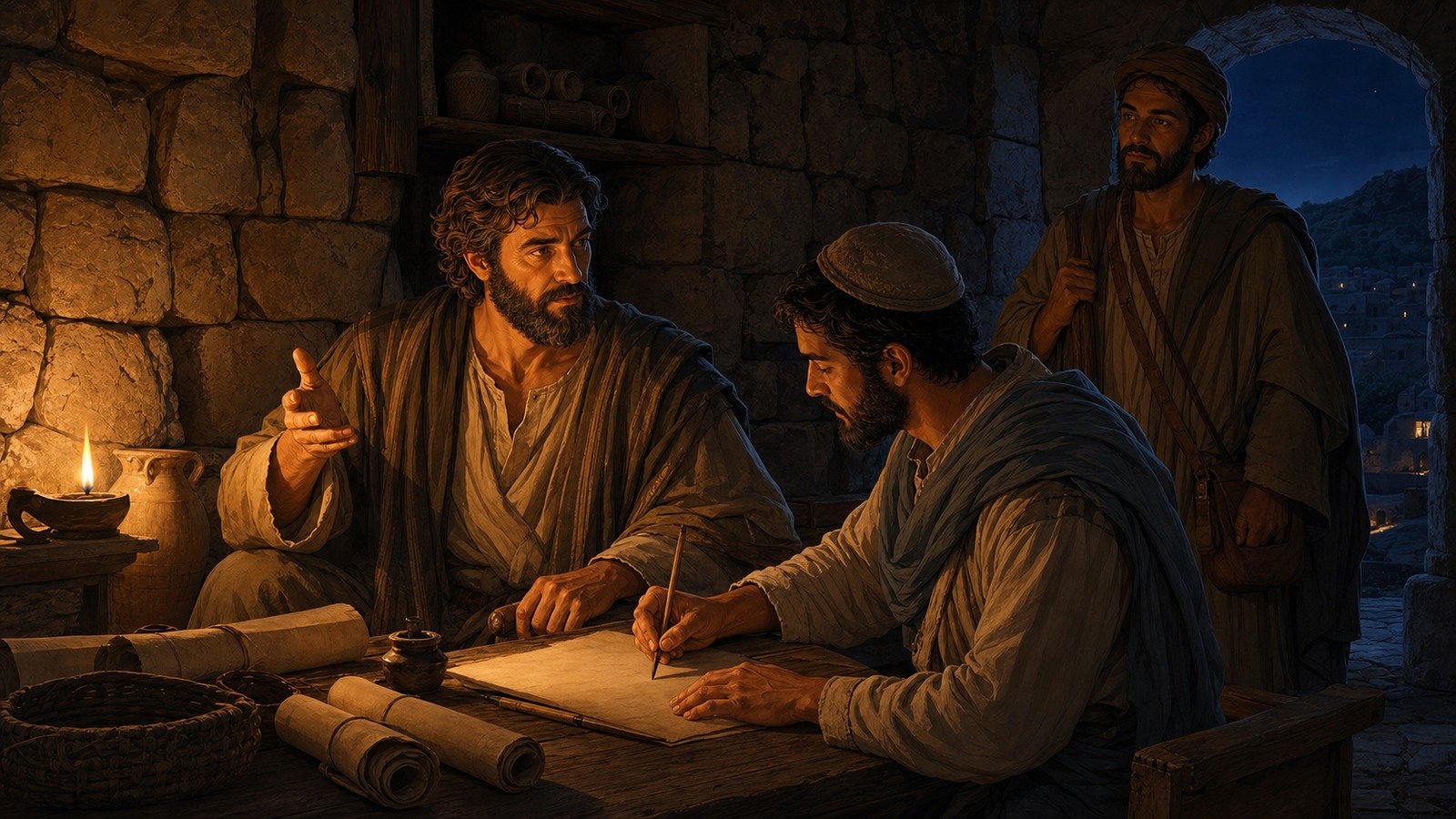
A short, urgent letter from a writer identifying himself as "a brother of James," traditionally understood as another brother of Jesus, warning against false teachers using vivid imagery from both Scripture and Jewish tradition outside it.
Further context
2 min readThe writer introduces himself as Jude, a servant of Jesus Christ and a brother of James.
Identifying himself by his brother rather than his father is unusual, and it only makes sense if the brother needed no further introduction. The James who needed none is the leader of the Jerusalem church, which makes this writer another brother of Jesus, and both names appear in the list of four brothers given in the Gospels.
He does not say so. What he calls himself is a servant, and the reticence is noticeable in a document that spends most of its length denouncing people.
He says he had intended to write about the salvation they shared, and changed his mind because something urgent had come up: certain individuals whose condemnation was written about long ago have secretly slipped in among you.
What they were teaching is described in one phrase: they pervert the grace of our God into a licence for immorality. Beyond that, they reject authority, heap abuse on celestial beings, and are described as shepherds who feed only themselves.
The letter is short and its imagery is dense. They are clouds without rain, autumn trees without fruit and uprooted, wild waves of the sea foaming up their shame, wandering stars for whom blackest darkness has been reserved.
Two features have made it awkward for the church.
It draws on Jewish writings outside the Hebrew Bible. It quotes a prophecy of Enoch directly, which comes from a book written in the last few centuries BC and preserved in full only in Ethiopic, and it refers to a dispute between the archangel Michael and the devil over the body of Moses, which comes from another work of the same period.
Whether quoting a book makes it Scripture is the question, and the usual answer is that it does not, on the grounds that Paul quotes Greek poets without endorsing them.
Its relationship to the second letter of Peter is the other issue. Most scholars think Peter's letter used Jude rather than the reverse, since it is easier to explain a longer document expanding a shorter one and dropping the awkward quotations.
It ends with one of the most used benedictions in Christian worship: to him who is able to keep you from stumbling.
Nothing else is known about the writer. The brothers of Jesus are named in the Gospels as James, Joseph, Simon and Judas, and none of them appears to have believed during his lifetime.
A fourth-century historian preserves a story that grandsons of Jude were brought before Domitian as descendants of David, and were released when the emperor saw their farmer's hands and heard that their kingdom was not of this world.
The letter's imagery of wandering stars and clouds without rain is drawn from the natural world in a way that suggests a writer used to the countryside rather than the city.
Its position in the New Testament, second to last and immediately before the book of visions, has meant it is rarely read on its own, and its twenty-five verses contain more direct denunciation per line than anything else in the collection.