

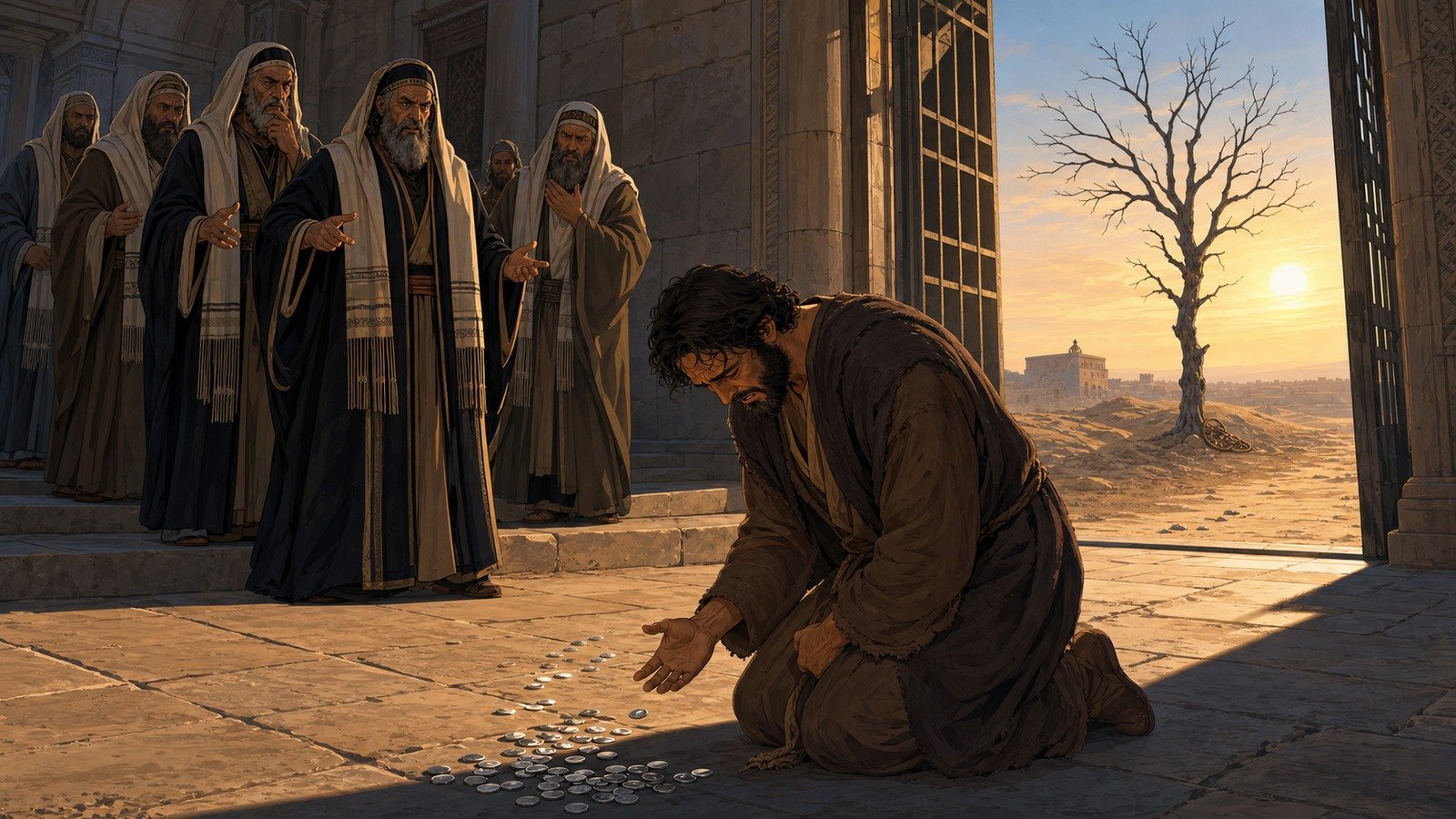
Overcome with remorse after seeing Jesus condemned, Judas returns the thirty pieces of silver to the chief priests and hangs himself; the priests use the money to buy a field, fulfilling, Matthew notes, an Old Testament prophecy.
Further context
2 min readWhen Judas sees that Jesus has been condemned, he is seized with remorse and takes the thirty silver coins back to the chief priests and the elders.
I have sinned, he says, for I have betrayed innocent blood.
The reply is one of the coldest sentences in the New Testament. What is that to us? That is your responsibility.
He throws the money into the temple and leaves, and then goes away and hangs himself.
The priests pick up the coins and encounter a scruple: it is against the law to put this into the treasury, since it is blood money. So they use it to buy a field belonging to a potter, as a burial place for foreigners, and it becomes known as the Field of Blood.
That scruple deserves attention. Men who had just paid for an informer and secured a death sentence in an overnight hearing stop to consider whether the returned fee can properly be banked, and conclude that it cannot. The care and the callousness are in the same paragraph and belong to the same people.
There is a second account of his death, given in a speech by Peter some weeks later, and it does not match. In that version Judas himself buys the field with the money, and falls headlong there, so that his body bursts open.
The discrepancy is real and has been noticed for as long as both have been read side by side. The commonest harmonisation is that the priests bought the field in his name, since it was legally his money, and that a body left hanging until the rope or branch gave way would fall and burst. Whether that satisfies anyone is a matter of judgement, and pretending the two accounts agree in their details does nobody any service.
What both agree on is the field, the money and the death.
He is the only one of the Twelve whose end is recorded in the New Testament at all. What was done about his place is recorded too: the eleven cast lots and appointed a replacement, on the grounds that the number twelve had to be restored before anything else happened, since it stood for the twelve tribes.
Dante put him in the lowest circle of hell. Others through the centuries have argued that a man who returned the money and confessed to condemning innocent blood is not a straightforward case. Nothing in the record settles it.
The field is still shown, on the southern slope of the Hinnom valley where it meets the Kidron, and it was used as a burial ground for pilgrims and strangers for centuries afterwards. The soil there was potter's clay, which fits the description.
Aramaic gives the name as Akeldama, and Luke stops to explain the word for readers who did not speak the language, which is one small sign of how quickly the events were being retold to people outside Judea.
The thirty coins are the only sum of money in the New Testament whose fate is followed from payment to purchase.