

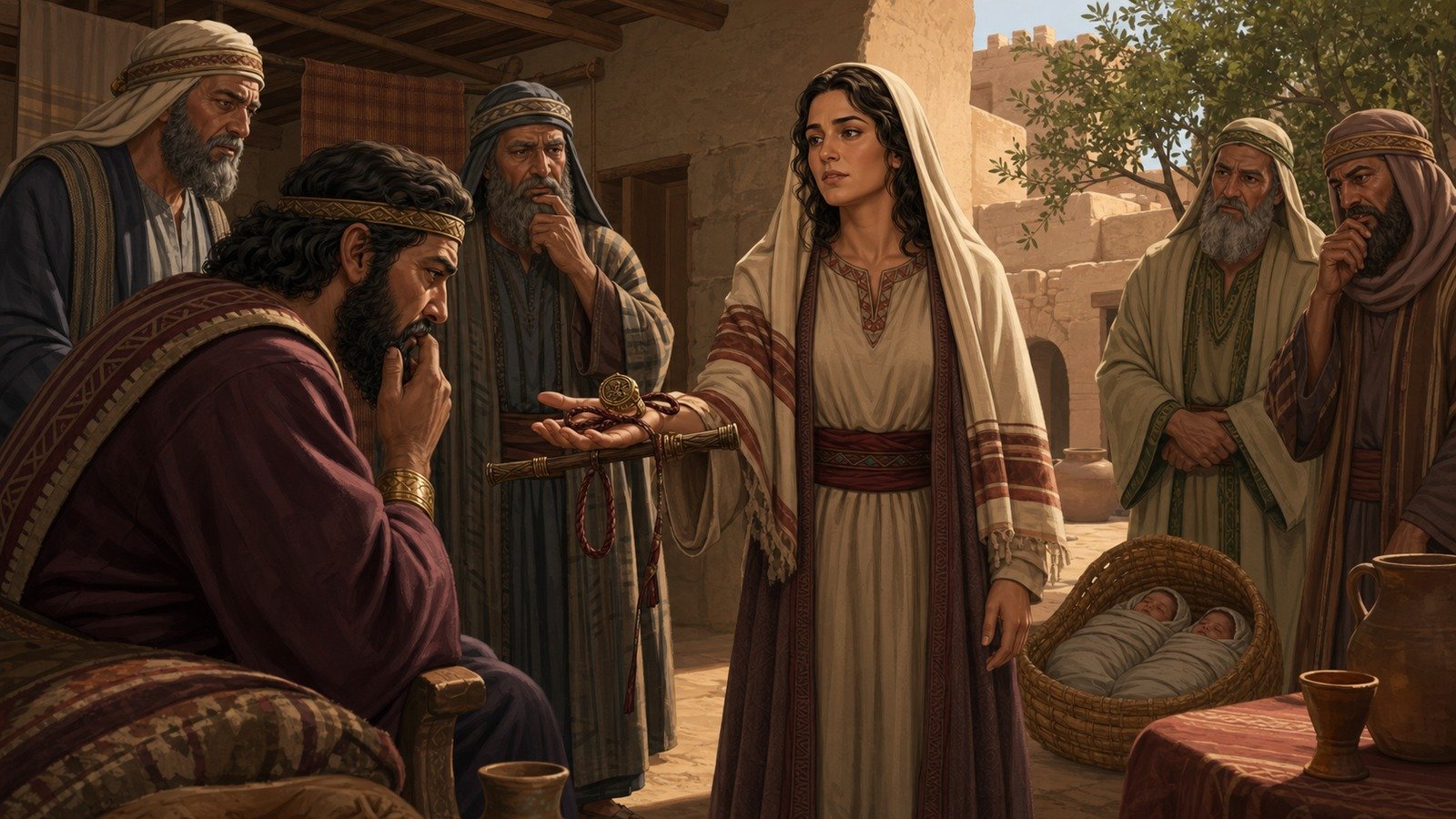
Judah's widowed daughter-in-law Tamar, denied her rightful levirate marriage, disguises herself and conceives twins by Judah himself. The episode, set apart from the main Joseph narrative, places Perez, an ancestor of David and of Jesus, in the family line.
Further context
2 min readJoseph has just been sold into Egypt, and the story stops dead and follows his brother Judah for a generation instead. The interruption is deliberate and the reasons emerge at the end of it.
Judah leaves his brothers, settles among Canaanites and marries the daughter of a man named Shua. Three sons follow: Er, Onan and Shelah. He finds a wife for Er named Tamar, and Er dies young. What he had done is unknown; he is described as wicked in the LORD's sight and nothing more.
Onan is then required to perform a duty that Israelite law would later codify: a man whose brother dies childless must father a son by the widow, and that child counts as the dead brother's heir and inherits his property. Onan sleeps with Tamar but spills his semen on the ground, and his motive is stated outright, that the child would not be his. He would have controlled his brother's estate if no heir existed, so he takes the widow and withholds the heir. That is the offence, and it is named. Readings that treat the episode as being about the physical act in isolation have to ignore the reason supplied.
Onan dies too. Judah, having lost two sons after each married Tamar, sends her back to her father's house as a widow with a promise that Shelah will be given to her when he grows up. He was afraid of losing a third son. Shelah grows up and nothing happens.
Tamar's response is calculated. Hearing that her father-in-law is going up to Timnah for the sheep-shearing, she takes off her widow's clothes, covers herself with a veil and sits at the entrance to Enaim. Judah takes her for a prostitute, agrees a price of a young goat, and hands over his seal, its cord and his staff as a pledge until the goat arrives. Those three items were how a man was identified, roughly the equivalent of leaving his papers behind.
Three months later he is told his daughter-in-law is pregnant through prostitution. His judgement is immediate: bring her out and have her burned to death. She sends him the pledge with a message asking him to look at whose they are.
His answer is what the whole episode exists for: she is more righteous than I, since I would not give her to my son Shelah.
Twins are born, and the delivery is described in detail because it settles a question of precedence. One puts out a hand and the midwife ties a scarlet thread on it, then he draws it back and the other breaks out first and is named Perez, meaning a breach.
Two details tie this back to what surrounds it. Judah is deceived by a goat and a garment, as his father was and as he himself had deceived his father. And the words Tamar sends, asking him to examine the pledge and identify it, are the same Hebrew phrase the brothers used when they sent a bloodstained coat to Jacob.
Perez is an ancestor of David, and Tamar is one of only four women named in Matthew's genealogy of Jesus.