

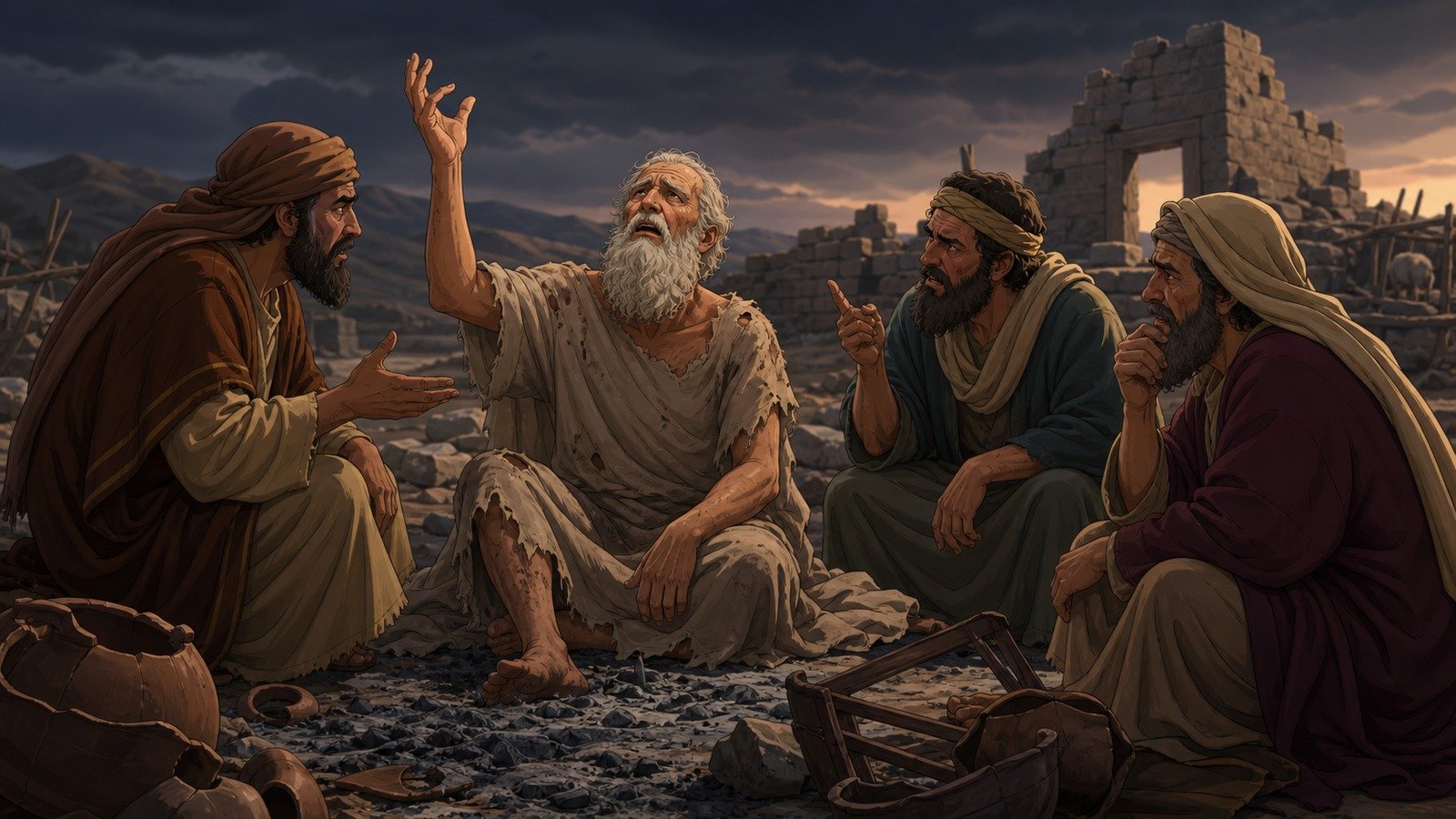
Job, a wealthy and righteous man from the land of Uz, loses his family, health and possessions in a series of disasters permitted by God after a challenge from "the Accuser." Job's own lament and lengthy debate with three friends over why he is suffering occupy most of the book.
Further context
2 min readJob lives in a place called Uz, rich in livestock and not an Israelite. He is called the greatest man among all the people of the East, and his wealth is counted out in animals: seven thousand sheep, three thousand camels, five hundred yoke of oxen and five hundred donkeys. He offers sacrifices himself, as head of his household, early in the morning after his children have been feasting, in case any of them has done something wrong.
Those details are why this story sits here on the timeline rather than anywhere else. There is no priesthood, no tabernacle or temple, no mention of Moses, the Law, the covenant or the nation of Israel, and wealth is measured in herds rather than in silver or land. The social world resembles that of the patriarchs. That is an inference from the setting and nothing stronger, because there is no king, no datable event and no genealogy anywhere in the book, and proposals for when it was written run from the second millennium BC to the period after the exile, partly on the strength of its unusual vocabulary and its Aramaic forms.
Then comes a scene Job himself never learns about. The heavenly beings present themselves before God, and among them comes the accuser (ha-satan). The Hebrew has the definite article, which makes it a title rather than a name at this stage: the adversary, the one whose function is to bring a charge. The charge is a question. Does Job fear God for nothing? Everything after it tests whether devotion that has been rewarded can survive the withdrawal of the reward.
The losses arrive in two waves, reported by four messengers arriving one on top of another. Raiders take the oxen and donkeys. Fire destroys the sheep. Chaldean raiding parties take the camels. A wind collapses the house where his children are eating. His response is to tear his robe, shave his head and worship. In the second round his body is covered with painful sores from the soles of his feet to the crown of his head, and he sits among the ashes scraping himself with a piece of broken pottery. His wife tells him to curse God and die.
Three friends arrive: Eliphaz the Temanite, Bildad the Shuhite and Zophar the Naamathite. They sit with him on the ground for seven days and seven nights without speaking, because they can see how great his suffering is. That silence is the last thing they do well.
He breaks it himself. He curses the day of his birth, wishes it struck from the calendar, and asks why light is given to those in misery. He does not curse God, and that distinction holds all the way through.
The speeches that follow run in three cycles and turn on a single proposition: that suffering is punishment and prosperity is reward. The friends apply it rigorously and conclude that he must have sinned. Job accepts the same framework, finds that his own case refutes it, and is driven to demand a hearing.
A New Testament letter commends his perseverance, and the Greek word means endurance under pressure rather than calmness. Anyone opening the dialogues expecting patient acceptance will find something closer to a man refusing to stop demanding an answer.