

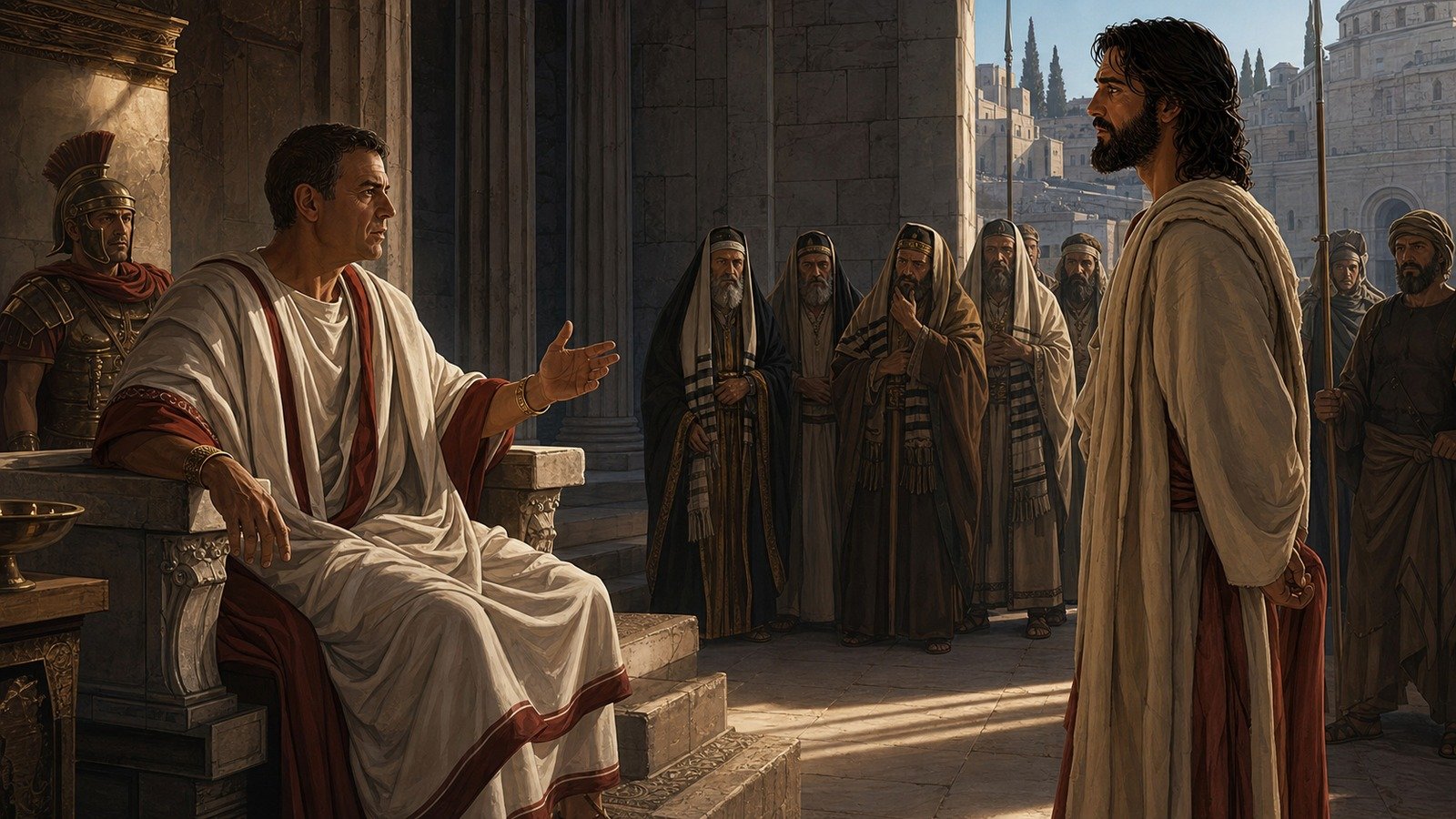
The Sanhedrin hands Jesus to the Roman governor Pontius Pilate, who questions him directly about kingship and finds no legal basis for a charge, despite Jesus' largely silent response to the accusations against him.
Further context
2 min readThe council could condemn on a religious charge and could not carry out an execution, so at daybreak Jesus is taken to the Roman governor.
Pontius Pilate held Judea from AD 26 to 36 as prefect, and he is one of the better attested minor officials of the period. A limestone block found at Caesarea in 1961 carries his name and title in a dedication to Tiberius, and coins struck under him survive. Two writers of the period, Philo and Josephus, describe him unflatteringly: he brought military standards bearing the emperor's image into Jerusalem and had to withdraw them after a five-day sit-down protest, he took money from the temple treasury to build an aqueduct and had the protesters beaten, and he was eventually removed from office after killing a crowd of Samaritans.
That is the man who is described as reluctant, and it is worth holding both facts together.
The charge presented is not blasphemy, which would have meant nothing to him. It is reframed: this man opposes payment of taxes to Caesar and claims to be Messiah, a king. Sedition was the one accusation that required a Roman response.
Are you the king of the Jews? he asks, and the answer is a question back: is that your own idea, or did others talk to you about me?
The exchange that follows turns on what kind of kingdom is meant. My kingdom is not of this world. If it were, my servants would fight to prevent my arrest. You say that I am a king. In fact, the reason I was born and came into the world is to testify to the truth.
What is truth? Pilate says, and does not wait for an answer.
He goes out and announces his finding: I find no basis for a charge against him. He says it three times over the course of the morning.
On the other accusations Jesus gives no answer at all, to the governor's evident amazement. A defendant in a Roman hearing was expected to plead, and silence in the face of a capital charge was not a recognised strategy.
Pilate's difficulty is political rather than legal. He had already been in trouble with Rome for mishandling this province, and a delegation complaining that he had released a man claiming kingship would have been fatal to him. The sentence that finally moves him is recorded plainly: if you let this man go, you are no friend of Caesar.
The residence Pilate used in Jerusalem was either Herod's palace on the western hill or the Antonia fortress beside the temple; the traditional route through the Old City assumes the second, and most historians now prefer the first.
His question about truth has been read as cynicism, as weariness and as the remark of a practical administrator who had heard a great deal of provincial philosophy. He does not stay for the answer, and the trial resumes outside.
The Caesarea inscription is a limestone block reused in a theatre, carrying a dedication of a building to Tiberius by Pontius Pilatus, prefect of Judea. Before it was found in 1961 his exact title had been a matter of inference.