

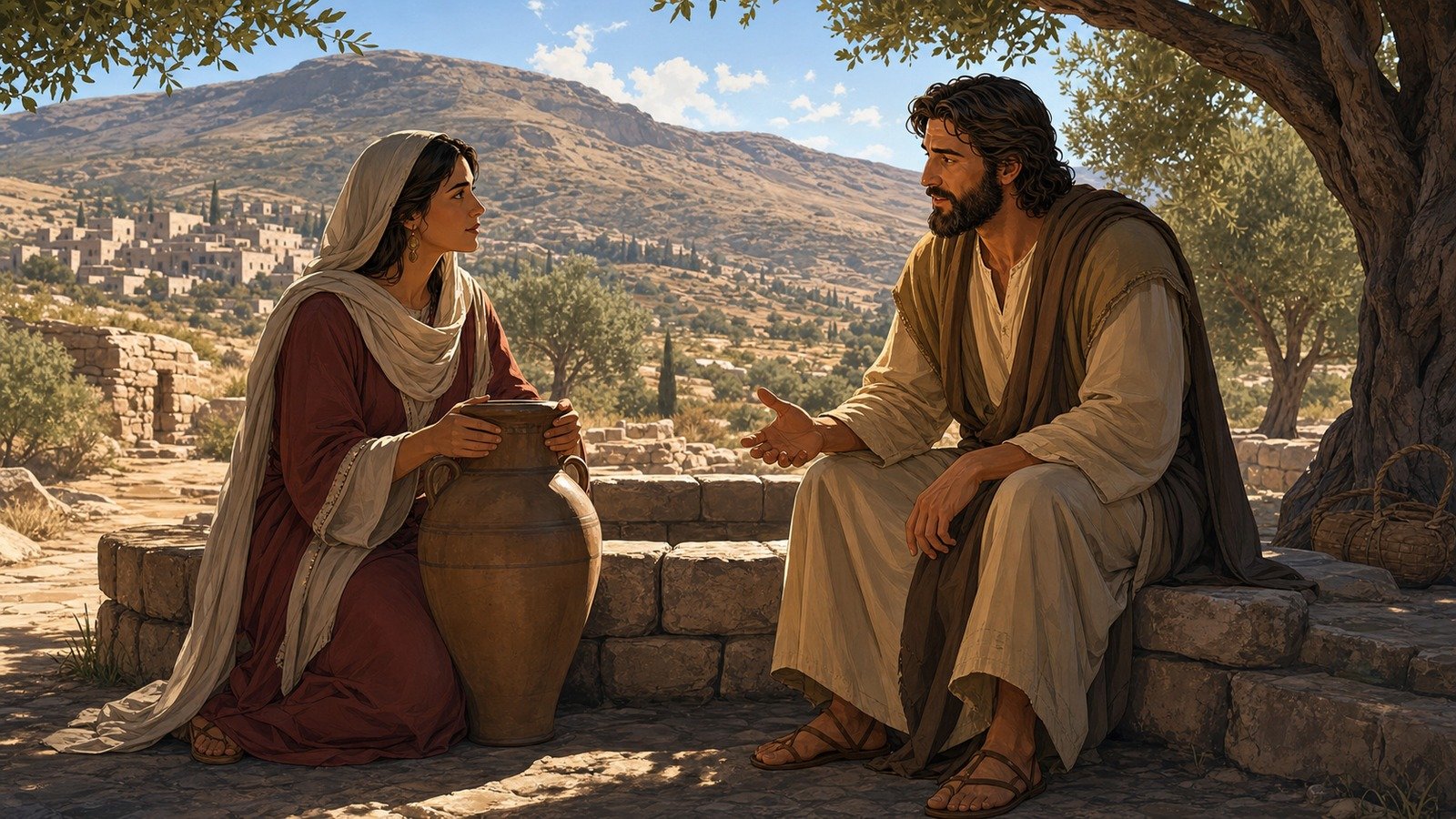
Travelling through Samaria, Jesus speaks with a Samaritan woman at Jacob's well, crossing both gender and ethnic boundaries of the day, offering her "living water" and revealing knowledge of her past; many Samaritans in the town believe as a result.
Further context
3 min readThree barriers are crossed in one conversation, and Jesus' own disciples are astonished when they get back.
Samaritans were descended from the mixed population left in the north after the Assyrian deportations, worshipped on Mount Gerizim rather than in Jerusalem, accepted only the five books of Moses, and had had their own temple destroyed by a Jewish king a century and a half earlier. The hostility was mutual and long-running, and Judean travellers frequently went round Samaria rather than through it.
He goes through it, sits down at Jacob's well near Sychar at about noon, tired from the journey, and asks a woman for a drink.
Her reaction is the first indication of how unusual this is: you are a Jew and I am a Samaritan woman. How can you ask me for a drink? A note is attached explaining that Jews do not associate with Samaritans, and a rabbi speaking with any woman alone in public was itself irregular.
The time of day is also doing something. Women drew water in the morning and evening, in company. Somebody at the well at noon is avoiding the other women.
The conversation moves from water in a bucket to living water, and she takes it literally at first, in the same way Nicodemus had. Then he tells her to go and call her husband, and she says she has none, and the reply is exact: you have had five husbands, and the man you now have is not your husband. Whether that is a history of widowhood, of being divorced repeatedly by men who could dismiss a wife at will, or of her own choices, is unknown, and readings that assume immorality are supplying something the conversation does not.
She changes the subject to the theological dispute, which mountain is the right place to worship, and gets an answer that abolishes the question: a time is coming when you will worship the Father neither on this mountain nor in Jerusalem. God is spirit, and his worshippers must worship in the Spirit and in truth.
Then the most direct self-identification anywhere in the Gospels, made to a Samaritan woman with an irregular domestic history, in the middle of the day, at a well. She says she knows Messiah is coming, and he says, I, the one speaking to you, am he.
Jacob's well is one of the few sites in the Gospels whose location has never been seriously disputed. It sits at the foot of Mount Gerizim near Nablus, is over thirty metres deep, and has been continuously identified since at least the fourth century, which is why her remark that the well is deep and he has nothing to draw with is a practical objection rather than a figure of speech.
She leaves her water jar, goes back to the town and tells everyone, and many believe because of her testimony.
Three barriers are crossed and the disciples' reaction confirms it: they were surprised to find him talking with a woman.
Jews did not use Samaritan vessels, a Jewish teacher did not converse alone with a woman in public, and this particular woman is at the well at noon rather than in the cool of the morning when the other women came, which suggests she was avoiding them.
The conversation moves through several evasions. She points out the practical problem, that he has nothing to draw with. She raises the ancestry question about Jacob's well. When he tells her to call her husband and she says she has none, and is told she has had five and is living with a man who is not her husband, she changes the subject to the oldest theological dispute between the two peoples: our ancestors worshipped on this mountain, but you Jews claim that the place where we must worship is in Jerusalem.
The answer moves the question off both mountains.