

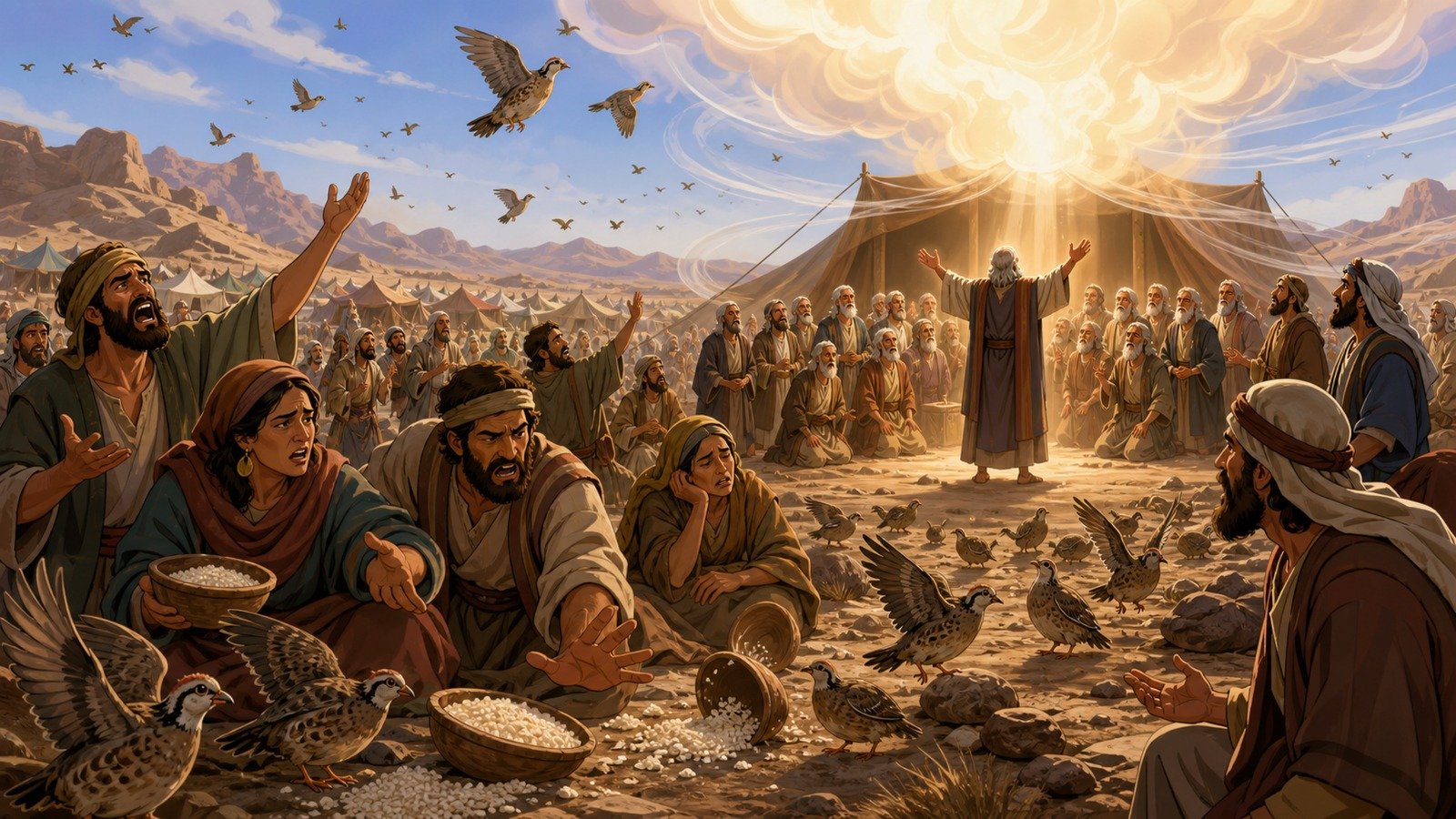
The people complain about the manna, longing for Egypt's food; God provides quail in overwhelming quantity along with a plague, and also empowers seventy elders to share the burden of leadership with Moses.
Further context
2 min readThree days into the march there is a general complaint about hardship, and fire from the LORD burns among the outskirts of the camp until Moses prays. The place is named Burning. It is the shortest episode in this stretch and it sets the pattern for the rest.
The main complaint starts with the mixed group travelling among them and spreads. What they say is worth quoting for the detail: we remember the fish we ate in Egypt at no cost, also the cucumbers, melons, leeks, onions and garlic. Every item on that list is a documented staple of the Egyptian diet, and fish from the Nile and its canals was the cheap protein of the labouring population. The part that has slipped is the claim that it cost them nothing. They were slaves.
Their conclusion is a complaint about monotony: we have lost our appetite, we never see anything but this manna. The stuff is then described again in ordinary domestic terms, as something people ground in a hand mill or crushed in a mortar, cooked in a pot and made into loaves that tasted of something baked with olive oil. It is being prepared like food and complained about like rations.
Moses' response is the most despairing thing he says anywhere. Why have you brought this trouble on your servant? Did I conceive all these people? Did I give them birth? Why do you tell me to carry them in my arms, as a nurse carries an infant, to the land you promised on oath to their ancestors? I cannot carry all these people by myself; the burden is too heavy for me. If this is how you are going to treat me, please go ahead and kill me.
Two answers follow. Seventy elders are gathered at the tent, some of the spirit that is on Moses is put on them, and they prophesy. Two men, Eldad and Medad, were not at the tent and prophesy in the camp instead. Joshua asks Moses to stop them, and the refusal runs against every instinct of an office holder: are you jealous for my sake? I wish that all the LORD's people were prophets and that the LORD would put his Spirit on them.
The second answer is the meat, and it arrives as a judgement rather than a provision. A wind drives quail in from the sea, lying around the camp to a depth of about a cubit and for a day's walk in every direction. Quail cross the Sinai in spring in very large numbers and arrive exhausted, so the mechanism is unremarkable and the quantity is not. The people spend a day and a night and the next day gathering them, and while the meat is still between their teeth a severe plague strikes. The place is named the graves of craving.