
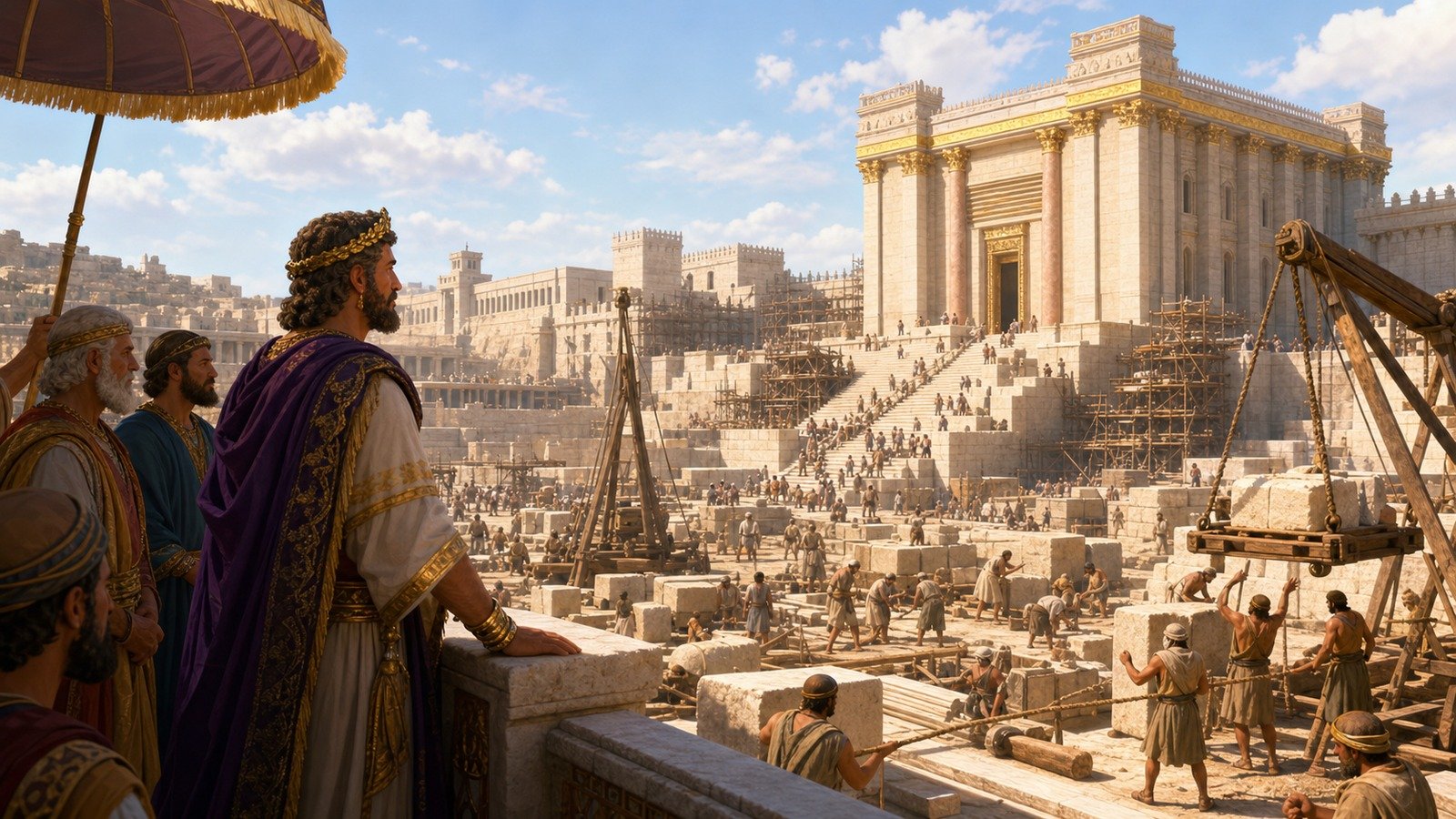
Herod undertakes an ambitious building programme across Judea, most significantly a massive expansion and rebuilding of the Second Temple, a project so extensive it continues for decades after his death and is still under construction during Jesus' adult ministry.
No canonical Scripture reference (historical context outside the Protestant canon)
Further context
3 min readNothing about the buildings is modest, and that is the point of them. A king with no legitimate claim spends four decades making himself unignorable in stone.
Caesarea Maritima is built from nothing on an open coast with no natural harbour, and the harbour is created by sinking enormous concrete blocks made with volcanic ash imported from Italy, which is one of the earliest large-scale uses of hydraulic concrete anywhere. The city gets a theatre, an amphitheatre, an aqueduct and a temple to Augustus, and it becomes the Roman administrative capital of the province. Paul is imprisoned there for two years.
Masada is fortified with two palaces, one of them built on three terraces down the northern cliff face, along with storerooms, cisterns and a bathhouse, on a rock in the desert. Herodium is an artificial cone of a hill outside Bethlehem with a palace-fortress inside it. There are palaces at Jericho and Jerusalem, a fortress at Antonia beside the temple, and rebuilding at Samaria, which he renames Sebaste in honour of Augustus.
The temple is the largest of them. Begun around 20 BC, it doubles the size of the platform to about fourteen hectares by building enormous retaining walls and filling behind them, creating the largest sacred enclosure in the ancient world. The sanctuary itself is rebuilt by priests trained as masons so that no unauthorised person entered the holy areas, and the whole complex takes decades; work is still going on when Jesus is an adult, and the remark quoted in John about the temple having taken forty-six years to build refers to it.
The masonry is distinctive: enormous ashlar blocks with a flat boss and a narrow margin chiselled round the edge, laid without mortar. The largest surviving stone in the western wall is estimated at several hundred tonnes. A disciple's remark to Jesus, look, teacher, what massive stones and what magnificent buildings, is what anyone would say standing under it.
One further project is worth naming because it survives intact. The enclosure over the burial cave at Hebron, built in the same style of massive drafted masonry, still stands to a considerable height and is the only Herodian building anywhere that remains substantially complete. The tomb Abraham bought for four hundred shekels of silver is inside it.
What survives is the platform and its retaining walls. The building on top was destroyed by the Romans in AD 70, forty years after the crucifixion and about six years after the works were finally completed. The western retaining wall is where people still pray, and the enclosure at Hebron over the burial cave is the other structure of his that stands largely intact.
The building programme is enormous by any standard and most of it can still be visited.
Caesarea Maritima was a city built from nothing on an open coast, with an artificial harbour of hydraulic concrete poured underwater, a theatre, a hippodrome and an aqueduct. Masada was a fortress on an isolated rock with two palaces, one of them built on three terraces down a cliff face, and cisterns holding forty thousand cubic metres of water. The Herodium was an artificial mountain with a palace inside it. There were also the fortresses at Machaerus and Alexandrium, a rebuilt Samaria renamed Sebaste, and winter palaces at Jericho.
The temple was the largest of them. The platform was roughly doubled in size to about fourteen hectares, supported by retaining walls of ashlar blocks weighing up to several hundred tonnes, and the work took decades. Josephus says a thousand priests were trained as masons so that the sanctuary itself could be rebuilt without laymen entering it.