

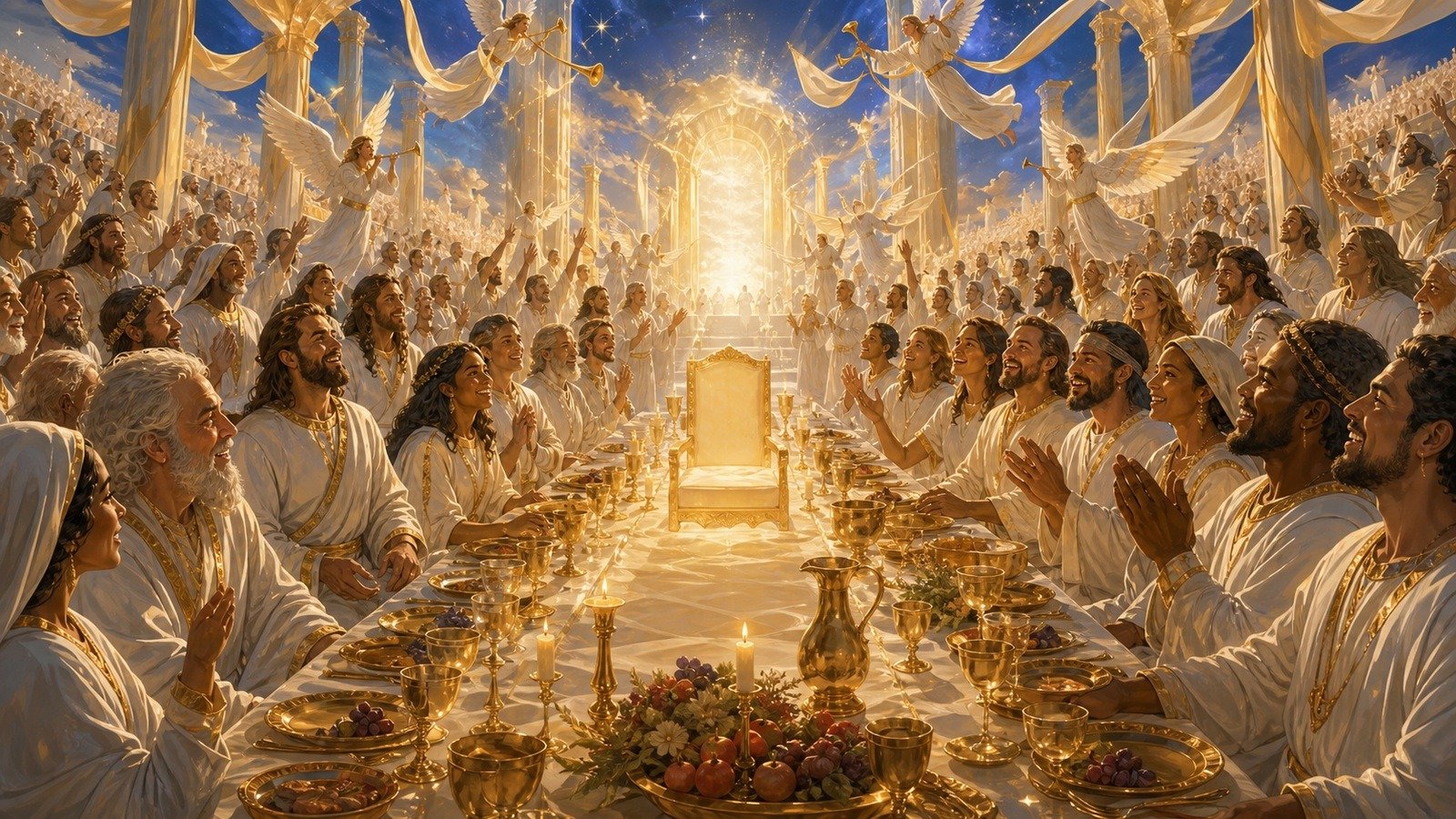
Heaven erupts in celebration at Babylon's fall, and the announcement comes that "the wedding of the Lamb has come," with the church pictured as a bride "given fine linen, bright and clean, to wear."
Further context
3 min readAfter the lament comes the reverse: a great multitude in heaven shouting Hallelujah!
That word appears four times in this passage and nowhere else in the New Testament. It is Hebrew, meaning praise the Lord, and it comes from the psalms sung at the festivals, which is why it survived untranslated into Greek, Latin and eventually English.
Salvation and glory and power belong to our God, for true and just are his judgements. He has condemned the great prostitute who corrupted the earth by her adulteries. He has avenged on her the blood of his servants.
The twenty-four elders and the four living creatures fall down and worship, and a voice from the throne says: praise our God, all you his servants, you who fear him, both great and small.
Then the sound changes, and the description of it is one of the best in the book: like the roar of a great multitude, like the rushing of many waters and like loud peals of thunder.
For our Lord God Almighty reigns. Let us rejoice and be glad and give him glory! For the wedding of the Lamb has come, and his bride has made herself ready.
Marriage as an image for the relationship between God and his people runs through the prophets, usually in the context of unfaithfulness, and the book has just spent a chapter on a woman who represents the opposite. The two women are set against each other deliberately: one covered in gold and scarlet, holding a golden cup of filth; the other given fine linen, bright and clean, to wear.
An explanation is attached to the linen: fine linen stands for the righteous acts of God's holy people. The clothing is given and it is also made of what they did.
Blessed are those who are invited to the wedding supper of the Lamb.
Then John falls at the feet of the angel to worship him, and is stopped immediately: do not do that! I am a fellow servant with you and with your brothers and sisters who hold to the testimony of Jesus. Worship God!
He does the same thing again near the end of the book and is corrected the same way, which in a document about who may be worshipped is not an accident.
The bride's linen is described twice in one sentence, as something given to her and as the righteous acts of God's people, and the two halves are not treated as a contradiction.
Weddings in that world involved a procession bringing the bride to the husband's house and a feast lasting days, paid for by the groom's family, and the guests were the whole community. The image is of a public celebration rather than a private ceremony.
John's attempt to worship the angel is one of two, and both are refused in almost identical words. In a book whose central conflict is about who receives worship, an angel refusing it is not a stray detail.
Four hallelujahs in a few lines is the densest concentration of the word anywhere, and after this passage it does not appear again in the New Testament at all.
The bride has been prepared and the linen has been given, and the guests are invited separately, which means the picture holds together a bride and a room full of people who are not her, without troubling to reconcile them.
The angel's refusal is followed by a sentence that has been debated for centuries: for it is the Spirit of prophecy who bears testimony to Jesus.