

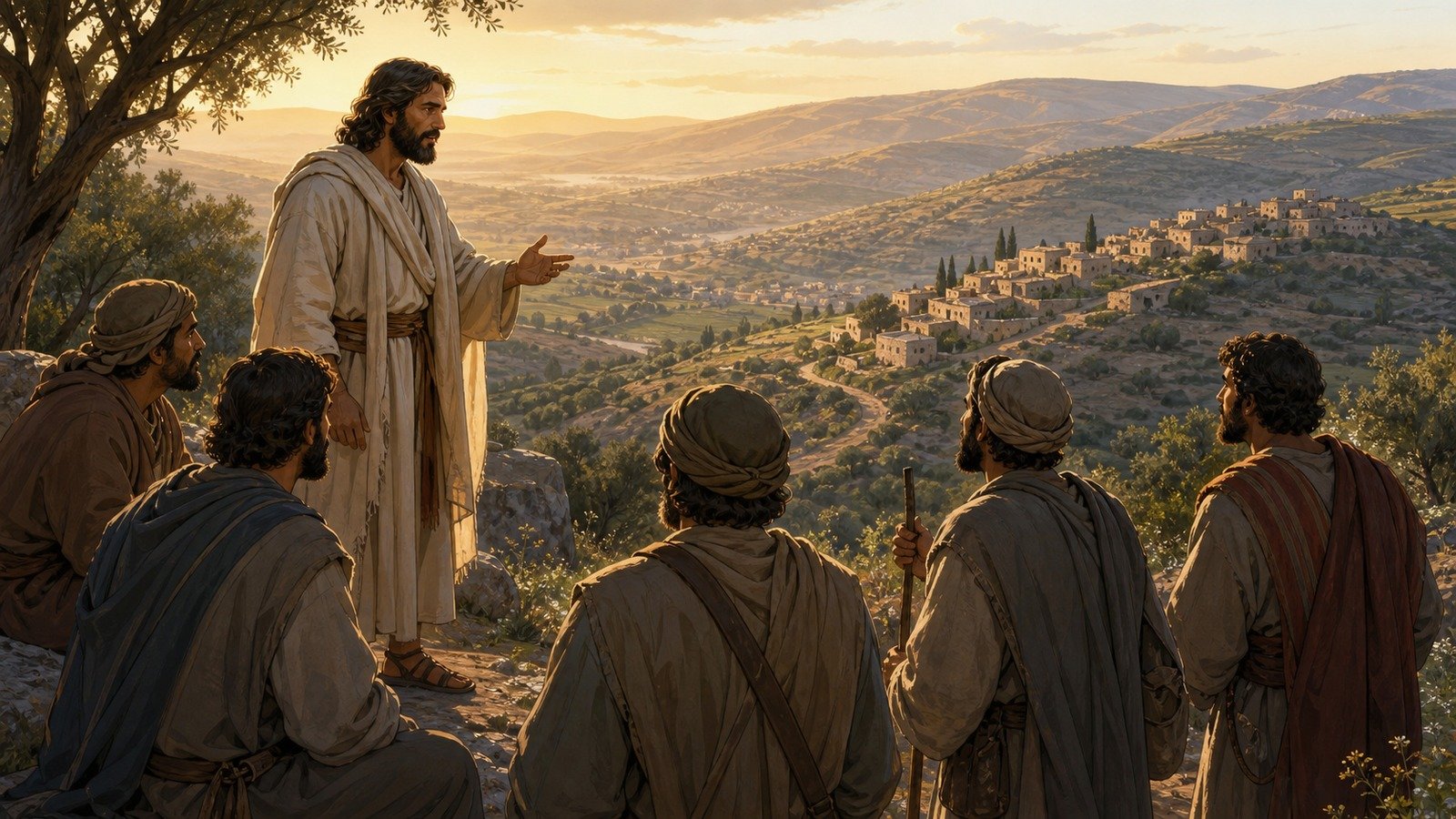
Rising early to pray alone, Jesus tells his disciples they must move on to preach in other Galilean towns as well, "that is why I have come," beginning a wider circuit of preaching, teaching and healing that draws crowds from well beyond Galilee.
Further context
3 min readJesus leaves Capernaum at the height of its enthusiasm, which is the decision the tour is built on. A whole town is at the door and the response is to go somewhere else.
The circuit covers the synagogues of Galilee, and the summary given of what he did in them has three parts that keep recurring: teaching in their synagogues, proclaiming the good news of the kingdom, and healing every disease and sickness among the people.
Galilee at this period is densely settled and prosperous by regional standards. It is fertile, well watered, and covered with villages and small towns within a few hours' walk of each other, with a population that was overwhelmingly agricultural and fished the lake on its eastern side. Two Greek-style cities, Sepphoris and Tiberias, were being built or rebuilt by Antipas during these years, and neither is ever mentioned as somewhere he went. The work is done in villages.
The synagogue is the obvious venue because of how it functioned. It was a meeting house rather than a temple, open to any competent man to read and comment, and it was the one institution present in every settlement. A travelling teacher had a platform available in every village he walked into, without permission from anybody.
The reputation spreads well beyond the district. People come from Syria, from the Decapolis, which is the cluster of Greek cities east of the lake, from Jerusalem, from Judea and from beyond the Jordan, and the list of conditions is unusually specific: those suffering severe pain, the demon-possessed, those having seizures and the paralysed.
Two things about that list are worth naming. It includes conditions that are described in the vocabulary of illness and conditions described in the vocabulary of possession, and the accounts distinguish between them consistently rather than merging them. And the crowds arriving from Gentile territory east and north mean that the audience is already mixed at this stage.
The pattern of withdrawal is established here and it holds for the rest of the ministry. He works, the crowds build, and he leaves. He goes out before dawn to pray in solitary places, crosses the lake to get away, withdraws to the hills, and repeatedly tells people not to talk about what has happened. Nothing in the recorded behaviour suggests a man building a movement in the ordinary way.
One consequence of working in villages rather than cities is that the audience was overwhelmingly agricultural, and it shows in the teaching. Seed, soil, weeds, harvest, sheep, vines, fig trees, yeast, patched cloth and wineskins are the materials of almost every illustration. Nothing in it requires an education to follow, and none of it is drawn from the two Greek cities within a day's walk.
What is being announced is summarised in one sentence at the start of it: the time has come, the kingdom of God has come near. Repent and believe the good news.
The decision to leave is the point of the episode. A whole town is at the door, the response has been overwhelming, and the answer is that we must go somewhere else, to the nearby villages, so that I can preach there also. That is why I have come.
Galilee was small and densely settled. Josephus, who commanded there during the revolt, gives a figure of two hundred and four towns and villages, and even discounting his usual exaggeration the region supported a substantial population within a compact area, roughly seventy kilometres by forty.
The pattern described is synagogue preaching combined with healing, and the two are treated as one activity rather than as a message with illustrations attached.
News about him spreads to Syria, and people bring the sick from the Decapolis, Jerusalem, Judea and beyond the Jordan, which is a description of crowds arriving from every direction and from outside Jewish territory.