

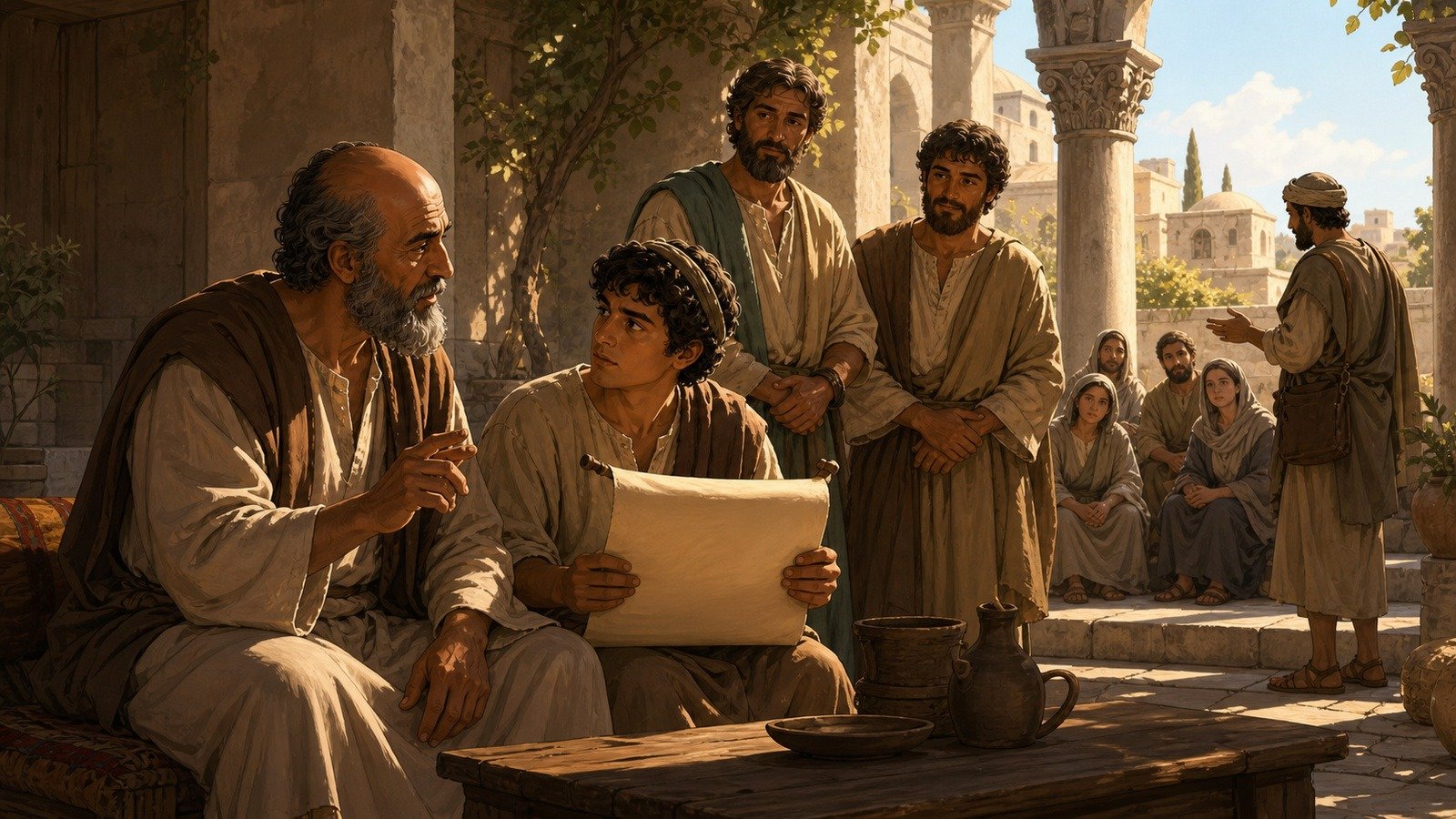
Writing from Corinth shortly after founding the Thessalonian church, Paul encourages believers facing persecution and addresses their concern about fellow Christians who have died before Christ's return, widely regarded as his earliest surviving letter.
Further context
2 min readPaul writes from Corinth to a congregation he had been with for perhaps three weeks before a riot forced him out at night.
That is the situation behind almost every line of it. He had left in a hurry, had tried twice to return and been prevented, and had eventually sent Timothy back to find out whether the church still existed. Timothy has just returned with good news, and the letter is the response to that report.
Most scholars date it to about AD 50 or 51, which makes it very probably the oldest surviving Christian document, written roughly twenty years after the crucifixion and before any of the Gospels.
Two things in it are worth knowing for that reason alone.
The first is what it takes for granted. Within twenty years of the events, a congregation of former pagans in a Greek city is described as having turned from idols to serve the living and true God, and to wait for his Son from heaven, whom he raised from the dead. Nothing is being argued; it is being assumed as the shared basis of the letter.
The second is the tone of the man writing. He compares himself to a nursing mother caring for her children and to a father encouraging his own children, reminds them that he worked night and day so as not to be a burden to anyone, and says that in his loneliness he could bear it no longer.
The specific question they had sent back concerns believers who had died. The congregation appears to have expected the Lord's return within their own lifetimes and did not know what happened to those who did not live to see it.
The answer he sends has been read at Christian funerals ever since: we do not want you to be uninformed about those who sleep in death, so that you do not grieve like the rest of mankind, who have no hope. The dead in Christ will rise first.
The phrase about being caught up together with them in the clouds to meet the Lord in the air is the origin of the word rapture, from the Latin verb used to translate it, and the elaborate systems built on it are much later than the letter.
He also tells them to make it their ambition to lead a quiet life, mind their own business and work with their hands.
The congregation had been founded in about three weeks and consisted largely of former pagans, which makes the letter's assumption of a shared vocabulary the more striking. Terms like the Lord, the gospel, the coming, and the day of the Lord are used without explanation.
Paul also mentions that they became imitators of the churches in Judea, having suffered from their own people what those churches suffered from theirs, which is the earliest reference to persecution outside Palestine.
Paul refers to the Thessalonians as having become a model to all the believers in Macedonia and Achaia, and says the message rang out from them everywhere, which for a congregation a few months old is a considerable claim.