

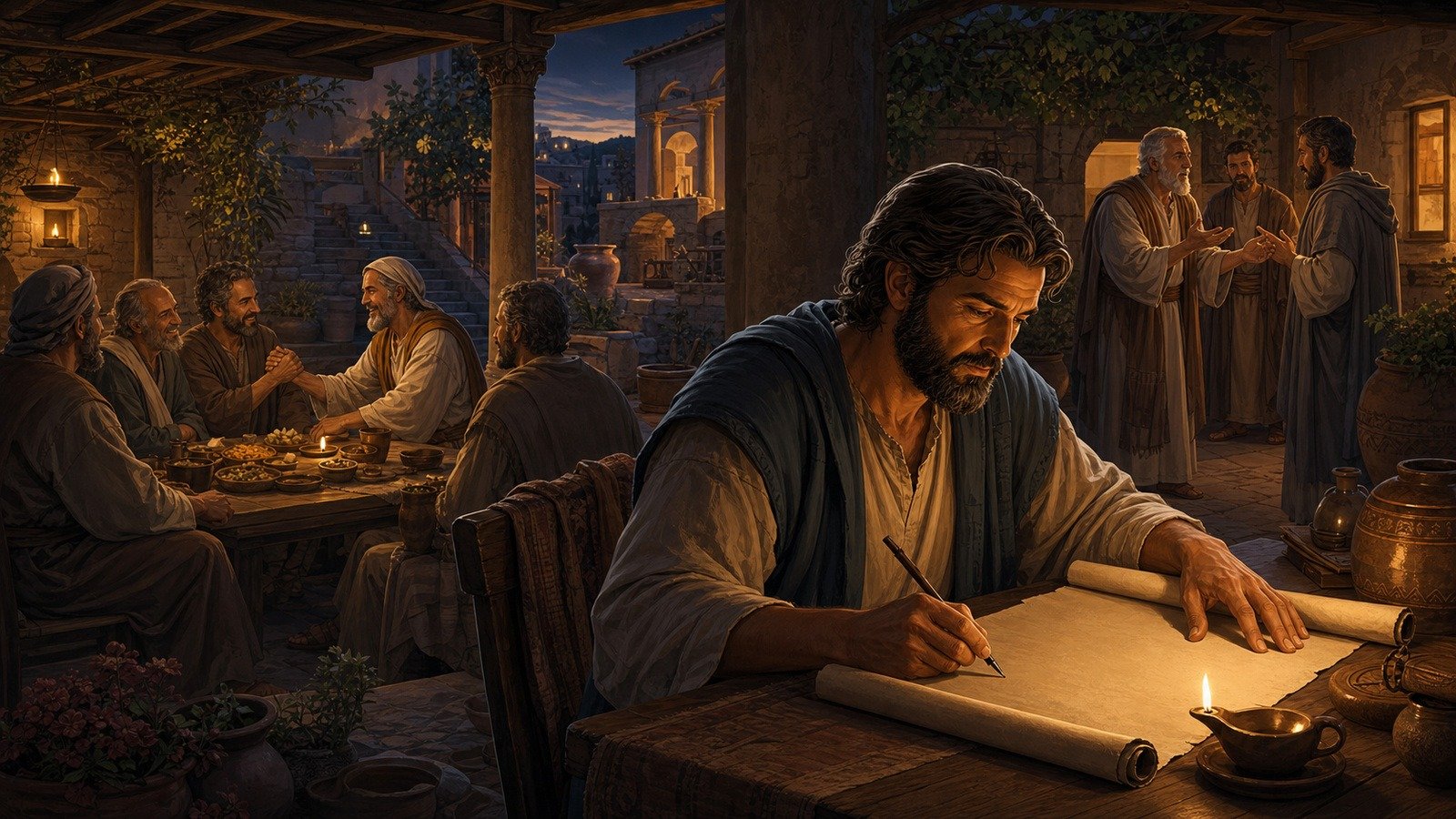
Writing from Ephesus, Paul addresses reports of division, sexual immorality, lawsuits between believers, disorder at the shared meal, and confusion over spiritual gifts and resurrection, in one of his longest and most practically detailed letters.
Further context
2 min readPaul writes from Ephesus to a church he had founded and lived with for eighteen months, and the letter is a response to two things: a report brought by members of Chloe's household, and a list of questions the congregation had sent him.
Corinth was a boom town of freedmen and traders where nobody's grandfather had been anybody, and the congregation reflected it. Paul reminds them that not many of them were wise by human standards, not many were influential, not many were of noble birth.
The problems he addresses are strikingly modern in their ordinariness.
Factions had formed around personalities: I follow Paul, I follow Apollos, I follow Cephas, I follow Christ. His answer is that he planted, Apollos watered, and God made it grow.
A man was living with his father's wife and the congregation was proud of its tolerance. Members were suing each other in the civil courts. The shared meal had degenerated into a class occasion, where the wealthy ate and drank their fill before the poor arrived from work: when you come together, it is not the Lord's Supper you eat, for when you are eating, some of you go ahead with your own private suppers.
Meat sold in the markets had usually been sacrificed in a temple first, and the congregation was split between those who thought eating it was participation in idolatry and those who thought an idol was nothing. His answer refuses to settle it as a rule and settles it as a question of not damaging someone else's conscience.
Two passages have become part of the language. The description of love, written not as a wedding reading but as a rebuke to a congregation competing over spiritual gifts: love is patient, love is kind. It does not envy, it does not boast, it is not proud.
And his treatment of the resurrection, which contains the earliest written statement of the Christian message, quoted as material he had received and passed on, along with the list of witnesses. Its argument is uncompromising: if Christ has not been raised, our preaching is useless and so is your faith.
He also gives the earliest description of the Lord's Supper anywhere, quoting words spoken on the night he was betrayed, decades before any Gospel recorded them.
Chloe's household is named as the source of the report, which is unusual in ancient correspondence and means Paul was prepared to say publicly where his information came from.
The congregation's questions cover marriage and singleness, food sacrificed to idols, head coverings, the shared meal, spiritual gifts and the collection, and the letter answers them in order, which is why it moves between subjects so abruptly.
Corinth's congregation contained slaves and slave owners, poor labourers and at least one city treasurer, and most of its problems come from that mixture meeting at a common table.
What he writes about spiritual gifts is addressed to a group that had ranked them, with speaking in tongues at the top. Paul's answer is that a body needs the parts that seem weaker, and that he would rather speak five intelligible words than ten thousand in a tongue.