

Herod Antipas, who had imprisoned John for condemning his unlawful marriage to his brother's wife Herodias, has him beheaded after a rash oath made to Herodias' daughter during a banquet, having been reluctant to kill John himself.
Further context
2 min readAntipas hears about Jesus and reaches a conclusion that tells you what was on his mind: John, whom I beheaded, has been raised from the dead.
The reason for the arrest was a public statement about the ruler's marriage. Antipas had visited his half-brother in Rome, and had left with his brother's wife Herodias, who was also niece to both of them, and had divorced his own wife to marry her. That divorced wife was the daughter of the Nabatean king Aretas IV, and the insult led to a war several years later in which Antipas was heavily defeated, a defeat Josephus records the population as regarding as divine punishment for what he had done to John.
John's objection was legal: it is not lawful for you to have your brother's wife.
Herodias nurses a grudge and wants him killed, and cannot manage it, and the reason is set out plainly. Herod feared John and protected him, knowing him to be a righteous and holy man, and when he heard him he was greatly puzzled, yet he liked to listen to him. A tetrarch keeping a prisoner alive because he finds his preaching disturbing and cannot stop going down to the cells is one of the odder relationships in the New Testament.
The birthday banquet is the opportunity. Herodias's daughter dances for the guests, the tetrarch is pleased and swears in front of his high officials, military commanders and the leading men of Galilee to give her whatever she asks, up to half his kingdom. That last phrase is an idiom rather than an offer, and no client ruler could give away territory.
She asks her mother, and comes back with a request for the head of John the Baptist on a platter, immediately.
He is greatly distressed, and does it anyway, because of his oaths and his dinner guests. That is the whole mechanism: a man who protected the prisoner for months has him executed rather than lose face in front of a room.
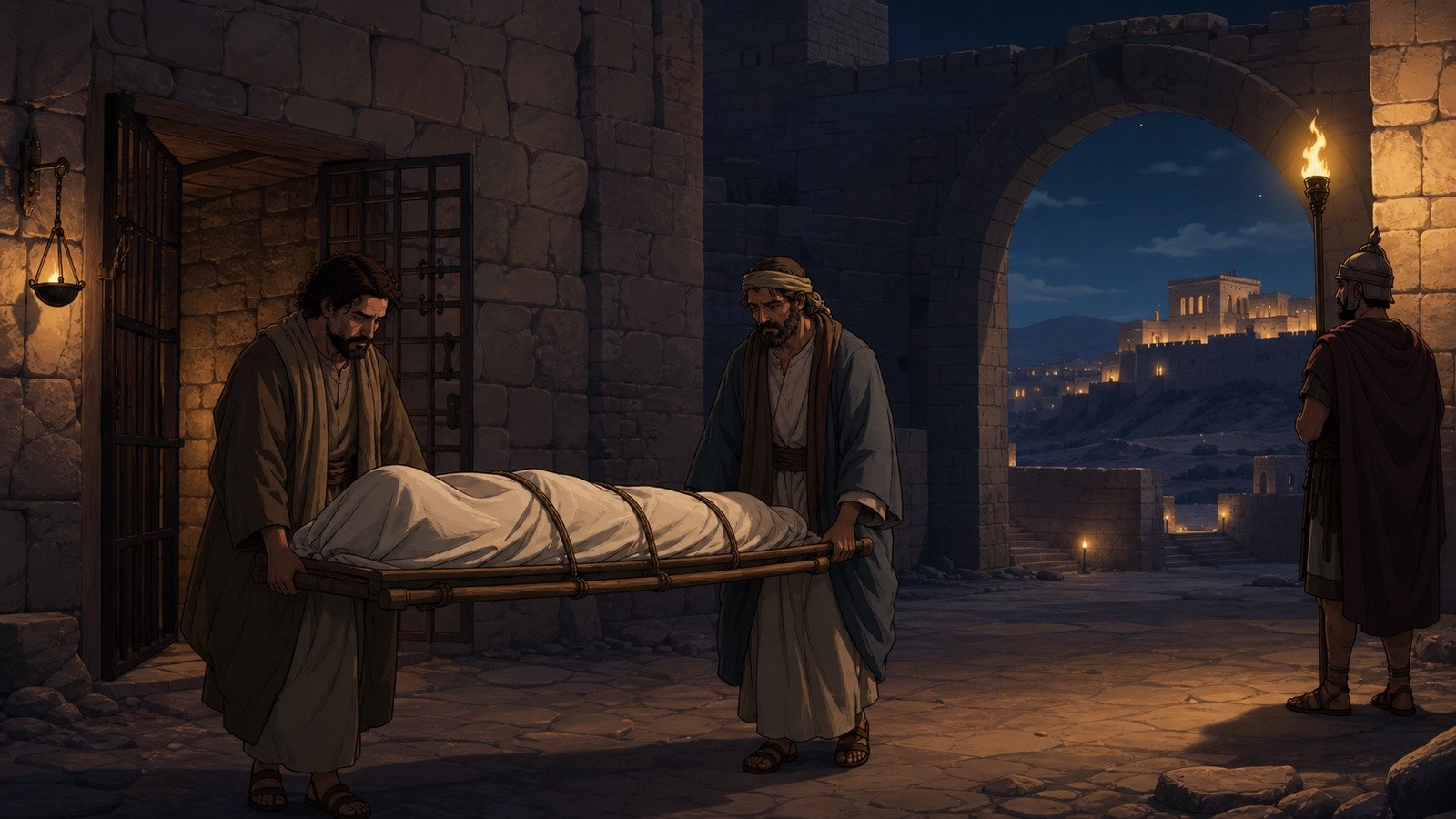
An executioner is sent, the head is brought on a platter and given to the girl, who gives it to her mother. John's disciples come and take the body and lay it in a tomb, and then go and tell Jesus.
The fortress was Machaerus, east of the Dead Sea, and its ruins have been excavated, including a courtyard and the lower cells.
Josephus gives an independent account of the execution, written about sixty years later for a Roman readership, and it is one of the clearest points of contact between the New Testament and a secular historian. He describes John as a good man who urged the Jews to righteousness towards one another and piety towards God, says that crowds were greatly moved by his words, and reports that Antipas feared this influence might lead to a rising and struck first. He names Machaerus as the place of imprisonment and death.
The two accounts differ in emphasis rather than substance, one giving the political calculation and the other the domestic quarrel, and both can be true of the same decision.