

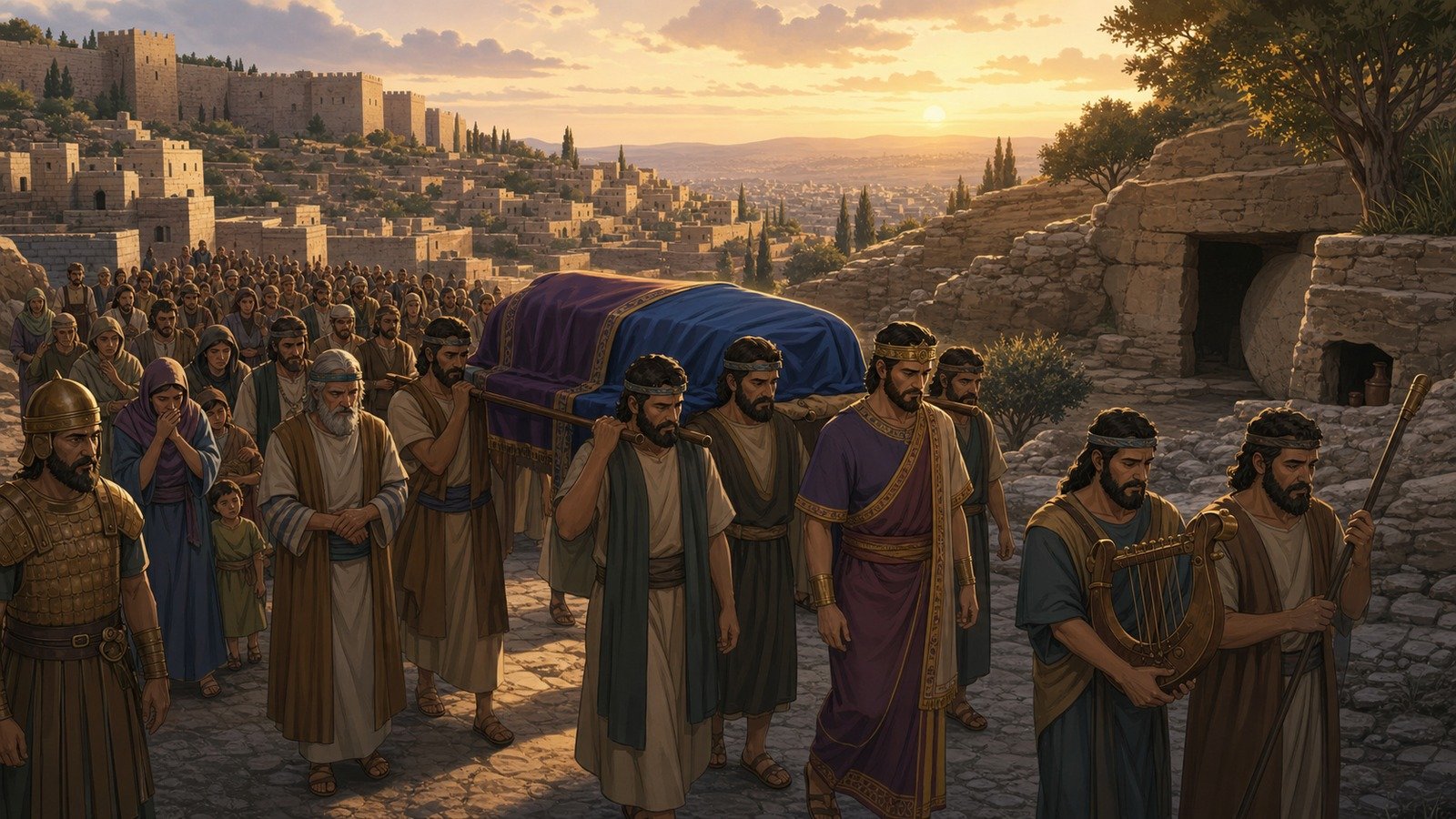
David dies after a reign of 40 years, seven and a half in Hebron and the rest in Jerusalem, and Solomon's kingship becomes secure.
Further context
2 min readDavid rests with his ancestors and is buried in the city that carries his name, and the regnal summary is given for the last time: he reigned forty years, seven in Hebron and thirty-three in Jerusalem.
What he leaves behind is not a tribal confederation. It is a state with a capital, a standing army, a professional bodyguard, a civil administration, a treaty relationship with Tyre, tributary kingdoms on three borders, a national sanctuary site bought and paid for, and materials stockpiled for a temple he was not permitted to build.
The reason given for that prohibition is worth stating because it is easy to misread as squeamishness. He is told that he has shed much blood and fought many wars, and that his son, a man of peace and rest, will build the house instead. It is not that fighting was wrong; every one of those campaigns is reported as a victory given to him. It is that the building was to be associated with the settled condition his wars produced rather than with the wars themselves.
His personal record is not tidied up anywhere. He is an adulterer who arranged a murder to conceal it, a father who would not discipline his sons and watched three of them destroyed, a king who ordered a census that killed seventy thousand people, and a dying man who arranged to have an old enemy executed by proxy. All of that is in the record alongside the rest, told by writers who plainly admired him.
One further thing outlasts him and it is physical. Everything Solomon builds is built on ground his father bought, with materials his father stockpiled, using a treaty his father negotiated with Tyre and a plan his father is said to have handed over. He is refused permission to build and spends the last years of his life assembling the components anyway.
What he is remembered for is something narrower and it is stated repeatedly in the assessments of later kings, who are measured against him one after another for the next four centuries. He was wholeheartedly devoted, and where he failed he confessed without excuses, which is precisely what Saul never managed to do in three attempts.
Two things outlast him. The promise of a permanent dynasty becomes the thread that later prophets hold onto when the actual kings are catastrophic, and after the monarchy is destroyed altogether it becomes the shape that hope for a coming ruler takes. And the poetry attributed to him becomes the prayer book of two religions.
The last words attributed to him are a short poem, and its opening lines describe what a ruler ought to be: when one rules over people in righteousness, when he rules in the fear of God, he is like the light of morning at sunrise on a cloudless morning, like the brightness after rain that brings grass from the earth.