

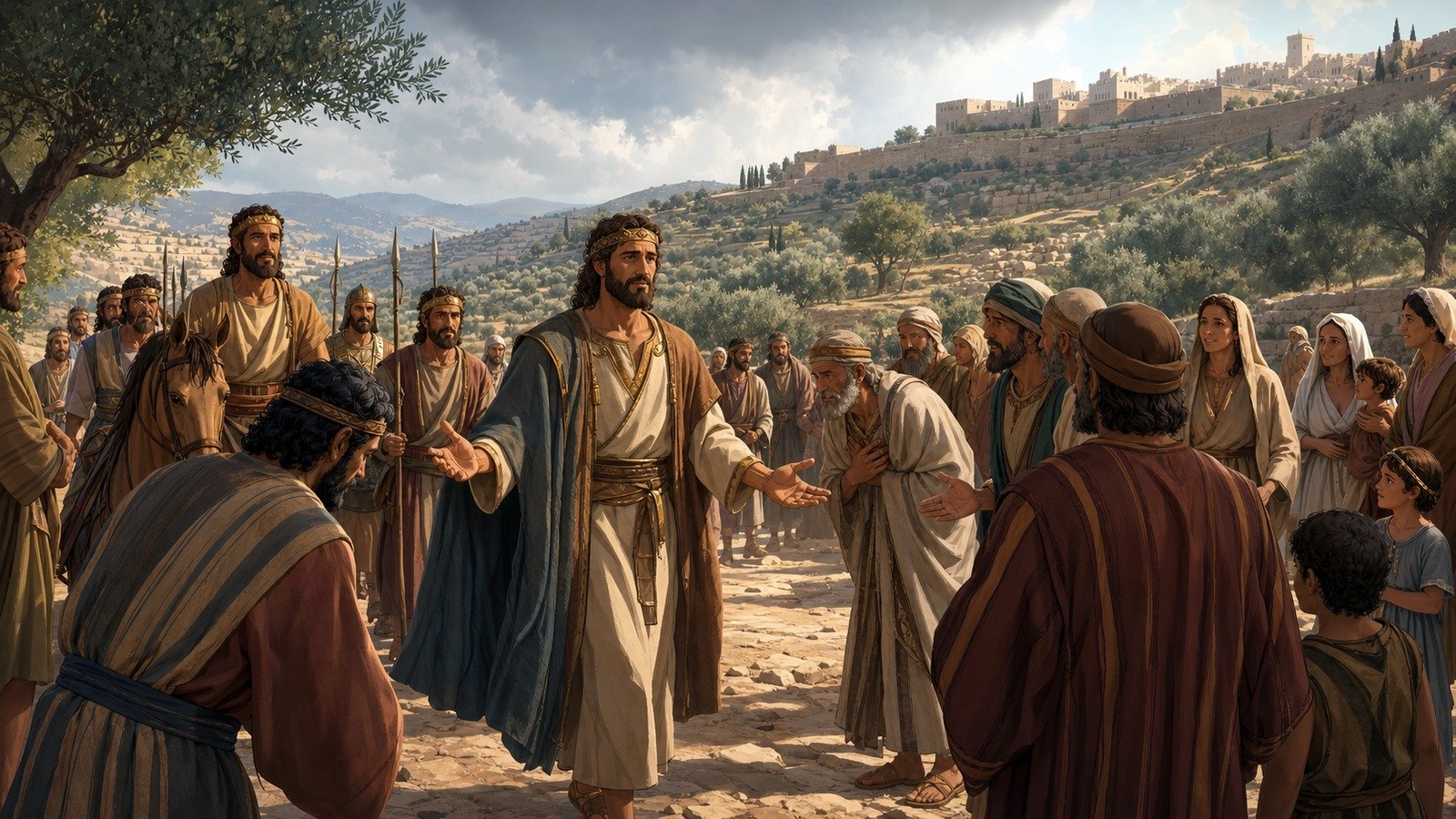
David is persuaded by Joab to set aside his public grief for Absalom, and negotiates a careful, deliberately gracious return to Jerusalem to rebuild loyalty across the tribes.
Further context
2 min readJoab ends the mourning by telling the king the truth in the harshest terms available. You love those who hate you and hate those who love you. You have made it clear today that the commanders and their men mean nothing to you. If Absalom were alive and all of us dead, you would be pleased. Now go out and encourage your men, and if you do not, not a man will be left with you by nightfall.
It is a threat from a subordinate who has just disobeyed a direct order and killed the king's son, and it is also accurate. David gets up and sits in the gateway, and the troops come before him.
The return is a negotiation rather than a procession. The northern tribes are arguing among themselves about bringing him back, and Judah is holding out, so he sends the priests to the elders of Judah with a message: why should you be the last to bring the king back? You are my relatives, my own flesh and blood. He also sends a private offer to Amasa, Absalom's commander, promising him Joab's job. Buying off the enemy general with the post held by the man who has just saved him is a piece of politics with obvious risks.
Three encounters on the road east of the Jordan show what returning actually costs.
Shimei, who had cursed him and thrown stones during the retreat, arrives with a thousand Benjamites and throws himself down, and Abishai again offers to kill him. David swears he will not die today, and keeps the oath, and then instructs Solomon on his deathbed to deal with him.
Mephibosheth, Jonathan's crippled son, comes down not having washed, trimmed his moustache or laundered his clothes since the day the king left. He says his servant Ziba deceived him and slandered him and took the donkey he had ordered saddled. Ziba had told a different story during the retreat and had been rewarded with the estate. David, unable to establish which of them is lying, splits the property between them, and Mephibosheth says Ziba can have all of it now that the king has come home safely.
Barzillai the Gileadite, who had supplied the army during the crisis, is invited to court and refuses on the grounds of age. He is eighty and asks how much longer he can live, whether he can still taste what he eats and drinks or hear the voices of male and female singers, and asks only to die in his own town near the tomb of his parents. He sends his servant Kimham instead.
Then the argument at the Jordan crossing between the men of Judah and the men of Israel over who has the greater claim on the king, conducted in the language of shares and rights, and the men of Judah press their case more harshly. That quarrel is still live when the next revolt starts a few sentences later.