

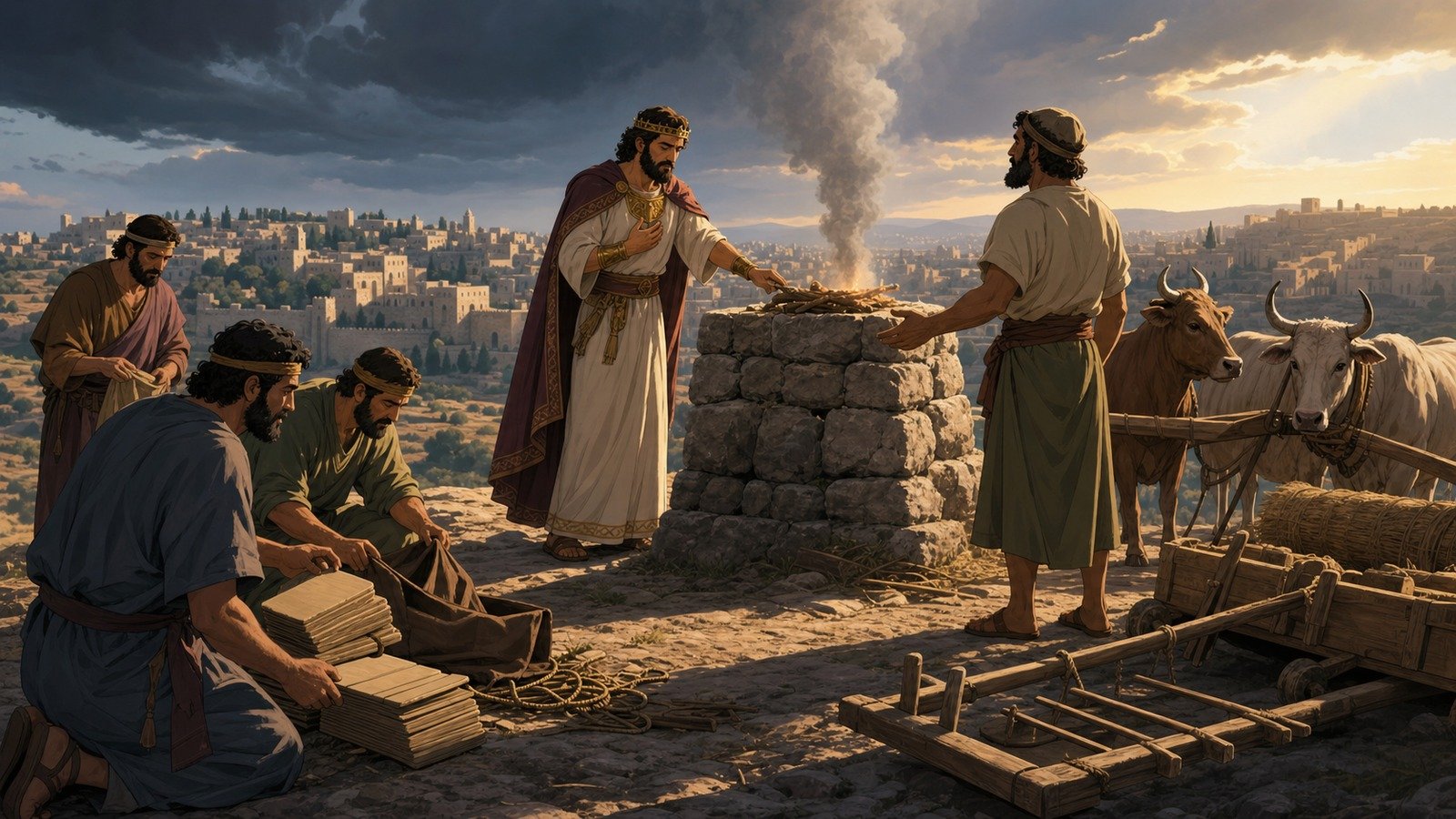
David orders a census of fighting men against Joab's advice, an act Scripture treats as prideful self-reliance; a plague follows as judgement, and David purchases Araunah's threshing floor as an altar, the site later identified with the Temple Mount.
Further context
2 min readDavid orders a count of the fighting men from Dan to Beersheba, and even Joab objects, which is unusual for a man who has murdered two commanders without hesitation. May the LORD multiply his troops a hundred times over, he says. Are they not all my lord's subjects? Why does my lord want to do this? Why should he bring guilt on Israel?
Why it was wrong is never stated directly, and that has kept the argument going for two thousand years. Counting the people was not forbidden in itself; two national censuses are ordered in the wilderness. The most defensible reading takes the objection at face value: a king counting his fighting strength is measuring what he can do with an army, and a nation whose whole story is about being delivered by something other than its own numbers has no business auditing them. The word Joab uses is guilt.
It takes nine months and twenty days and produces figures given as eight hundred thousand in Israel and five hundred thousand in Judah, with a different set of numbers in the parallel account, one of the several places where the two histories of this period do not agree on arithmetic.
Afterwards David is conscience-stricken and confesses before anyone accuses him. The prophet Gad brings three options: three years of famine, three months of fleeing before enemies, or three days of plague. His answer is the reasoning of a man who has spent his life among both: let us fall into the hands of the LORD, for his mercy is great, but do not let me fall into human hands.
Seventy thousand die. When the angel reaches Jerusalem and stretches out his hand to destroy it, the order comes to stop, and the angel is standing at the threshing floor of Araunah the Jebusite.
David sees the angel and says the sentence that is the most creditable thing in the episode: I have sinned. I, the shepherd, have done wrong. These are but sheep. What have they done? Let your hand fall on me and my family.
He is told to build an altar on that threshing floor. Araunah offers the site, the oxen for the offering and the threshing sledges for wood, free. The refusal is the line the whole episode turns on: no, I insist on paying the full price. I will not sacrifice to the LORD my God burnt offerings that cost me nothing.
He buys the floor and the oxen for fifty shekels of silver, and the plague stops.
That threshing floor is the site on which Solomon builds the temple. The most sacred ground in Israelite religion is bought at full market price from a Jebusite farmer, in the aftermath of a plague caused by the king's own census, and the receipt is recorded.