

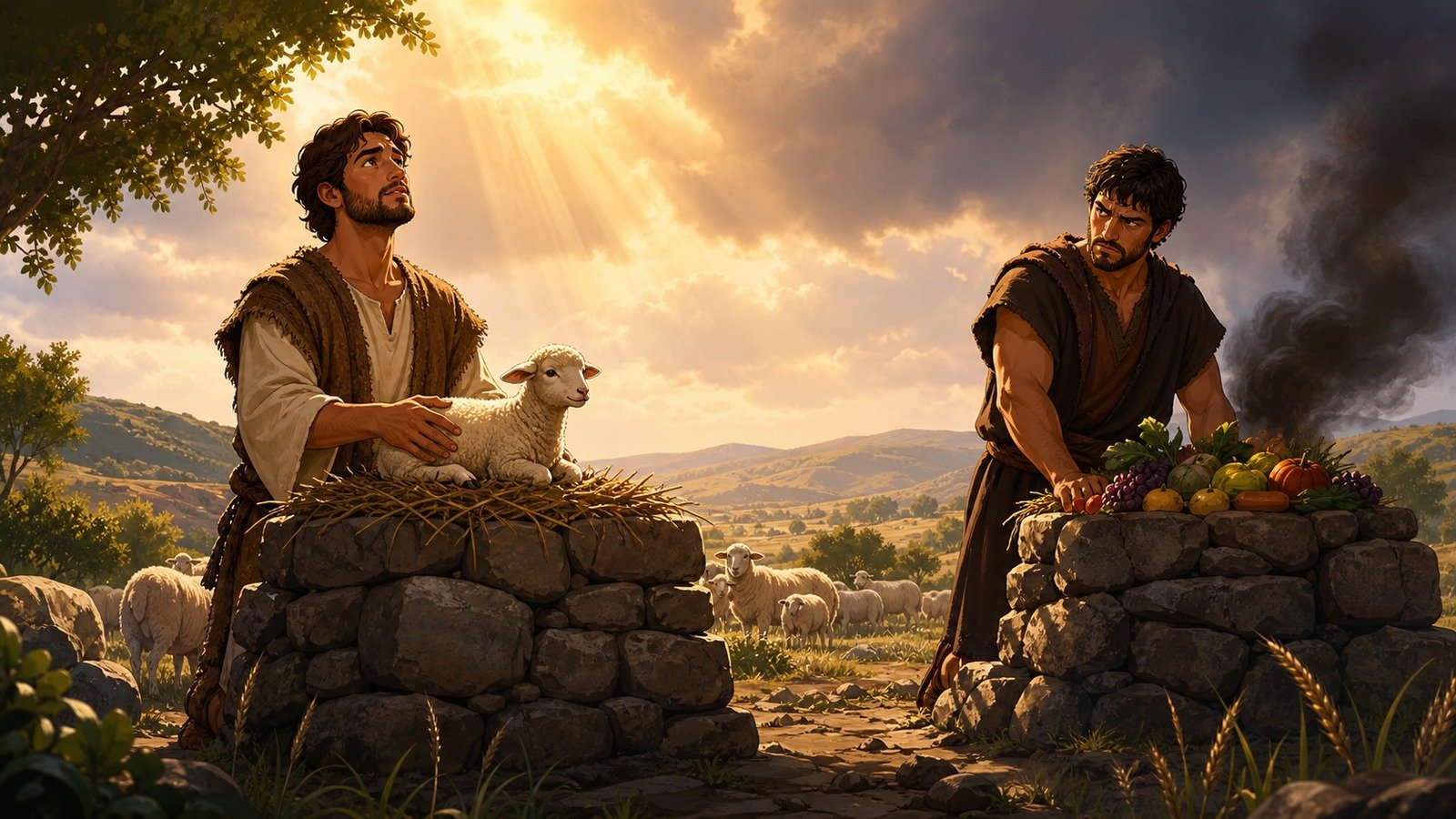
Cain and Abel each bring an offering to God; Abel's, from the firstborn of his flock, is accepted, while Cain's is not, and God warns Cain directly that "sin is crouching at your door" as his anger builds.
Further context
3 min readAt the end of days, the Hebrew says, which suggests a fixed occasion rather than a spontaneous impulse. Both brothers bring an offering out of their own work. Cain, who farms, brings some of the fruits of the soil. Abel, who keeps flocks, brings fat portions from some of the firstborn of his flock.
The two descriptions are not parallel, and that asymmetry is the only clue available. Abel's offering is specified twice over: it comes from the firstborn, and it consists of the fat portions, which in later Israelite practice were the parts reserved for God. Cain's is described simply as some of the fruits of the soil, with no indication that anything was chosen. God then looks with favour on Abel and his offering, and does not look with favour on Cain and his. In both sentences the person is named before the gift.
One popular explanation can be ruled out on the evidence. It is often said that Cain's offering failed because it involved no blood. That does not survive contact with the Law, which commands grain offerings and treats them as fully acceptable in their own right, using the same vocabulary of choicest portions. If produce from the ground were disqualified in principle, a large part of the sacrificial system would make no sense. The distinction being drawn is between an offering of the best and an offering of some.
Later Jewish and Christian writers located the difference in the person rather than in the material, describing Abel's sacrifice as offered in faith, which fits the Hebrew word order, where God's regard falls on the man before it falls on what he brought.
What happens next is the more remarkable part and it is easily lost. Cain becomes angry and his face falls, and God speaks to him directly instead of dismissing him. The question is an offer: if you do what is right, will you not be accepted? The warning that follows uses vivid language. Sin is described as crouching at the door, using a participle applied elsewhere to an animal lying in wait. It desires to have him, and he must rule over it. Those two words, desire and rule, are the same pair used in the judgement on the woman a few paragraphs earlier, which suggests a deliberate connection between the two situations.
Nothing in the exchange treats Cain as beyond reach. He is warned, told what is required and given a way back before he acts, and the tragedy of what follows depends entirely on that: the outcome is presented as avoidable.
Two details of the scene are worth holding on to, because they set patterns that run a long way. The first is that this is the earliest act of worship anyone performs in the Bible. There is no priest, no altar mentioned, no sanctuary and no instruction to bring anything; two men decide independently to give something back from what they have produced. Everything the Law later specifies about sacrifice is built on a practice that starts here without a rule attached to it.
The second is that the response is not equal. One offering is accepted and one is not, and no principle is announced that would have let Cain predict it in advance. Anyone who has resented a decision that went someone else's way for reasons never made explicit is standing where Cain stands, and the conversation that follows treats his anger as the real danger rather than the disappointment behind it.