

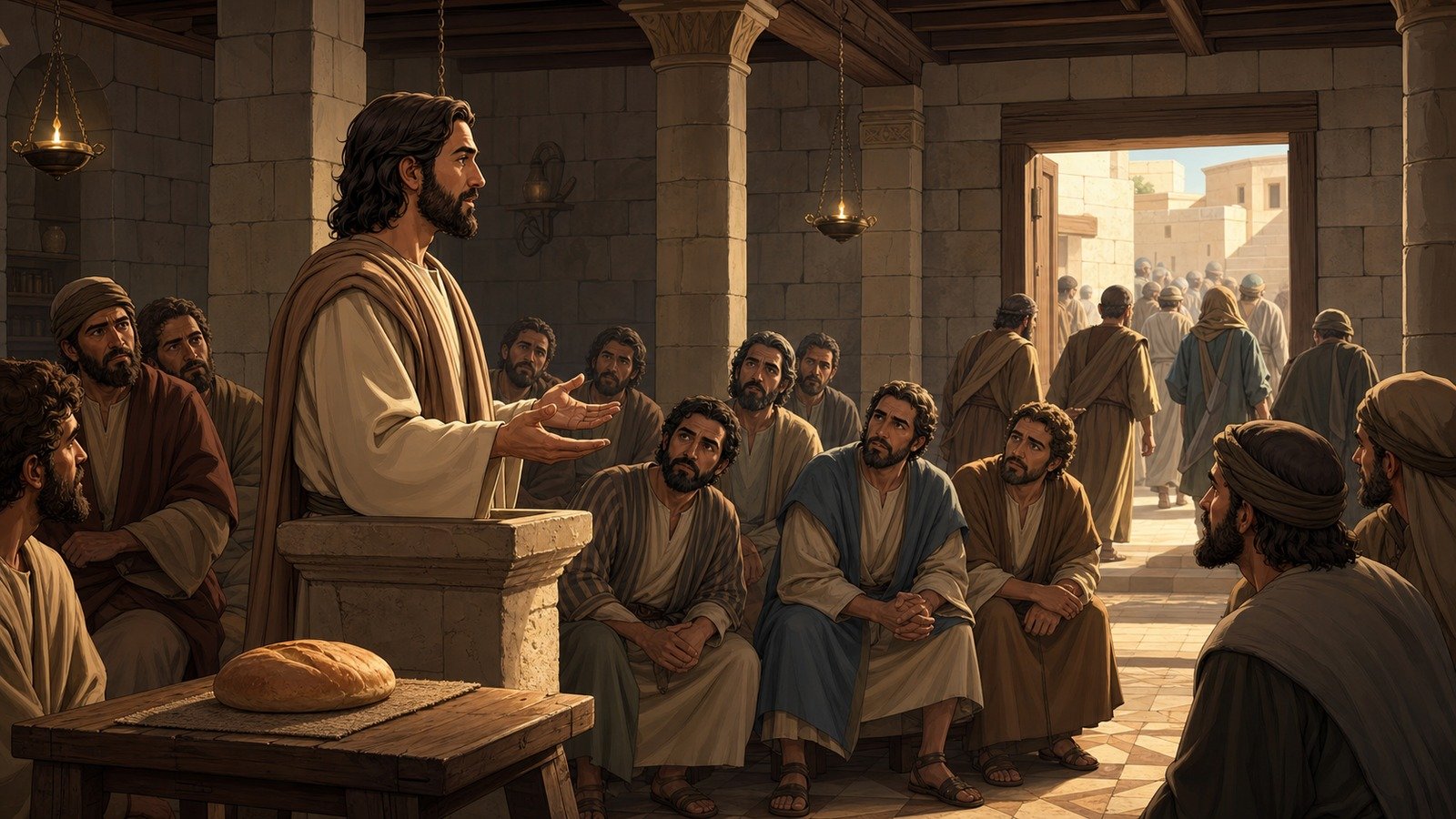
Following the feeding of the crowd, Jesus teaches in Capernaum's synagogue that he himself is "the bread of life" and that eating his flesh and drinking his blood is necessary for eternal life, language so difficult that many who had followed him abandon him at this point.
Further context
2 min readThe crowd from the feeding tracks Jesus down on the other side of the lake, and the first thing he says to them is an accusation about motive: you are looking for me not because you saw the signs I performed but because you ate the loaves and had your fill.
What follows is an argument conducted in the Capernaum synagogue and it goes badly by any ordinary measure.
They ask for a sign and cite the obvious precedent: our ancestors ate the manna in the wilderness. Having been fed the day before, they are asking whether he can keep it up, since Moses managed forty years.
The reply corrects two things at once. It was not Moses who gave you the bread from heaven, but my Father, and it is he who gives the true bread. When they ask for that bread, always, the answer is: I am the bread of life. Whoever comes to me will never go hungry, and whoever believes in me will never be thirsty.
The grumbling starts there and it is a village objection: is this not Jesus, the son of Joseph, whose father and mother we know? How can he now say he came down from heaven?
Then the language becomes deliberately harder rather than easier. Unless you eat the flesh of the Son of Man and drink his blood, you have no life in you. Whoever eats my flesh and drinks my blood has eternal life. The verb used for eating in the later sentences is a coarse one, closer to chew or gnaw.
To an audience for whom consuming blood in any form was among the oldest and most absolute prohibitions, that is close to unbearable, and nothing is done to soften it. Christians have read these sentences in several ways ever since, and the differences between those readings are among the sharpest divisions in the church's history.
Many of his disciples say, this is a hard teaching. Who can accept it? And from this time many of them turned back and no longer followed him.
He turns to the Twelve and asks whether they want to leave too. Peter's answer is not a profession of understanding: Lord, to whom shall we go? You have the words of eternal life.
Then a sentence that goes unexplained until the last week: one of you is a devil.
The synagogue at Capernaum where this was said has been located. A white limestone building from the fourth or fifth century stands on the site, and beneath its floor archaeologists found the black basalt walls and pavement of an earlier synagogue, the one in use in the first century.
That so many walked away is what makes the episode worth attention. Nothing is done to retrieve them. There is no clarification, no softer restatement, no attempt to explain that the language was figurative. The question put to the Twelve is whether they intend to go as well, which is not the behaviour of a movement counting heads.