

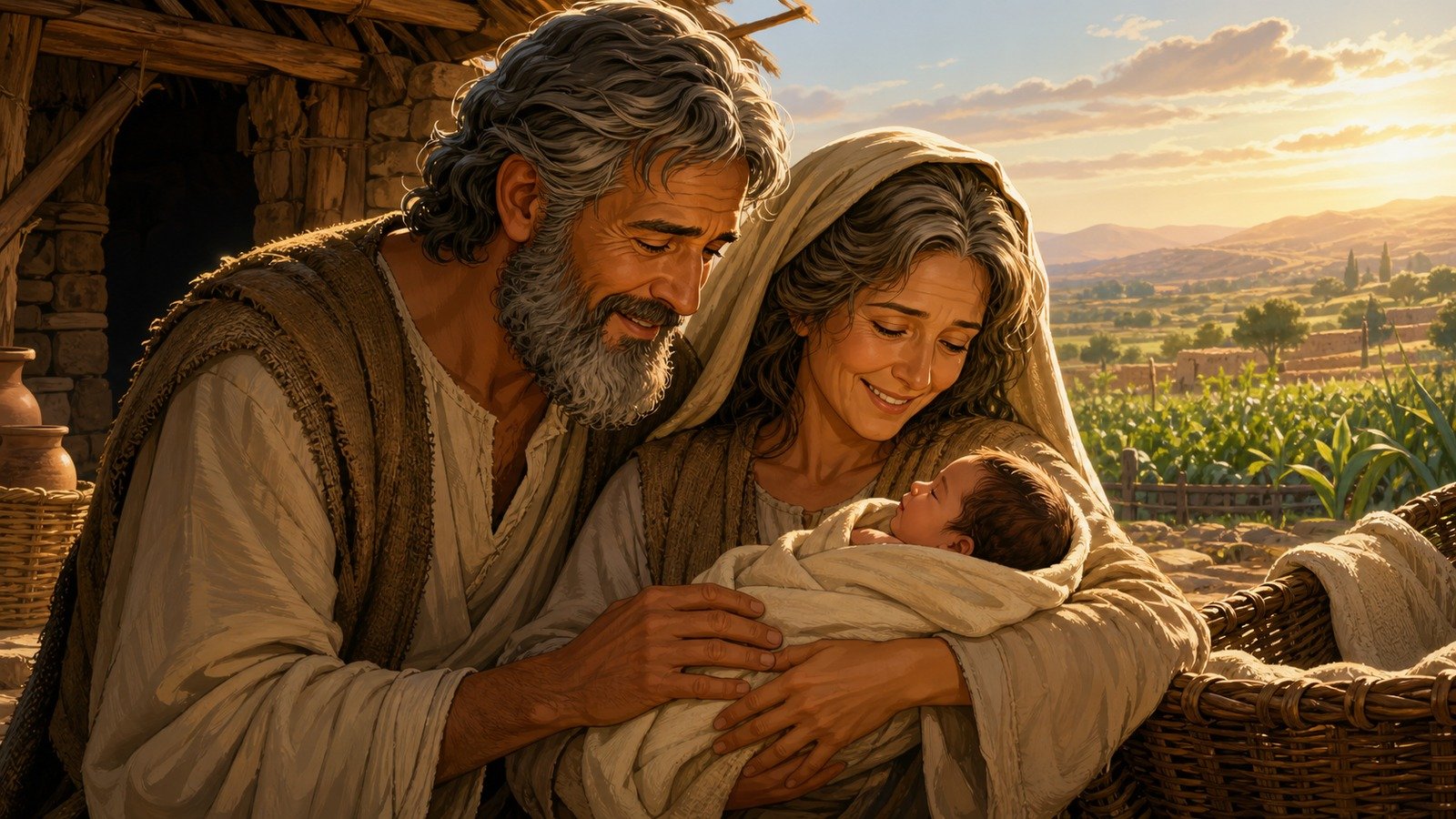
Seth is born to Adam and Eve "in place of Abel," and people begin "to call on the name of the Lord" in his son Enosh's generation.
Further context
2 min readA third son arrives to a couple who have lost both the others, one murdered and one banished, and Eve says what she thinks he is for: God has granted me another child in place of Abel, since Cain killed him. The verb she uses, meaning granted or appointed (shat), stands behind the name Seth.
What makes this obscure birth matter is the route everything afterwards takes. A whole chapter has just traced Cain's descendants, who build the first city and invent music and metalwork and end with a man boasting about murder. That is not the line the rest of the Bible follows. The genealogy that runs down to Noah, and from Noah to Abraham, and eventually to David and beyond, starts again with Adam and goes through Seth. Luke traces the ancestry of Jesus back along that route and ends it with Seth and Adam.
The second thing recorded here is harder than it looks. Seth has a son, and at that time, it says, people began to call on the name of the LORD. The Hebrew expression is used elsewhere for public, formal invocation rather than private thought, so it is usually understood as the beginning of organised worship.
That raises a genuine difficulty, because Moses is told much later that God appeared to Abraham, Isaac and Jacob as God Almighty but did not make himself known to them by the name used here. Interpreters have gone two ways. Some read the later statement as denying knowledge of the name itself, which requires treating its appearance in these early chapters as the writer's own usage rather than the characters' speech. Others read it as denying not the name but the experience of what it means, since what follows in Egypt is precisely a demonstration of that meaning. Whether the Hebrew verb "to know" will carry that weight is the whole of the argument, and it has not been settled.
One number enters the story at this point and it is the first in the Bible that can be added to anything: Adam was a hundred and thirty when Seth was born. Every traditional chronology of the ancient world, including the calculation that produced the date 4004 BC, begins its arithmetic here.
That figure is not stable. The Hebrew manuscripts give a hundred and thirty; the Greek version used across the ancient Mediterranean gives two hundred and thirty. A century of difference at the very first link in the chain. Similar divergences occur at almost every generation in the two genealogies that follow, and the accumulated gap between the Hebrew and Greek totals from Adam to Abraham runs to well over a thousand years. Anyone quoting a date for the earliest events is quoting one manuscript tradition rather than a fact, and counting forward from a starting point that is itself unfixed.
What this short passage establishes is a line of descent rather than a moment in time. Everything from here to the Flood, and from the Flood to Abraham, and from Abraham to the whole subsequent story, is traced through a child born to replace a murdered brother.