

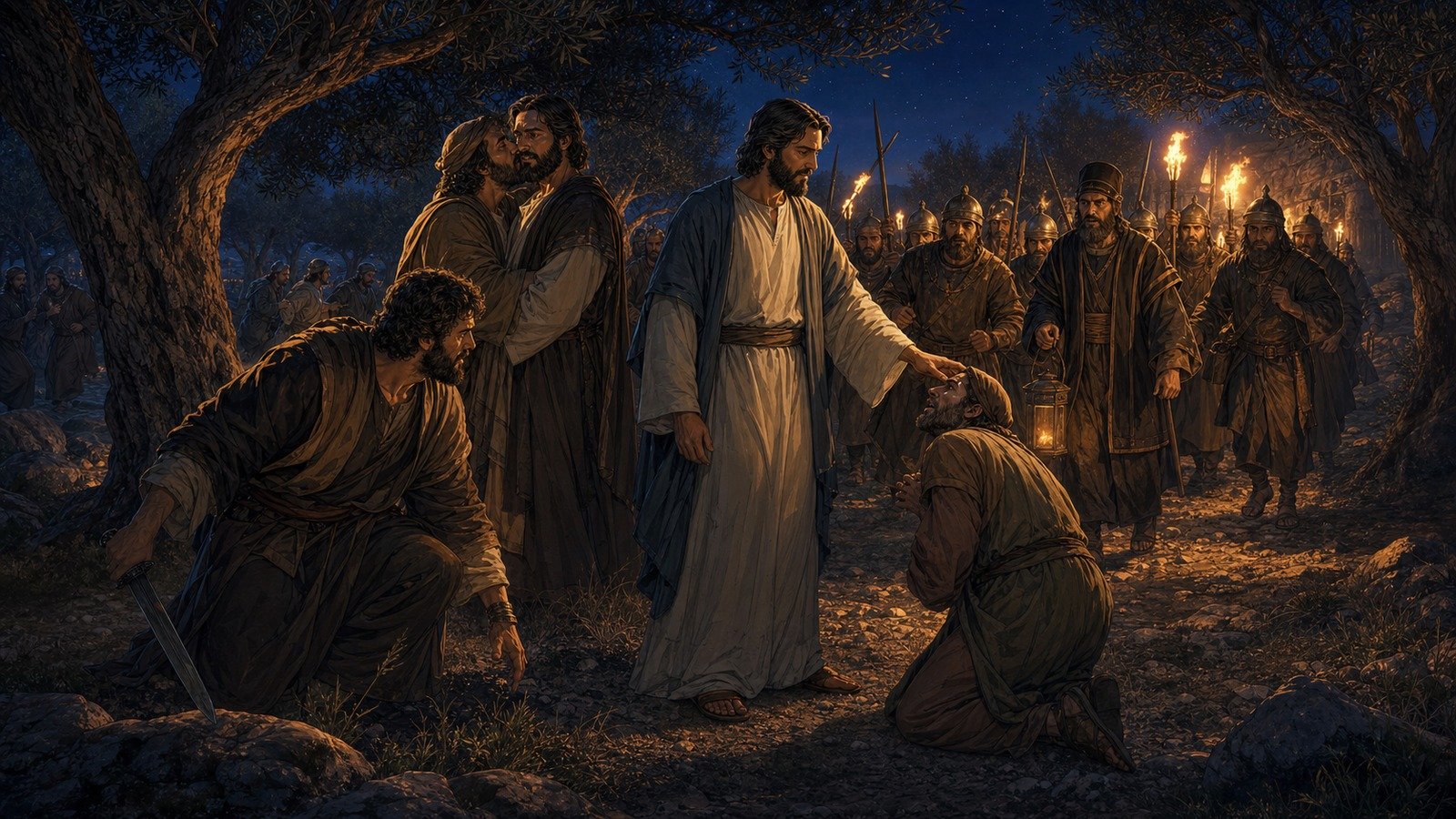
Judas identifies Jesus to an armed crowd with a kiss; Peter strikes off a servant's ear, which Jesus immediately heals, before rebuking the use of violence and submitting to arrest, and the rest of the disciples scatter.
Further context
2 min readJudas arrives with a crowd armed with swords and clubs, sent from the chief priests and the elders, and one account adds a detachment of soldiers, which would mean Romans.
The signal had been arranged in advance: the one I kiss is the man; arrest him. A kiss on the cheek or hand was the ordinary greeting between a disciple and his teacher, which is what makes it usable as a signal and what makes it what it is. Greetings, Rabbi, he says, and kisses him.
Judas, are you betraying the Son of Man with a kiss?
The arrest itself is almost anticlimactic until one of the disciples draws a sword and cuts off the right ear of the high priest's servant, who is named as Malchus. Only John names the two men, writing long after everyone concerned was dead, and he identifies Peter as the swordsman.
That there was a sword in the group at all is a detail people miss. Two are mentioned at the supper.
The response is immediate and it goes in the opposite direction to the crowd's expectations. Put your sword back in its place, for all who draw the sword will die by the sword. Then the wound is touched and healed, which is the last healing recorded before the crucifixion and the only one performed on a man who had come to arrest him.
Do you think I cannot call on my Father, and he will at once put at my disposal more than twelve legions of angels? A legion was between five and six thousand men.
Then a question aimed at the composition of the crowd. Am I leading a rebellion, that you have come out with swords and clubs to capture me? Every day I sat in the temple courts teaching, and you did not arrest me.
That is the whole objection to the procedure. He had been publicly available all week in the most public place in the city, and they have come at night with a mob, in an olive grove, guided by an informer.
Then all the disciples deserted him and fled.
One of the strangest details anywhere follows: a young man wearing nothing but a linen garment is following, is seized, and runs away naked, leaving the garment behind. Nobody knows who he was, and the guess that it was Mark himself is a guess.
Judas is not needed to point him out to the temple authorities, who had seen him teaching daily, but the arresting party is a mixed crowd in an olive grove at night by torchlight, and a signal removes any risk of taking the wrong man or losing him in the dark among a dozen others.
The two swords mentioned earlier are also the reason the crowd came armed. Whatever else the authorities expected, they had prepared for resistance and got one blow before it was stopped.
Malchus is the only servant in the New Testament whose name and injury are both recorded, and one account adds that a relative of his was in the courtyard later, and was the man who challenged Peter for the third time.