

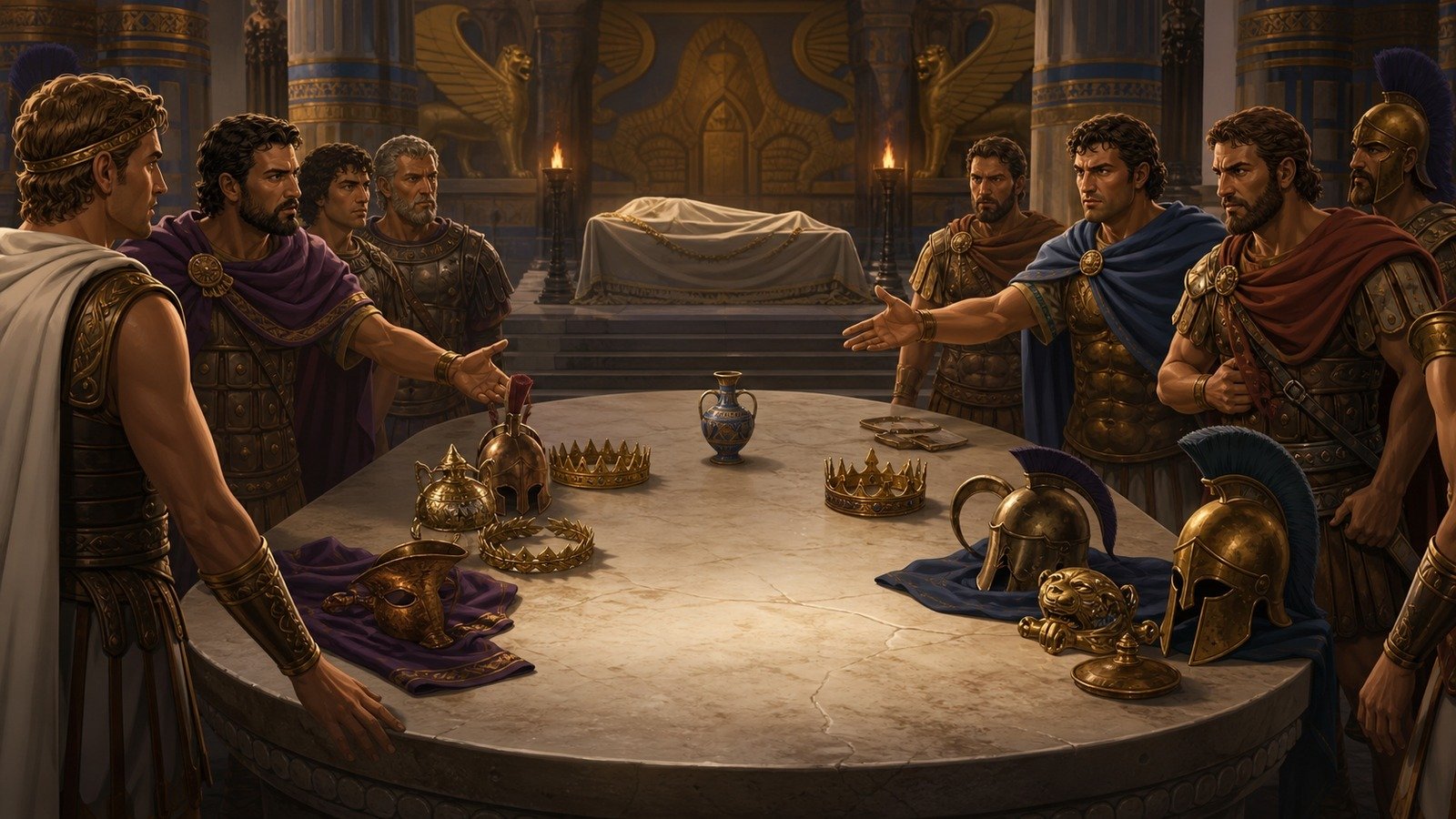
Alexander's sudden death without a clear heir leads his leading generals, the Diadochi, to carve his empire into rival successor kingdoms, setting the stage for two centuries of Hellenistic dynastic competition that Judea's geography placed directly in the middle of.
No canonical Scripture reference (historical context outside the Protestant canon)
Further context
3 min readAlexander dies at Babylon in June 323 BC, aged thirty-two, after a fever, with no adult heir and no arrangements made. Asked on his deathbed who should have the empire, he is reported to have said, to the strongest.
What follows is forty years of war between his senior officers, the men Greek historians call the successors. The fighting runs through several rounds, and by 301 BC, after the battle of Ipsus, the empire has settled into roughly four blocks, which is the outcome that matters here.
Ptolemy takes Egypt and rules from Alexandria. Seleucus takes Babylonia and Syria and eventually the whole eastern stretch to the Indus. Lysimachus takes Thrace and western Asia Minor. Cassander takes Macedonia and Greece. The last two are absorbed within a generation, and the two that endure are Egypt under the Ptolemies and Syria under the Seleucids.
Judea sits exactly between them. It is the land bridge between Egypt and Syria, the route any army moving in either direction has to take, and for the next century and a half it changes hands repeatedly and is fought over in six separate wars between the two houses.
Ptolemaic Egypt holds it first, for about a hundred and twenty-five years. Seleucid Syria takes it in 198 BC. The consequences of that transfer are the subject of everything that follows.
Both dynasties are Macedonian Greek, both run Greek-speaking administrations, and both regard themselves as bringing civilisation. The Ptolemies mostly left the Jewish community's religious arrangements alone and taxed it. The Seleucids eventually did not.
One institution from this period lasts to the present. Judaism outside Judea becomes permanently established as a diaspora with its own synagogues, its own Greek scriptures and its own relationship with the local authorities, and by the first century there are Jewish communities in every substantial city around the Mediterranean. Those communities are exactly where the first Christian missionaries go, and the network they use was built here.
Readers of Daniel encounter this period in unusual detail. The vision in the eleventh chapter describes a mighty king whose empire is broken up and parcelled out towards the four winds of heaven but not to his descendants, and then traces a long sequence of wars between the king of the South and the king of the North, with marriages, betrayals, campaigns and treaties. The correspondence with the Ptolemaic and Seleucid wars is close enough that it can be matched event by event, and that precision is one of the main reasons the scholarly majority dates the book's final form to the second century BC while the traditional position reads it as prediction.
What nobody disputes is that the world the Gospels open in was made here: Greek-speaking, Greek-administered, with a Jewish population divided over how much of that to accept.
The wars of the successors ran for about forty years, and by the end of them four kingdoms had emerged: the Ptolemies in Egypt, the Seleucids in Syria and Mesopotamia, the Antigonids in Macedonia, and Pergamum in Asia Minor.
Judea sat on the border between the two largest, which is the single most important fact about the next century and a half. Five wars were fought between the Ptolemies and the Seleucids over the same corridor of territory, and every one of them was fought across it.
Daniel's later visions describe the conflict between a king of the South and a king of the North in such detail that scholars who date the book to the second century BC treat those chapters as history written after the fact, while those who date it to the sixth treat them as prediction. Both sides agree the chapters correspond closely to what happened.
Greek cities were founded across the region, some of which appear in the Gospels as the Decapolis.